The most distant memories of eastern Galicia, engraved once and for all in a memory that is more than personal, a memory that is almost generational, perhaps even a potential memory, as Perec puts it, a lacunary memory reconstructed out of debris that was never handed down, out of fragments wrested from oblivion. Memories going back not to the dawn of time, nor even to childhood, but to that emergence from adolescence accompanied by the first stirrings of love, bound up with questions of identity. As a student at the University of Vienna, where I had gone in the hope of recovering some trace of my grandfather, who had “come from Central Europe” and of whom I knew so little, I was fascinated by a great map of the Austro-Hungarian Empire spread across the walls of the Institute of Slavic Studies, and most particularly by the immensity of that region, Galicia, which I knew from the writings of Joseph Roth and Karl Emil Franzos: Lemberg, Brody, Czortkow, Czernowitz were names already familiar to me from my reading, while a few towns in western Galicia were easily accessible to me, since I often went to Poland to meet a young woman dear to me.
It was at Cisna, near Sanok and Lesko, in the Bieszczady range (Bieszczady), a Polish range attached to the Carpathians, remarkable for its spectacular high pastures along the mountain crests, their flanks covered with fir forests; we were a few kilometers from what was then the Soviet border, a veritable iron curtain dividing Galicia in two. In the course of our journey we had already visited many towns whose buried and engulfed Jewish past we discovered with astonishment: Lublin, with its old Grodzka Street and its magnificent castle square, where only the Jewish stalls were missing; Rzeszów, with its two synagogues, two of the most remarkable buildings in town, a stone’s throw from the central square, and its astonishing abandoned Jewish cemetery, in which children were playing, one of them, plainly an orphan, having come up to us and thrown his arms around my companion, calling her “mama!”—repeating, unwittingly and unknowingly, a scene that could have taken place in that very spot thirty-five years earlier; Łańcut, with its beautiful baroque synagogue, ochre-yellow in color, just in the shadow of the Potocki castle; Jarosław, with its old marketplace, its baroque town hall, and its “square of synagogues,” now disused, one of which later became a music school; Sanok, Lesko, with a very beautiful and very old fortified Renaissance synagogue, remarkable for its turrets and its small keep, transformed at the time into a tourism office of the PTTK association.1 Even at Cisna and Lutowiska, small villages almost on the USSR border, there had once been three places of worship: a Catholic church, an Orthodox church, and a synagogue, and our landlady, Mrs. Niemczyk, told us that when she was little, before the war, she went every Saturday to milk the cows at her Jewish neighbors’; she was, so to speak, without knowing the word, their “shabbes-goy.” There were, she said, very good relations among the town’s three communities, never any trouble. I was fascinated to see a living person, and not even that old—she was perhaps barely fifty—who had known at close hand, through her neighbors, an engulfed world that seemed to me to exist only in books, in literature, in the tales of Sholem Aleichem. One day, she told us, in 1941 or ’42, the Germans came, rounded up all her Jewish neighbors, a quarter or a third of the village, and took them off to an unknown destination; they were never seen again. The destination, unknown at the time, is known today to the historians of the Holocaust: it was Bełżec.
On the way back, we had decided to visit Przemyśl, a fortified town on the border, a former Austrian stronghold, and to get there no longer by bus but by train. Now what was our surprise, on reaching Ustrzyki Dolne, to learn that the rail line leading to Przemyśl, built in the Austrian era, passed for some fifty kilometers through the Soviet Union. We asked whether we needed a visa; we were told no, that the train would be sealed, the doors hermetically shut, and that no one could either board or alight—we would be passing, so to speak, through a corridor. It was especially exciting. Indeed, just after the Polish station of Krościenko, we passed through a double row of barbed wire and anti-tank obstacles, then the train halted at the little station of Smolnicja, where Soviet soldiers boarded, checked that all the windows were shut, but inspected no identity papers, then positioned themselves, weapon on shoulder, on the footboard of each car to make sure that no one boarded or alighted or threw anything out the windows. The train then made the whole journey at a fairly slow speed so as not to endanger the soldiers. On this stretch, the track gauge had remained the same as in Poland, so there was no need to wait for hours at the border, as one does on an international line, at Przemyśl for example.
This was how, for the first time, villages appeared to me whose names were written in Cyrillic characters: first of all Smolnicja, Stariava, Khyrov, then the train changed direction, toward the northwest, through Dobromil and Nyžankovici as far as Przemyśl. Without knowing it precisely, but unconsciously suspecting it, I was passing through former shtetls, in particular Khyrov and Dobromil, ruined market towns that preserved, as best they could, a few traces of Jewishness and Polishness. I have kept above all the memory of Khyrov, where the train made a halt of a few minutes, which allowed one to see the station building on the left while, on the right, on the hill facing it, one had a view of a monastery or a large religious institution that blocked the whole view, but which one was not allowed to photograph. Later I had the chance to visit Khyrov and to learn a little more about this town. Khyrov, in Polish Chyrów, is a small town of the Polish borderlands, remarkable for its beautiful Catholic church located in the very center, today under reconstruction, at the edge of the marketplace, with an inscription in Polish and Ukrainian, and also, clearly visible from the station, in the suburb of Bąkowice, a former Jesuit teaching institution, konwikt jezuicki, with a church, a boarding school, and a large library. During the German occupation, treasures looted by the Nazis in the town and in other churches of the region had been gathered in this “konvikt.” Bruno Schulz, at the beginning of the occupation, was charged by SS officer Felix Landau with making an inventory of the books and works of art looted at Drohobycz, but also at Khyrov. When one goes today to Khyrov (or more exactly Hyriv in Ukrainian) and observes the tracks of the station’s three platforms, one notices that those of the third platform—the one farthest from the station building, and from which one therefore has the best view of the “konvikt”—have two pairs of rails, a pair at the broad gauge characteristic of Russian and Ukrainian trains, and inside, a pair at the narrow gauge proper to Polish and European trains. It was indeed on this platform that the Polish train from Ustrzyki Dolne to Przemyśl passed, and perhaps still passes. An inquiry made at the station ticket window tells us that this train of the old days, which passed through a corridor, no longer exists as such, that a train does come from Ustrzyki Dolne or from Przemyśl, but stops here and that its passengers are subject to passport and customs control. In the marketplace, a few ladies sell tomatoes, apples, peaches, and other fruits and vegetables. One of them remembers well those Polish trains that did not stop, those ghost trains that breathed the scent of the forbidden, of the West and of capitalism, even though Poland was at the time a “brother country.” The soldiers were proud to defend their country against possible incursions by enemies or by bearers of harmful influences. Bruno Schulz would have liked to take one of these trains that today cross the borderlands of one and the other country, of Polish as of Ukrainian civilization, but which in his day were marked, on both sides, by Jewish culture. The market woman confirms that in the old days, all the houses on the marketplace were Jewish (“vse bulo žydovske,” she says in Ukrainian, without its being possible to know whether she uses this term in its neutral sense, as in Polish, or in the pejorative sense, as in Russian), that the Jews had a synagogue, which stood on the site of the kindergarten, over there, at the foot of the hill, to the northwest of the square, just in front of the Jewish cemetery that extended over the slopes of the hill. Indeed, there is there a small school or kindergarten, of which it is hard to imagine that it is lodged in a former synagogue, so much has the structure been altered. But one does notice the adjoining garden, rising up the slopes of the hill, a large park surrounded sometimes by a wall, sometimes by a fence, and although there is no longer any visible grave, it is not difficult to grasp that this is the former cemetery of that community.
Dobromil is also a former shtetl, well situated in the mountains, and magnified by the humor-filled book of a Yiddish author native to this village, Saul Miller: “The little Jewish town of Dobromil is a small shtetl like the other shtetls of Galicia, but it is of spectacular natural beauty. It is situated in a valley, this shtetl, surrounded by high green hills, beautiful orchards, gardens in bloom, good fresh and fragrant air. The only thing that was lacking was the parnosse (the means of subsistence).”2 The shtetl, Saul Miller describes, has at its center a marketplace called the Ringplatz. In the middle of the square stands a bell tower that chimes on the hour, the quarter, the half, and the three-quarters, so that one always knows what time it is. “And in this tall building there are also the town hall, the municipal administration, the mayor’s office, the police, the prison. And also the military commission sent by the Austrian government. Beside the town hall stands a statue of the Polish poet Adam Mickiewicz.”3 Then he describes the Jewish quarter proper, the synagogue, the heder, the shops of the Jewish artisans, the various trades possible in alphabetical order, from aleph as in arbeiter to tav as in thallismakher, maker of prayer shawls. Even today one can see a few traces of this shtetl, in particular Stars of David discreetly formed by the iron frames of the balcony of a pharmacy and of a veterinary office, and the building of the former synagogue, which today bears the name “Ukraïna Supermarket.”
Since that first incursion into Soviet territory and into eastern Galicia, the beauty and strangeness of these landscapes has never ceased to haunt me: the first appearance of a shtetl set in the Russian world combined with the fantastic images, then quite recent, of Wojciech Has’s film La clepsydre (The Hourglass Sanatorium), inspired by the short stories of Bruno Schulz, all but choreographing the writer’s fantasies. The city of Lvov fascinated me too in its inaccessibility; it was, moreover, the city of origin of the Jewish father and grandparents of my girlfriend, with whom I identified for want of being able to identify with my own, of whom I then knew almost nothing. Zygmund Halbersztadt, her father, was at Lvov with his parents at the beginning of the war, then enlisted in the Red Army, as did many Jews of these territories, and survived while his parents perished in the ghetto, probably at the camp on Janowska Street. I had forged myself a substitute identity, or one by proxy, through this family. But it would take many more years, the fall of the Berlin Wall and the disintegration of the Soviet Union, before it became possible to travel to this region and visit it, to discover Lvov and the towns and villages that surround it.
It was during the winter following that collapse that I was able to visit the Lvov region for the first time, on the road to Ostroh, in Volhynia. I had set out from Dresden with a group of students who were bringing “humanitarian aid.” On the way, I had insisted on stopping at Kraków, and while the others visited the central square with the Sukiennice (the cloth hall), I slipped away to Kazimierz, the old Jewish quarter still completely dilapidated, with its unsanitary houses, its disused and ruined synagogues, and I had fixed on my camera, in black and white, a few sad, snow-covered views of this empty, devastated quarter, almost without inhabitants, without a single tourist, walking through the ghosts of Szeroka, Izaaka, Jakuba Streets, the round square with the old Jewish market, the empty courtyard that links Meiselsa Street to Józefa Street, without imagining that, a few years later, after the shooting of Schindler’s List, this quarter would be restored and overrun by tourists from all over the world. From Kraków, we had continued our route across Polish Galicia—Tarnów, Rzeszów, Jarosław—then crossed the border at Przemyśl and passed through the city of Lvov, where we were able to see and “steal,” through the car windows, a few images of the central station with its groups of soldiers in still-Soviet uniforms, of St. George’s Cathedral, of Horodetska Street with its rickety trams and its directional signs hung from iron wires, on traffic lights themselves set horizontally, across the road, and of the Vienna-style Opera House, a striking irruption of Austria into the Soviet world. I had the feeling of being in a high place of Polish, Viennese, and Jewish culture, and very close to the places where Zygmund Halbersztadt had lived in his youth, my late “father-in-law” of the time whose biography intrigued me so, and who was a kind of imaginary substitute father, but we had neither the time nor the right to stop there, pressed as we were to reach Ostroh before nightfall. A few months later, in December of the same year, I therefore returned, alone, to carry out my research, to see Lvov, Horodok, Brody, and Drohobycz, to try to understand how such a culture, so rich, could have disappeared, and to try to grasp, to retain, to isolate a few traces preserved after the catastrophe.4 A few years later, having learned the birthplace and a few fragments of the biography of my grandfather, I rushed, as soon as I could, to Czernowitz, to Vyzhnytsia, to Kuty, and to Kosiv, to see the places where he spent his childhood and to attempt once more to understand this history and this geography, marked by the memory of Paul Celan and of other poets of Bukovina.
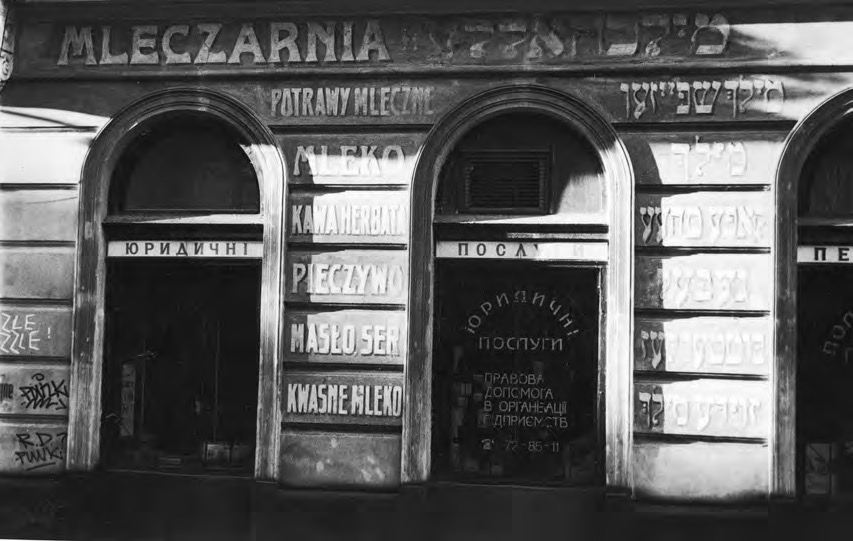
My first discovery of Kosiv, Kuty, and Vyzhnytsia—small spa towns nestled in the Carpathians, in the former palatinate of Pokuttia attached to Galicia—followed by a few months the revelation made to me of his birthplace. It was there, then, from this little town of no importance, that my grandfather had set out on the long wanderings that had then led him to Vienna and then to France. It was therefore the towns of Kosiv and Vyzhnytsia that lay hidden beneath the far too vast name of “Austria-Hungary” found in his official biographies, deliberately evasive. I have always been certain that, beneath the vague term Austria-Hungary, designating a country that no longer existed, lay hidden not Austria proper, nor Hungary, but one of those distant provinces of the imperial and royal Austrian Monarchy, of the Kakania of Musil and Roth, one of those provinces which, like the Bohemia of Kafka or the Moravia of Mahler, make one dream by their in-between character, their improbable entity, their shifting geography, one of those borderland provinces that leaves a doubt hovering over its ethnic or national belonging, so that it is simpler to designate it by the generic name of a supranational reality that encompasses the others, just as a native of Dacia, of Illyria, of Gaul, or of Palestine might have said, in his time, that he came from the Roman Empire, quite simply, without revealing the rest of his identity. I have always had the feeling, consciously or not, and this was confirmed, that the term Austria-Hungary could cover, in this particular case, only the eastern marches of Cisleithania, that is to say eastern Galicia, Bukovina, or perhaps Subcarpathian Ruthenia, and that my passion for Lvov and for all this immense region stretching from Przemyśl to Czernowitz was bound up with this topographical search for my family origins.
So one winter day I set out to storm the Carpathians, accompanied by a friend from Lvov, Sergei, who had offered to take me by car in his little Moskvitch of the time—barely two or three years after the fall of the Soviet Union. In view of the weather conditions, we took the best route, though a bit longer, the one that passes through the large towns of Stryi, Kalush, Stanisławów, Kolomyia—impossible not to think of Sacher-Masoch’s “Don Juan”—then Zabolotiv, of which Manès Sperber says that the town evokes in its very name the mud and marshes it contains. There, we crossed the Prut—the river that, a little farther on, irrigates Czernowitz, and which Rose Ausländer evokes with nostalgia in Immer zurück zum Pruth (Always Back to the Prut)—and turned south in the direction of Kosiv, a town known for its great regional market where one can buy fruit and vegetables, livestock and poultry, as well as Ukrainian artisan craftwork. Having arrived at Kosiv, we found lodging in one of those Soviet-style “sanatoriums” (rest houses), where one can take a hotel room without being obliged to follow all the “procedures” and take all the baths on offer. We had first questioned the hotel director, but he knew nothing, could say nothing about the former Jewish community or the location of the synagogue. He knew there had been many Jews before the war, but could not or would not say anything, as if it were a world completely foreign to him, almost foreign to the history of the town. I was astonished by the fact that he refused to answer in Russian the questions I put to him in that language; he spoke only Ukrainian, and Sergei had to translate for me. So we went into the town and questioned people in the very center, near the marketplace, where the heart of the shtetl had once stood. There, a lady told us that the synagogue had stood right on the site of the post office, but that the building had been destroyed, and that nothing remained of the former Jewish community. On the marketplace, a few houses are still typically Austrian, with a Maria-Theresa-style balcony, a little as at Brody, and this lady presented these houses to us as former Jewish houses. Then a man showed me where another synagogue stood, a short distance from the marketplace, along the Rybnytsia, on the road leading to Stary Kosiv (Old Kosiv). The building is today transformed into a gymnasium. The floor is fitted out for indoor sports, and on the eastern wall, at the place of the Tablets of the Law, one sees a basketball hoop as well as a slogan supporting a local athletics club. I caught myself imagining that it was in this synagogue that my great-grandfather, Abraham Schreiber, officiated, and that his son, my grandfather, therefore attended it when he was little, before pursuing his studies at the yeshiva of Vyzhnytsia.
The town of Kosiv—a name that evokes the hay and the harvests—is pleasantly situated, on the flank of the mountain, in a Carpathian valley crossed by the Rybnytsia, a tributary of the Prut, a stone’s throw from the Cheremosh. All around stretch the green mountains, with meadows that gradually turn into forests, then into high pastures. One sees beautiful images of the region in Paradzhanov’s film Shadows of Forgotten Ancestors, drawn from Kotsyubynsky’s novel of the same name, which is set in the high pastures, above the sources of the Cheremosh, in the almost deserted regions inhabited solely by the Hutsuls, a people of Ukrainian mountain-dwellers: “On the distant heights lay the Hutsul villages, silent and solitary, to which the breath of the firs gave a cherry hue, the pointed roofs of the fragrant hay barns, and, in the valley, the winding and graying Cheremosh sparkled in anger and beneath the rocks shone with a green and menacing fire. […] All was desert and wild in those cemeteries of trees, forgotten by God and men, where only the grouse cried and the vipers slipped about. Here reigned calm, the great repose of nature, austerity and sadness.”5 Kosiv is one of the last towns before the immensity of these mountains. Mentioned in 1424 by the grand prince of Lithuania Švitrigaila, it was in the sixteenth century that it began to develop, with the discovery of a salt deposit and the opening of salt baths. The town was the property of a Polish noble, the Jasłowiecki family, until the partition of Poland in 1772. The Jews began to settle there from the very beginnings of the town’s existence, in the sixteenth century, even if traces of a cemetery are found only from the eighteenth century onward. A hundred and ten Jewish families were present there at the end of the eighteenth century, about a third of the town. The Jews were considered at Kosiv to be well-off people, unlike in other shtetls, where they belonged to the poor classes.
The most important personage who visited the town and stayed there, it is said, for seven years, at a time when he was not yet known, is Israel ben Eliezer, who later became the Baal Shem Tov, who withdrew here, into the mountains between Kosiv and Kuty, to meditate, to read the Torah, and to learn the divine teachings. Shortly before, he had married the daughter of Rabbi Ephraim of Brody, but his brother-in-law, Rabbi Gershom, son of Ephraim, was ashamed of him, because he found him ignorant, and he enjoined his sister either to part from him or to leave, which they did. Israel ben Eliezer went off with his wife into the Carpathians, left his wife at Kosiv, and “went off alone into the mountain where he built himself a hut in order to set about extracting clay. Two or three times a week, his wife came up to join him; together they loaded the cart, and then she drew a few meager coins from the sale. When he felt hunger, Israel mixed flour and water in a hollow of the rock, kneaded that handful of dough, and let it bake in the sun.”6 It was there, in those mountains, that the Baal Shem Tov is said to have performed his first miracles. “Once, so deep was his ecstasy, he did not notice that he had approached the edge of a yawning abyss, and already he was advancing his foot in pursuit of his march. With a bound, the mountain opposite was there, pressing against its neighbor, and the Baal Shem passed.”7
It was shortly after, when he was an innkeeper on the bank of the Prut and a pupil of his brother-in-law came to see him, that he revealed himself in broad daylight. He was then thirty-six years old. Martin Buber relates: “Waking with a start in the middle of the night, the host perceived from his bed, in the room of the inn, a great glow that he took for the beginning of a fire […] What he believed to be the fire was a dazzling white light that radiated out of the hearth to spread everywhere and fill the house. Overthrown and blinded by such incandescence, the man fell as if struck and lost consciousness. And when the Baal Shem had brought him back to his senses: ‘One does not look,’ he told him, ‘at what is not granted to you.’”8 The pupil in question went to Brody, rushed to Rabbi Gershom to give him the account of this revelation. Rabbi Gershom understood that his brother-in-law was the Baal Shem Tov and went to seek him in the mountain. Four years later, in 1740, the Baal Shem Tov was able to settle at Medzhybizh (Mejbij), in Podolia, on the banks of the Southern Bug, in a magnificent site protected by a great Polish fortress. There he served as rabbi of the community, had many pupils who founded and developed the Hasidic movement throughout Ukraine and Poland, and he died in 1760. Even if he did not remain very long at Kosiv, even if his years spent in the Carpathians were years of study and meditation, the Baal Shem Tov marked the town a posteriori: many are the pilgrims who visited it because of him, and among the rabbis who settled there, several of them, nourished by his teaching, made up the Hasidic dynasty of Kosiv, related by marriage to the neighboring dynasty of Vyzhnytsia. In the nineteenth and twentieth centuries, the great names of this dynasty were Moshe Hager of Kosiv, Baruch Hager of Vyzhnytsia, Shraga Feivish Hager of Zalishchyky, who was also the son-in-law of the first, then Abraham Yehoshua Heschel Hager of Kosiv, son of the latter, and so on. My great-grandfather knew and frequented the members of this dynasty, but was not descended from this family, contracted no alliances and marriages with it, and remained somewhat apart from the great Hasidic tradition, even if he was subject to its influence, like everyone in the region.
But there was not only the Hasidic dynasty at Kosiv; all the tendencies of Judaism were represented—for the shtetl was considerable: alongside the Hasidim were found other communities and other groupings of the faithful, maskilim, adepts of the Enlightenment that had come from Berlin and Vilna, as well as mitnagdim, more conservative, and also Bundists, socialists, Zionists.
The town was small in size and everyone knew everyone. Of the 3,100 inhabitants it numbered at the beginning of the twentieth century, 2,560 were Jews, that is to say more than 80%, the rest being composed above all of Ukrainians, but also of Poles. The minority character of the latter is expressed by the fact that the Catholic church is located on the right bank of the Rybnytsia, in an outlying quarter, whereas the synagogue stood in the very center, on the marketplace.
At the other end of the town, on the west side, where the last houses run up against a barely habitable hill, on a sloping piece of ground that was not the best in Kosiv, lies the old Jewish cemetery, comprising very many graves whose inscriptions are often difficult to read, not only because they are all in Hebrew, without any other more easily legible language, but also because the letters are often effaced, attacked by time and vegetation. Certain graves of some tzaddik of Kosiv—Moshe or Baruch or Yehoshua Hager—stand out from the others by their venerable aspect that invites contemplation, surrounded by a railing locked with a key, forming a protection or retarding vandalism. It was not possible for me to find the grave of my great-grandfather, whose name I could not discover or decipher, even knowing his Hebrew name, and I do not even know whether he is buried here, for he died on the Galician front of the First World War, as a chaplain of the Austrian armies, and one does not know whether he was transferred to his native town or summarily buried in a military cemetery near the battlefield. During my first visit to Kosiv, I did not realize the immensity of the cemetery, for it was winter, it was covered with snow, and one could not see where it ended and where the forest began, but during my second visit, two or three years later, in summer, I was even more impressed by its dimensions and by the great number of graves. The people with whom I was able to lodge also showed me the place where the Jews of Kosiv were exterminated: when one goes all the way up to the top of the cemetery, to the summit of the hill, one discovers a monument erected over a mass grave recalling the memory of the six thousand Jews of the Kosiv ghetto and the surrounding area murdered here in 1942. Two monuments mark the event, one from the Soviet era, the other, more recent, in Ukrainian and Hebrew. Neighbors and witnesses say that the earth was still stirring some days after that savage slaughter. There, on that November day of 1942, the history of this shtetl found its completion, its definitive outcome; each destiny of each member of this community ran up against a wall, a brutal halt beyond which lies the void, the void of memory and of transmission.
Not far from Kosiv, one crosses the Cheremosh at Kuty, where one passes into the neighboring region, Bukovina. From 1919 to 1939, this was the border between Poland and Romania. In September 1939, after the collapse of the Polish army, caught in a vise between the Hitlerite forces and the Red Army, it was through the Kuty border post that the president, the prime minister, and the whole Polish government fled, taking refuge in London by way of Romania. A great number of limousines crossed this border post, whose customs officers were little used to seeing so many fine people. From Kuty, one reaches very quickly Vyzhnytsia, the first town of Bukovina, in the Carpathians, another former high place of Hasidism, where lofty personalities distinguished themselves. At the entrance of Vyzhnytsia, one can visit, as at Sadagora, near Czernowitz, the former residence of the tzaddik Menachem Mendel of Vyzhnytsia, today transformed into a dairy cooperative (molochny zavod). The town of Vyzhnytsia was 90% Jewish: in 1880, there were 3,800 Jews out of 4,165 inhabitants; in 1940, 5,000 Jews out of barely 6,000 inhabitants. The town is still marked by their former presence. The Yiddish-language poet Josef Burg, who died a few years ago, was a native of Vyzhnytsia, “that little town of Bukovina where, from the most ancient times, hard-working Jews lived in Hutsul houses with mezuzahs on their doors”;9 his father was a raftsman, transporting wood on the rafts of the Cheremosh: “A raft bore my childhood along with my home and the waves rocked me”;10 he relates that he had the chance to hear, at Czernowitz, as an adolescent, a reading by the poet Itzik Manger, and that he showed his first verses to Eliezer Steinbarg.11 In the streets of the town center, one still recognizes today houses with balconies, characteristic of the Jewish architecture of the Austrian and Polish borderlands, as at Brody. In the middle of the marketplace, the most imposing building, where the town hall is today located, is none other than a former synagogue, monumental, built in the 1930s. The first great synagogue had been built in 1789, the one where the rabbis of the Vyzhnytsia dynasty officiated, but it seems to have been destroyed. The other synagogues of the town bore the name of their founder: “Rabbi Leibele” for the adepts of the Hasidim of Sadagora, “Itzig Frankel” for the wood merchants and carpenters, and there was also the “Vordere Beth Midrash” for the carriage drivers, the “Hevra Tehilim,” and still others, as well as a famous yeshiva, whose teaching my grandfather followed and which later reconstituted itself in Israel. The other places of worship in the town are the Catholic church of Sts. Peter and Paul, today disused, and the Orthodox churches of St. Demetrius and St. Nicholas, all three from the nineteenth century, as well as a German Protestant church at Stara Zhadova, in ruins today.
The cemetery of Vyzhnytsia is very impressive, better maintained than that of Kosiv. It is not located on sloping ground and the graves do not subside, even if they too are attacked by the vegetation. At the entrance are the graves of the tzaddik of Vyzhnytsia Menachem Mendel Hager of Kosiv, author of the treatise Ahavas Shalom, and of his son Chaim Hager of Kosiv, author of the treatise Toras Chaim, surrounded by a railing. A small house, or “ohel,” protects the burial places of other personalities, but one cannot enter it. A few graves emerge from a sea of vegetation, adorned with a beautiful Star of David. In the most recent part of the cemetery, one found postwar graves, up to 1993 or 1994. Unlike at Kosiv, Jews survived the Shoah here, for Vyzhnytsia was located in Romanian territory, from which the Jews were deported to Transnistria. The history of their deportation is terrible—it is, among others, the history of Paul Celan’s parents—but not all were exterminated; some returned after the war. During my visit, in 1998, I was told that the last Jew of Vyzhnytsia had just died, a few months earlier, the last representative of a presence of several centuries, interrupted, vanished, engulfed in the Shoah and the other catastrophes of the century.
Notes
PTTK (Polskie Towarzystwo Turystyczno-Krajoznawcze): This “Polish Tourist and Sightseeing Society,” founded in 1948 out of a grouping of associations dating from the nineteenth century, promotes tourism in Poland and possesses tourist offices, youth hostels, and hotels. One of the founders was Mieczysław Orłowicz, the author of a famous Guide to Galicia (Ilustrowany Przewodnik po Galicyi, Lwów 1919) which is still today a mine of information about this country.↩︎
Shoil Miler, Dobromil, Zikharonoth fun a shtetl in Galitsia in di Yohren 1890 bis 1907 / Saul Miller, Dobromil, Life in a Galician Shtetl (1890–1907) (bilingual Yiddish-English edition), New York 1980, p. 1 / p. 3. Saul Miller, born in 1890 at Dobromil, emigrated in 1907 to Berlin and then two years later to the United States. He wrote this book in 1964 in Yiddish, in the form of letters to his children. His son Leo Miller published it posthumously in 1980, with an English translation (without indicating the exact year of his father’s death).↩︎
Ibid. p. 2 / p. 4.↩︎
See our text “Confins,” Les Temps Modernes, no. 565–566, September 1993.↩︎
Mykhailo Kotsyubynsky, Les Chevaux de feu ou Les ombres des ancêtres disparus (Shadows of Forgotten Ancestors), translated from the Ukrainian by Jean-Claude Marcadé, Lausanne 2001, pp. 24–35.↩︎
Martin Buber, Les récits hassidiques (Tales of the Hasidim), I, translated by Armel Guerne, Paris 1978, p. 89.↩︎
Ibid.↩︎
Ibid. p. 96.↩︎
Josef Burg, A farschpetikter echo / Ein verspätetes Echo (bilingual Yiddish-German edition), Munich 1999, p. 132. Josef Burg (Vyzhnytsia 1912 – Czernowitz 2009) began to publish in 1934 in the review Czernovitzer Bleter, banned in 1938 by the Romanian government. He survived the Holocaust by taking refuge in the USSR during the war. He continued to write in Yiddish in Sovietisch Heimland and other reviews. From 1990 onward he recreated and directed the review Czernovitzer Bleter.↩︎
Ibid. p. 46.↩︎
Ibid. p. 16.↩︎