We present here a few selected pieces from a virtual exhibition devoted to the memorials of the Rwandan genocide. The exhibition was produced in 2011 and has been enriched since — something made possible, of course, by the highly flexible medium that is the web. There is no print version, even though a publication is currently being considered that would include some of the texts now online, augmented by a new chapter on “Law as memorial.” The exhibition is divided into three sets. The first situates the memorials within Rwanda’s recent history: Jean-Pierre Chrétien [Le génocide des Tutsis au Rwanda (The Genocide of the Tutsis in Rwanda)] has retraced the history of the genocide. Catherine Coquio kindly agreed to inscribe the memorials within the more general analysis of what is at stake in constructing a memory of genocides [Le génocide culturel ; l’État, la mémoire et les rescapés (Cultural Genocide; the State, Memory and the Survivors)]. Rémi Korman speaks to us of another site of memory, the cemeteries [Le Rwanda face à ses morts ou les cimetières comme lieux de mémoire du génocide (Rwanda Facing Its Dead, or Cemeteries as Sites of Genocide Memory)]. By way of counterpoint, we also wanted to present other experiences that might help bring out the specificity of the Rwandan political experience. The last set therefore offers an analysis of state memory policies on genocide in various lands. In East Germany, it is the State and/or the Party that consider themselves the sole legitimate holders of historical truth. Laure Billon decodes — in particular through the permanent exhibitions of the Ravensbrück memorial, opened in 1959 — the silences of an East German State that often flirted with antisemitism [La RDA et le génocide (The GDR and the Genocide)]. Silences too on the part of the Polish State, which did not, however, prevent the investigative work of specialized institutes. Jean-Charles Szurek leads us from the immediate postwar period to the development of a genuine Polish historical school of the genocide [La Pologne et le génocide des juifs (Poland and the Genocide of the Jews)]. Paola Bertilotti takes an interest in the evolution of Italian legislation, the reflection of a slow dawning awareness of a specificity of the genocide of the Jews, as well as in the passage from a “memory of deportation” to a “memory of the Shoah” [Politiques mémorielles d’Italie (Italy’s Memory Politics)]. And this in a “schizophrenic” country which, even while promulgating antisemitic legislation from 1938 onward, was able relatively to “protect” the Jews in the regions it occupied. Claire Mouradian historicizes the commemorative practices of the Armenian genocide, from the striking of a first medal in 1915 to the inauguration in April 1995 of the genocide museum at Tsitsernakaberd, by way of the “24 April” commemoration days [L’Arménie et sa mémoire (Armenia and Its Memory)].
But the heart of the exhibition is indeed devoted to the Rwandan memorials. The great Rwandan memorials — Gisozi, Murambi, Nyamata and N’tarama, Bisesero, Nyarubuye — each occupy a specific place in a memorial score laid out by the Rwandan State. Working from photographs taken on site, and at different periods, Nathan Réra, Boris Boubacar Diop, Françoise Blum and Émilie Martz-Kuhn describe and decode this “memorial palimpsest,” with an eye that is now that of historians, now that of an image specialist, now that of a novelist.
Gisozi
Gisozi, located within Kigali itself, is in a sense an “international showcase,” with a reflection upon and a setting-in-perspective of the Rwandan genocide in relation to the other genocides and ethnic massacres of the twentieth century. “On arriving at the Gisozi memorial, a kind of antechamber to the memory of the genocide of the Tutsi in Rwanda, a curious impression of déjà-vu seizes the Western visitor, provided he has some knowledge of the sites of memory commemorating the extermination of the Jews of Europe. Unlike Murambi or N’tarama — sites bearing a singularity and a frontality unprecedented in the tradition of the memorial — Gisozi cultivates its similarities with the West, drawing its motifs from the history of representations of the destruction of the Jews of Europe… While the memorial’s permanent exhibition addresses fairly fully the Rwandan past and recent history, from colonization to genocide, it does so with a constant concern to place these events within a historiography of genocides. The room of ‘Lost Lives,’ the final space of the museum where the other massacres and genocides of the twentieth century are deliberately taken up, clearly plays this role of opening out: indicating to the foreign visitor that Rwanda’s path cannot, in many respects, be thought of independently of that of Nazi Germany, of Cambodia or of the former Yugoslavia. Just as explicitly, a preceding section, entitled ‘Road to the Final Solution,’ reappropriated the expression consecrated by the Nazis to speak of the extermination of the Jews, applying it to Rwandan history.” [Réra, Gisozi. Kigali : itinéraires de la mémoire et de l’oubli (Gisozi. Kigali: Itineraries of Memory and Forgetting)].
Bisesero
Bisesero is the memorial of Tutsi resistance, but, far from any heroic gesture, it leaves an impression of solitude and despair: “During the fourth commemorations of the genocide, in April 1998, President Pasteur Bizimungo laid the first stone of the Bisesero memorial. This memorial, conceived by the architect Vedaste Ngarambe, stands on the hill of Nyakomo, the one where Birara, head of the resistance organization, used to come and sit to enjoy the view it offered over the whole region. The architectural complex is entirely organized around a stone path, which allows the visitor to climb gradually toward the summit of the slope. One enters by passing beneath a great arch, originally white and violet — the color of mourning — which is crumbling for lack of upkeep. To the right, a pile of stones holds nine spears arranged in a circle, pointing toward the sky. They open the path, a ‘path of Calvary,’ which the visitor must ascend in order to make symbolically the crossing through the genocide. The steep route passes through three buildings housing nine rooms, emblems of the communes of the prefecture of Kibuye. These premises are meant to receive the bones of the victims so as to form ‘open graves.’1
According to our sources, the remains of the bodies are still today stored in a makeshift sheet-metal building, situated below the monument. The ascent continues for the visitor, with the goal of reaching the summit, which symbolizes survival of the genocide. But for lack of budget, the memorial is not finished, more than ten years after its construction began. Indeed, the ‘summit of hope’2 was meant to receive several installations, including a painted fresco depicting scenes of the resistance. For now, only three graves are present: a common grave with ‘the remains that have not been processed,’3 the grave of Birara and the grave of the unknown combatant. But how does this monument partake of the spirit of the place? How does this site of memory, built and designed to celebrate the remembrance of the resistance fighters, interact with the memory or memories of the place? Visitors are rare at Bisesero; located 34 km as the crow flies from Kibuye, the memorial’s situation discourages tourists, who, few in number, are received by a handful of survivors. If, as James Ernest Young maintains, ‘[t]he visitors are an integral part of the commemorative text […] for public memory and its representations depend not only on the forms and figures of the monument itself, but on the responses of the spectators before the monument,’4 the Bisesero memorial remains a frozen place, and at times illegible to anyone who does not know the history of the hills. Moreover, for the well-informed travelers, the disappointment is sometimes even greater; welcomed by ‘a handful of men who are now dying of grief,’5 the foreigners abandon, in exchange for a photograph with the ‘heroes,’ the images of the ‘enclosed holy place’6 and of the resistance fighters they had forged for themselves, notably through their reading. Disoriented by mute stones and by a people of warriors today reduced to begging in order to survive, the visitor goes on his way, colliding with the chocolate-box images he had constructed for himself. The place as it can be experienced today by visitors seems to be out of step with its spirit, the spirit conveyed before, during and just after the genocide. No tangible trace materializes at Bisesero the symbol of a prosperous land and a land of refuge, an emblem of protection for the weakest. A few emaciated cows are led across the hills by young children in rags. The Abaseseros, survivors of the genocide, still suffer today from grave traumas that go untreated. The monument, empty and deserted, overlooks the hills with its silence.” [Martz-Kuhn, Bisesero, palimpseste mémoriel ? (Bisesero, a Memorial Palimpsest?)].
Murambi
Murambi offers to the visitor’s gaze the bodies preserved with quicklime, in a terrible nakedness: “We know it: for the strange politicians of Hutu Power, handing the corpses of the Tutsi over to dogs and vultures was one way among others of signing their crimes. Murambi was the sole exception to this rule, since the bodies, at first abandoned on the spot, ended up being buried so as to allow Operation Turquoise to occupy the premises. It is impossible to go through the rooms of the site without being struck by the near-perfect state of preservation of the remains of these thousands of Tutsi, exhumed after the RPF’s victory. According to the guide, it is because of the clayey nature of the soil where they had been interred that they did not fall apart. This is also what explains their reddish color. Never have the dead seemed so powerfully expressive. One recognizes the children very well, and before our eyes is reproduced the last gesture, derisory and vain, by which many of them, seeing an Interahamwe rush at them, had tried to escape the machetes… [a few years later] Going through the rooms, one notices that the skeletons, still as well preserved, are no longer clay-colored. Regularly treated with lime for years, they have become whitish. In one room are laid out the bladed weapons that served the carnage: hammers, machetes, nail-studded clubs. One wonders, aghast: how did thousands of family fathers suddenly come to think it normal to smash the skulls of newborns with these clubs bristling with rusty nails? …..The rooms, about ten meters from the central building, are identical. Yet even though one knows that all of them will offer the same spectacle, one struggles not to stop for at least a few minutes in each of them. As a mark of respect. And also because one hopes that at the end of the path answers will arise from somewhere.” [Diop, A propos de Murambi (Concerning Murambi)].
At Ntarama
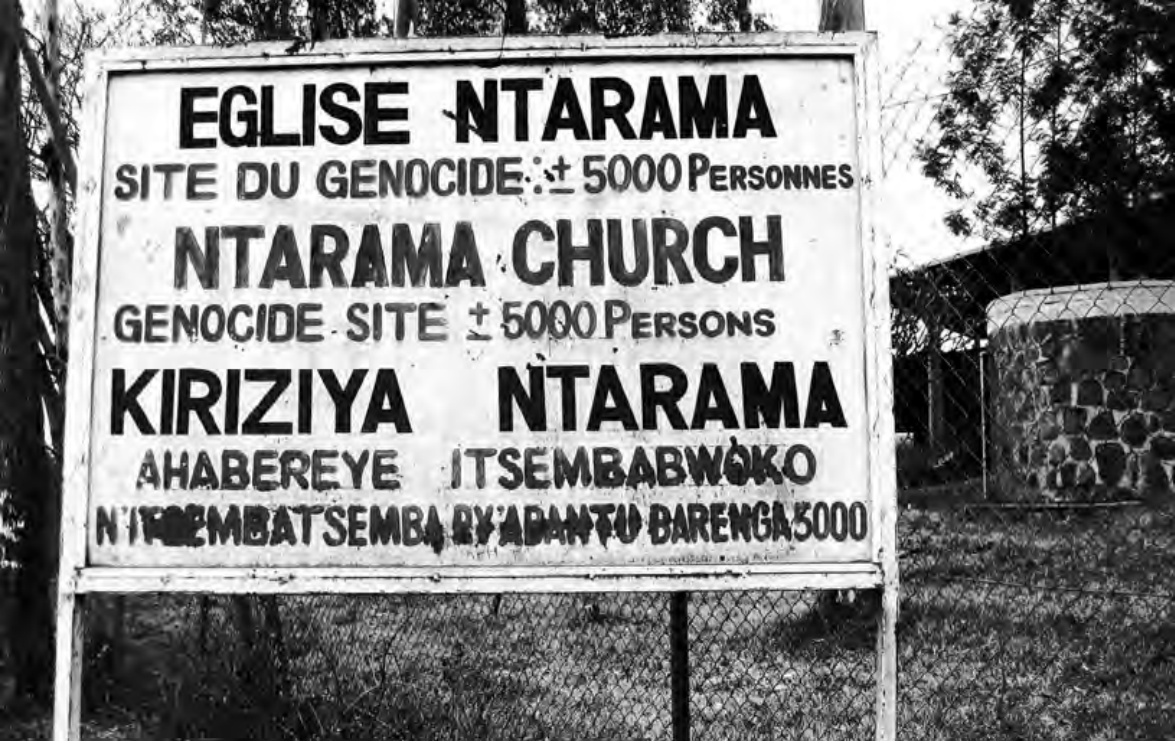
At Ntarama, “the church has today become a place of worship again, even though there are displayed in it objects relating to the genocide: a few garments, notebooks or other poor relics that belonged to children, the inevitable skulls in the display cases. But the rows of small wooden benches are there and receive the faithful during mass. Garments too hang from the windows, which can only be seen from outside. The building adjoining the church burned down entirely. Nothing remains of it but the roof and the pillars, along with charred heaps of one knows not quite what.” And Nyamata… “Nyamata, by contrast, was the only deconsecrated church transformed into a site of memory. If masses can, at times, be said there, it is only in memory of the victims. At Nyamata, the Church is a Memorial. In fact this case of the church become memorial is unique. The question was of course raised after the genocide, and was the subject of bitter negotiations between the State and the Churches on the one hand, between the Church and the survivors on the other. An agreement between the Church and the State stipulates that the churches ‘will shelter signs in suitably arranged places inside, without disrupting the customary proper conduct of worship. Among the signs that will be preserved there are the bones, remains of the victims of the massacres perpetrated there…’ The Church of N’tarama fits perfectly within the framework of this agreement. That of Kibeho was the subject of a compromise, recounted by Jean-Pierre Chrétien and Ubaldo Rafiki.7 At Kibeho, a place of Marian worship, a place of miracles, a seer was still receiving, in the very heart of the genocide, ‘very Vichy-like’ messages from the Virgin, as Jean-Pierre Chrétien and Ubaldo Rafiki note,8 messages immediately broadcast by national radio and by Radio Mille Collines. The survivors did not wait for any authorization to bury their dead in the church itself. The dispute with the Church was resolved by the construction of a wall of opaque glass at the center of the building, which became on one side a memorial and remained on the other a place of worship. At Nyamata, the Rwandan Church and the Vatican were presented with a fait accompli. The Church of Nyamata was, at least in the beginning, one of the most visited memorial sites in Rwanda.” [Blum, Nyamata et Ntarama : église-mémorial, églises et mémoriaux (Nyamata and Ntarama: Memorial-Church, Churches and Memorials)].
At Nyarubuye
And at Nyarubuye, it is the objects used by the killers that are on display. “In the long corridor of the convent of Nyarubuye, a tree trunk cut in two, used for the preparation of urwagwa, is precisely preserved. The Hutu used it to decapitate the Tutsi and display their bodies, while the beer calabashes collected their blood. It was a ‘joke’ commonly current among the interahamwe: to mock them, they claimed that the blood of their victims was going to turn into milk — since the Tutsi, mostly herders, drank a great deal of it according to widespread belief. Nyarubuye, more than any other place, makes one understand how total the inversion of values and traditions was during the genocide.
It is a fact: the killers used a roundabout vocabulary to speak of the extermination of the Tutsi: ‘to cut, to shorten, to roast,’ rather than ‘to kill, to amputate, to burn’… The perversity of the murderers even drove them to vie in ingenuity to flush out, among the carpets of corpses, those who were still alive. Thus, at Nyarubuye, the grinding stones (urusyo) used for the preparation of sorghum and cassava flour, and the mortars for pounding groundnuts, were used in an entirely different way: to grind chili pepper. Jean Damascène, one of the memorial’s guides, describes in the smallest detail the macabre ritual of the interahamwe: ‘Once the chili had been ground fine, in the stone, they spread it over the bodies of the Tutsi, to make sure they were really dead. Those who were still alive would cry out or sneeze, and afterward the killers would give them a blow with a machete or a ntampongano (the nail-studded club with which the militiamen struck the skulls of their victims).’ According to other testimonies, Hutu women went so far as to sprinkle it on the vaginas of the young girls their husbands had just raped. Facing a makeshift table on which the personal effects of the Tutsi had been heaped — shoes, hats, utensils of daily life — the weapons of the crime have been preserved: arrows, picks, hoes, iron bars, sharpened sticks. In the middle of this museum of horrors, a strange object arrests one’s attention. Jean Damascène explains that it is a chopper, and that the killers used it to grind up the hearts of the Tutsi. And he adds, pointing to an old brick oven outside, in the middle of the courtyard: ‘A Hutu, named Simba, used this oven to cook the flesh and hearts of his victims, before eating them. They say he took refuge in Tanzania, and that he died there.’ Acts of cannibalism are nothing new; several witnesses have corroborated Jean Damascène’s account. In March 2007, three Rwandans (two men and a woman) were in fact sentenced by a gaçaça to twenty-seven years’ imprisonment for similar acts that occurred in the west of the country. Such accounts might appear exaggerated, even grotesque; in the face of the most muffled horror, humans often tend to minimize the nature of the crimes, as a form of self-protection, as if to reassure themselves about their own humanity. However, one must not see these acts of cannibalism as the product of any taste of the killers for human flesh: it is plain that these practices, if they are indeed established, were part of a logic of aggression, motivated by the desire to exercise power over the Tutsi victims. To eat the heart of the other, symbolically the seat of courage, betrays an evident desire for possession and for the stripping away of social rank. How frequent were these anthropophagous acts in Rwanda? Hard to say, really. We stand at a constant border between the real and the phantasm, where the resurgence of a primitive cannibalism seems to embody, in the survivors’ words, the horror of the crimes they have undergone.” [Réra, Nyarubuye : quelque part, entre les vivants et les morts (Nyarubuye: Somewhere, Between the Living and the Dead)].
Behind these fragmented stagings there were multiple negotiations — with the survivors, with the relatives of the victims, with the Church, with the mourning process of an entire country… The memory politics itself evolved from 1994 to the present day, and the memorials with it, and with it the exhibits of this gigantic “proximity” massacre that brought about, amid the near-general indifference of the international community, the death in three months of close to a million people: to take up Jonathan Littell’s grim tally, 11,111 murdered per day, 463 per hour and 7.70 per minute, and this, not in the immense territories of “the Shoah by bullets,” but in a very small country…
Bisesero is abandoned. Nyamata and N’tarama receive very few visitors. Only Gisozi, where one hears weeping, and where one sees the marks of immense sorrows, and Murambi, still receive survivors and visitors. If one could try to understand something, modestly, it was indeed the function and the history of these memorials, still brief but already rich in multiple transformations. The photographs taken on site, at various moments, thus served as the framework for the presentation of the Rwandan sites of memory. It would be interesting, too, to pursue this work and its online presentation by carrying out a new photographic survey, a few years on.
Françoise Blum (Centre d’histoire sociale du XXᵉ siècle)
The authors of this electronic publication are: Paola Bertilotti (Sciences-Po), Laure Billon (Centre d’Histoire sociale du XXᵉ siècle), Françoise Blum (Ed.) (Centre d’Histoire Sociale du XXᵉ siècle), Jean-Pierre Chrétien (Centre d’études des mondes africains), Catherine Coquio (Univ. Paris 7), Boris Boubacar Diop (Writer), Rémi Korman (EHESS), Claire Mouradian (CERCEC), Nathan Réra (Univ. de Provence/Aix-Marseille 1), Jean-Charles Szurek (Institut des sciences sociales du politique).
The graphic design is the work of François-Jean Dazin.
The exhibition was produced with the support of the Université Paris-1 and of the Fondation pour la mémoire de la Shoah.
http://chs.univ-paris1.fr/genocides_et_politiques_memorielles/
Notes
Veraste Ngarambe, 2006: interview conducted with Marie-France Collard in Rwanda 94 : à travers nous, l’Humanité, documentary film directed by Marie-France Collard, Belgium, Groupov, 2006, 105 min.↩︎
Id.↩︎
Id.↩︎
James E. Young, “Ecrire le monument, site, mémoire, critique,” Annales, vol. 48, no. 3, 1993, pp. 729-743.↩︎
Groupov, Une tentative de réparation symbolique envers les morts à l’usage des vivants, Paris, Editions théâtrales, 2002, p. 147.↩︎
Alain Mabanckou, Rwanda : ce génocide qui nous mine la conscience, 2008, online: http://www.lecreditavoyage.com/ (Accessed 2008)↩︎
Jean-Pierre Chrétien and Ubaldo Rafiki, “L’Eglise de Kibeho au Rwanda : lieu de culte ou lieu de mémoire du génocide de 1994,” Génocides/Lieux et non-lieux de mémoire, Revue d’histoire de la Shoah, no. 181, 2004/2, pp. 277-290.↩︎
Id.↩︎