We know that the visibility and invisibility of historical facts and phenomena depend on numerous factors (researchers’ work, political orientations, good and bad popularizations, “fake news,” etc.) and that fragmentary information can distort historical realities and feed certainties. The examples are not lacking. For our concerns here, Portuguese crypto-Judaism remains all the less visible — little known and too often associated with the history of the Jews of Spain, as one sometimes sees in specialized works, chronologies, on maps, or even in museums.1 Yet we know today that the Marrano phenomenon is more specifically Portuguese and that crypto-Judaism would prove far more persistent in Portugal than in Spain. Our contribution seeks to render more visible the original features of Portuguese Marranism that played a decisive role in its evolution and its resilience down to the 20th century.
Prologue
Discoveries: who discovers whom — a play of mirrors
“These words, like signs and billboards in oversized letters, escape the observer through the very fact of their excessive obviousness.” (Edgar Allan Poe, The Purloined Letter).
We are in 1917. The place: the village of Belmonte in northeastern Portugal. The action: a face-to-face encounter unfolding over several weeks to unmask the Jewish identity of the protagonists. Who are they? On one side, Samuel Schwarz, an Ashkenazi Jew from Poland, a mining engineer, who is in Portugal for prospecting work and who, besides, is passionately interested in Jewish history. On the other side: representatives — men but especially women — of a few families in the village who claim to be Christians but who were presented to Schwarz by another inhabitant of the village as judeus (Jews), or at least of Jewish origin, and who continue to practice the Jewish religion in secret — in other words, who would be crypto-Jews or Marranos.
For Schwarz, “the existence of clandestine Jews in the middle of the 20th century, in a democratic and republican country of Europe, seems, at first sight, implausible.”2 For the said Marranos, it seems inconceivable that a Jew would not seek to hide his Judaism, as they themselves did. Like him, the villagers have drifted from normative, orthodox Judaism, but the former through centuries of persecution, while Schwarz’s family was opening itself to the Haskalah (Jewish Enlightenment). This play of mirrors promises to be complex. Indeed, Schwarz comes up against difficulties that seem insurmountable. Every attempt to prove his Judaism fails. His erudition and his knowledge of Jewish history in general, as well as his fervent adherence to Zionism in particular, find no echo. The Marranos are unaware of the information that the said “foreign Jew” seeks to share with them, in particular that which seems to inspire so much enthusiasm in their interlocutor — namely the very recent declaration of a certain English lord, Balfour, promising a national home for the Jewish people. The test continues with the evocation of prayers. At this stage, Schwarz makes a breakthrough in his stalled inquiry. He understands that it is the women — and especially the older women, doubly invisible — who know the prayers by heart and who preside over the religious ceremonies. Nevertheless, he is unable to pronounce “their” prayers in Portuguese and seeks in vain to make them understand that the Jews of today recite prayers in Hebrew — a language whose existence the women are unaware of. Then comes the moment of “excessive obviousness.” One evening, one of the Marranos — the eldest, who would hold the role of hazan (sacerdotisa) — asks him to recite a prayer “in this Hebrew language that you assure us is that of other Jews.” Schwarz of course pronounces the Shema Israel, the Jewish profession of faith. At the word Adonai the women cover their eyes with their hands. The “priestess” then proclaims the verdict: “he is truly a Jew because he has pronounced the name of Adonai.”3
The paradoxical pathways of secrecy
By this simple moving sentence, Schwarz was adopted as a brother by the group of Marranos and then initiated into their secrets. His “discovery” also altered the course of his own life, for from then on he would never cease to study these Marranos of Belmonte and of numerous neighboring towns. Becoming a historian and anthropologist, Schwarz combined intuitively the methods of these two disciplines: he made long stays among the Marranos, transcribed their prayers — until then transmitted orally or kept in the greatest family secrecy — and scoured archives and libraries.
Schwarz is undoubtedly one of the first to have grasped the complexity of the notion of secrecy among the Marranos. Indispensable for escaping the clutches of the Inquisition, secrecy is transmitted from generation to generation before becoming, over time, a fundamental element of their “religion.” In doing so, Schwarz prefigures an anthropological vision of crypto-Judaism that, far from being reducible to a clandestinely practiced Judaism, would be a system of beliefs in which the secret — pillar of the practice — conditions the psychism of the faithful.4
At the end of eight years of original research that led him into an unceasing back-and-forth between archives and the field, he publishes Os Cristãos novos em Portugal no século vinte.5 This brief work of barely a hundred pages, though not the work of a professional ethnologist, is one of the most complete studies of the way of life, practices, rites, and prayers of the Marranos, and remains to this day one of the greatest contributions to the history of Portuguese Marranism. Yet this publication also reveals a contradiction: by making the prayers and secrets of the Marranos public, Schwarz breaks with the imperative of secrecy which, as he has perfectly understood, constitutes one of the pillars of their religiosity. Conscious of this paradox, Schwarz emphasizes the urgency of collecting and publishing these prayers — which would even be the raison d’être of his study: “These prayers, which had nevertheless resisted three centuries of persecutions, ran the risk of being forgotten and lost completely.”6 He refers to the “young Marrano generation” won over by “religious indifference” and undergoing the effects of what he calls “national dissolution” — namely mixed marriages and, more broadly, the consequences of assimilation.7 As Nathan Wachtel emphasizes, Schwarz’s project constitutes an “ethnology of urgency,” intended to save the Jewish heritage of Portugal, and can be situated in the prolongation of the “Jewish ethnographic school” of Eastern Europe, in full expansion since the mid-19th century.8 Ultimate paradox: much later, in the 1990s, when Portuguese Marranos from the same region of Belmonte will once again be “discovered,” Schwarz’s book will play an essential part in these Marranos’ quest for identity, to the point of becoming the “vade mecum of the perfect crypto-Jew.”9
Birth of Marranism: grandeurs and miseries
To understand this resilience of the Marrano phenomenon in Portugal (and not in Spain) in the 20th century, we must go back to its origins, whose context and sequence of events differ considerably from the Spanish case. In Spain, the waves of forced conversions had begun as early as the end of the 14th century, spread throughout the 15th century, leaving a Jewish community ever more weakened and eroded, until the final stage: the expulsion of 1492. The Inquisition was established as early as 1478 to hunt down deviant converts. Its prosecutions were of such intensity and severity that by the middle of the 16th century, Spanish Marranism was practically eradicated. In Portugal, by contrast — where numerous exiles from Spain found refuge — Jews continued to enjoy royal protection and juridical autonomy until 1496, when the Portuguese king Manuel I considered a marriage with Isabel, heiress of the Spanish Catholic Monarchs. The first condition imposed by the Infanta was to follow the Spanish example and expel the Jews. On 5 December 1496, a decree ordering the expulsion of all the Jews of Portugal was published. What followed is crucial: fearing a considerable decrease in revenues after the Jews’ departure, Manuel I sought to eliminate Judaism while retaining the Jews. This would result not in expulsion but, in 1497, in the forced conversion of all the Jews of the kingdom. The contrast with Spain is striking: by a single brutal and irreversible act, the entire Jewish community is converted; its networks of sociability and solidarity are drastically transformed into clandestine networks.
But that is not all. The forced conversion of the Jews of Portugal is followed by a radical policy of forced assimilation of the converts, dictated by the king, who hoped from it their social and religious integration. Yet it is precisely at the moment when he seeks to render Judaism invisible that the Jews would become more visible. The invisibilization of Judaism begins with the obligation to change one’s family name, the dismantling of Jewish quarters (judiarias), the confiscation of furniture and books, the expropriation of synagogues, the transformation of cemeteries into pastures… It is reinforced by the king’s promise that no distinction would be made between “new” and “old” Christians. All professions previously forbidden to the Jews are now open to them. Indeed, the “New Christians” (or these “former Jews”) experience a strong socio-economic rise at the beginning of the 16th century. This rekindles the traditional hostility formerly directed against the Jews, and translates into acts of violence, paroxysmal in 1506 during the Jewish Passover. A veritable massacre — like a classic anti-Jewish pogrom — unfolds for three days in the streets of Lisbon. Two thousand “New Christians” are murdered.10 Social assimilation is aborted.
And religious integration? Here too, the years following the forced conversion prove decisive. A royal decree (1497, renewed in 1512) exempts the converts from any inquiry into the sincerity of their conversion and their real faith. The Inquisition, it must be noted, would not be established in Portugal until 1536! This relative religious tolerance leaves the converts time to create bonds of solidarity and the conditions to form a solidly constituted crypto-Judaism. This phase of some forty years (1497–1536) permits the consolidation of Portuguese Marranism and explains its survival through the centuries.
Finally, the visibility — meaning the stigmatization — of these “invisible Jews” would only intensify with the installation of the Inquisition and especially the establishment of the “statutes of purity of blood,” which forbade access by the New Christians and their descendants, Marranos or not, to a great number of offices, privileges, honorific titles, and fields of activity (they would not be abolished until the 18th century, and 1870 for Spain). This discriminatory legislation, based on racial criteria, was accompanied by a growing use of expressions marking exclusion: gente da nação (people of the nation) or os da nação (those of the nation).11
Seeing crypto-Judaism
Concealment and the invisibility of Judaism are indeed at the heart of Marranism, which is commonly called crypto-Judaism (kryptos — κρυπτός in Greek means “hidden”). Hence one of the many etymological hypotheses about the word Marrano — though today recognized as false — which derives it from an assembly of two Hebrew terms mareh ain (“to give to see,” “to give the appearance,” seeking to express the idea that they are Christians in appearance). However, we know today that the word derives from marrano, marrão, which, in the Middle Ages, in Castilian and in Portuguese, mean “pig” or “swine.”12 At the time, it was used to designate, in an insulting manner, those converts who abstained from eating pork. It is worth recalling that during the three centuries of inquisitorial persecutions, the word remains invisible — absent from the inquisitorial archives, where only cristão novo (New Christian) and “Judaizer” appear. It is only later, with modern research, that the word Marrano would be employed by historians in a neutral sense to designate crypto-Jews. Finally, it has today become a word that inspires compassion and admiration for the victims and their resistance, a symbol of resilience and heroism, even a metaphor of the resistance of the Jewish people, or again a concept, a figure of “identification.”13
The inventory that Schwarz draws up of the rites, practices, and prayers of the Marranos renders extremely visible the heartrending dichotomy inherent in Marranism: the desire to remain Jewish beyond the rite and the practice from which they were cruelly cut off by persecution and by their distance from the sources of orthodoxy. His work, very probably without his knowing it, perfectly echoes the famous formula of one of his contemporaries, the Spinozist Carl Gebhardt, according to which the Marrano appears as a “Catholic without faith, Jew without knowledge, and yet Jew by will.”14
Schwarz exposes the principal stratagems to which the Marranos found themselves forced to resort over time in order to conceal their Judaism and escape the spies of the Inquisition. The result is the disappearance of certain practices, as well as numerous alterations, which would enter into the Marrano tradition and be transmitted across generations. What disappears, indeed, is everything that is difficult to conceal: circumcision, ritual slaughter, the use of cult objects, and certain festivals — notably Tabernacles (Sukkot). The only reminiscence of the festival of Purim is the Fast of Esther, to which the Marranos give particular attention. Queen Esther, obliged to hide her Judaism, would she not be an incarnation of their own destiny?15 The celebration of certain festivals is modified, such as that of Pesach. Given the close inquisitorial vigilance during this period of the year, the Marranos, unable to prepare the unleavened bread and celebrate the seder, would let the first days of the festival pass before being able to do so. This secret preparation of the matzot (on the third day of Pesach) would still be practiced by the Marranos of Belmonte in the 1990s. As for the Sabbath candles, they are lit in an earthenware jar, and often placed out of sight of the neighbors.16
Among the Marrano prayers transcribed by Schwarz, two in particular give us a striking example of the visible–invisible, or rather, audible–inaudible link. The first is a paraphrase of the Christian Our Father. It is a device intended to transform it into a crypto-Jewish prayer: only the last line of each quatrain is pronounced aloud; strung together, they form the Our Father.17
Lord, who art in the highest heavens,
For your high favors
Sinners call upon you
OUR FATHER
Lord, as long as I am able,
I will invoke your name,
For I know well that it is you
WHO ART IN HEAVEN
Succor, Lord, a sinner,
Whose only desire is to see you,
May your name be
HALLOWED
Eternally be praised,
In this way,
With one voice let us all proclaim:
BE IT
None is ashamed to say it,
Still less to praise you
Alone must triumph
YOUR NAME.
The second is a prayer that the Marranos say in a low voice on entering the church:
Within this house worship
Neither wood nor stone
But only God who reigns over all.18
Finally, even a certain culinary specialty typical of northeastern Portugal would bear the Marrano trace: the alheiras — sausages whose appearance resembles those made of pork meat, but which are in fact based on poultry or game meat mixed with flour or sandwich bread.
The end of Marranism?
For the Portuguese Marranos, from the 16th century onward, returning to the fold of Judaism was possible only outside Portugal. We know today — though it remains still less visible (!) — of the vast Portuguese Jewish diaspora which, between the 17th and 18th centuries, spread to an almost planetary scale — as far as India in the East, the Caribbean and the Americas in the West, by way of Northern Europe and the Mediterranean basin — in close connection with Portuguese maritime expansion, the rise of mercantilism, and the beginnings of colonialism.19 We know above all of the shocks, the tearings, and the upheavals provoked by the encounter between Marranism and normative Judaism. The religiosity of the Marranos — as a very ample historiography has shown — rests on a set of beliefs and practices mixed with doubts, hesitations, and hybridizations, even with double sincerities, from which emerge a critical mind and a certain religious relativism, all the way to the ideas of tolerance and freedom of conscience. As Natalia Muchnik writes: “This ‘Marrano scission’ between public and private identities, the primacy given to the sentiment of belonging, to a collective memory and history, would thus seem to announce the secular Judaism of the centuries to come — more ethnic and cultural than cultic.”20 Indeed, the relationship between Marranism and modernity has today proved visibly visible, and has even become a commonplace.21
What happened when Schwarz made his sensational “discovery” in the 1920s? Aware that his book would mark a milestone, he endeavors to publish it in other languages in order to draw the attention of the Western Jewish world to the Portuguese Marranos and to raise its consciousness so as to help integrate them within orthodox Judaism. In the eyes of the fervent Zionist that he is, the survival of a Jewish consciousness among the Marranos represents above all a proof of the rebirth of the historical Jewish people. Indeed, the news spreads like wildfire. This time, the mission of bringing the Marranos back into the fold of normative Judaism would have to be carried out in Portugal.
Called the “Work of Redemption,” it is entrusted to an extraordinary figure, Captain Artur Carlos Barros Basto (1887–1961). Having discovered Marrano origins in his youth, he decides to return to Judaism — which was possible for him in Tangier — and adopts the Hebrew name Avraham Israel Ben-Rosh. He builds up an entire missionary infrastructure: founding of Jewish communities equipped with synagogues, dispatch of the necessary personnel and cult objects, publication of booklets and pamphlets. In Porto, he founds a “theological institute,” Yeshiva Rosh Pina (Cornerstone), launches a journal, Ha-Lapid (The Torch), intended for crypto-Jews and serving both as a pedagogical instrument and as an organ of propaganda, and has a sumptuous synagogue built, Mekor Haim (Source of Life), aspiring to be “the Jewish cathedral of northern Portugal” as well as a tangible symbol of the rebirth of Judaism. With messianic ardor, Barros Basto — whom the historian Cecil Roth dubbed “the Apostle of the Marranos” — undertakes “pastoral tours” in the villages where his flock is scattered, performs circumcisions, inaugurates synagogues, attends religious ceremonies, and preaches tirelessly. The “message of redemption” reaches, within a few years, some forty towns and villages. The number of Marranos at that point is estimated at a few thousand. But this remarkable movement of great scope would not attain the results hoped for. The reasons for this failure undoubtedly do not reduce to the controversial personality of Barros Basto — accused of offenses against morality, dismissed from the army, and rejected even by Jewish circles — or to the political context — the installation of the Salazar regime and the reinforcement of clericalism in Portugal, as well as the outbreak of the Second World War. His proselytizing enterprise did not correspond to the principles of official Judaism and was not adapted to the Marranos, most of whom were illiterate. More still, it ran up against the very reality of their religiosity, anchored for centuries in invisibility and of which secrecy constituted a fundamental component. Nathan Wachtel expresses well this paradox of memory: “even as it seeks to be the most faithful, it nevertheless betrays something essential by unveiling the ultimate legacy of a tradition long, obstinately perpetuated.”22
Indeed, in the 1990s, of all the villages and groupings inventoried by Samuel Schwarz and Ha-Lapid, Belmonte seems to remain the last bastion of crypto-Judaism in Portugal. It is there that the photographer Frédéric Brenner and the journalist Inácio Steinhardt are in turn presented to judeus — yet baptized and going regularly to church. Brenner and Steinhardt photograph and film them in their daily life, their prayers, and their ceremonies. But radio and television (at the time, no internet yet!) reveal to the young people of Belmonte that other Jews exist, along with a traditional Judaism. Even before the arrival of the rabbis from Lisbon and then from Israel, a movement of return begins among the Marranos, which itself encounters resistance — especially from the elders. To the paradox of memory is added that of the “new” and the “old”: “— In the old-style religion, did the women predominate? — Yes, but now it’s the opposite. It’s the men who decide and who move forward.” Before the camera, the group of men calls into question the predominant role of women in the Marrano tradition. Dona Emilia explains: “The modern [religion] (a nova religião), I don’t go to it. I practice that of my parents […] for me, these new prayers are not like ours […] I will not abandon my religion for anything in the world. — Why? — Because I have faith, my faith,” and concludes: “[The young] must go forward with the new. They are right to do so.”23
The film bears its title well: “The Last Marranos.” In 1990, an official community is founded. Today, thirty years later, it numbers no more than a few dozen people. The young continue to emigrate to Israel in search of work but also of spouses, leaving in Belmonte the “last Jews.”
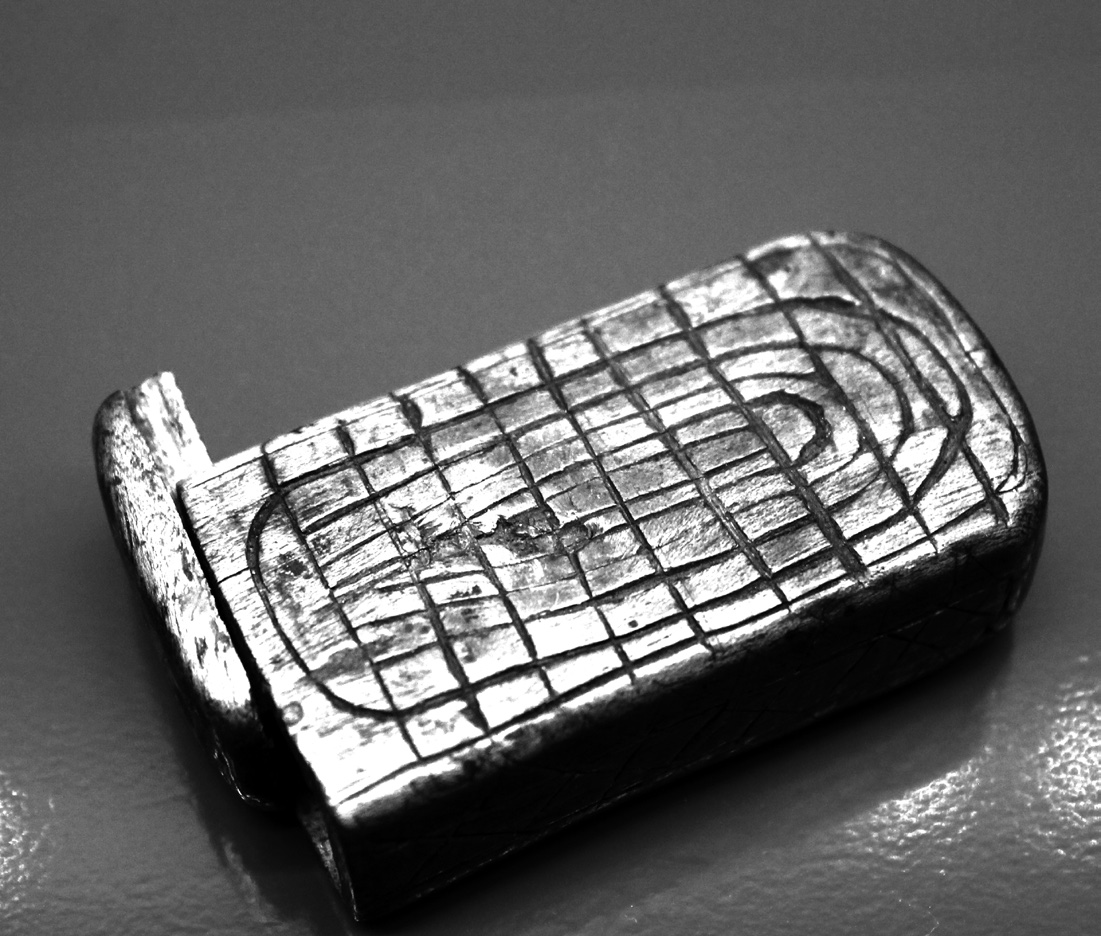
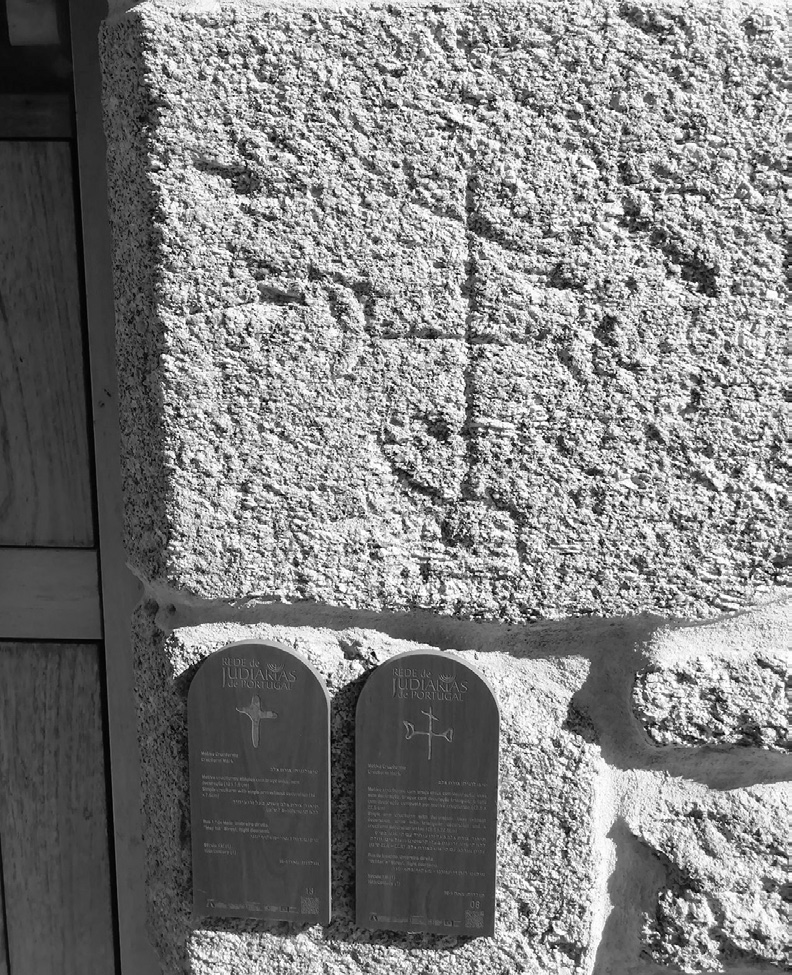
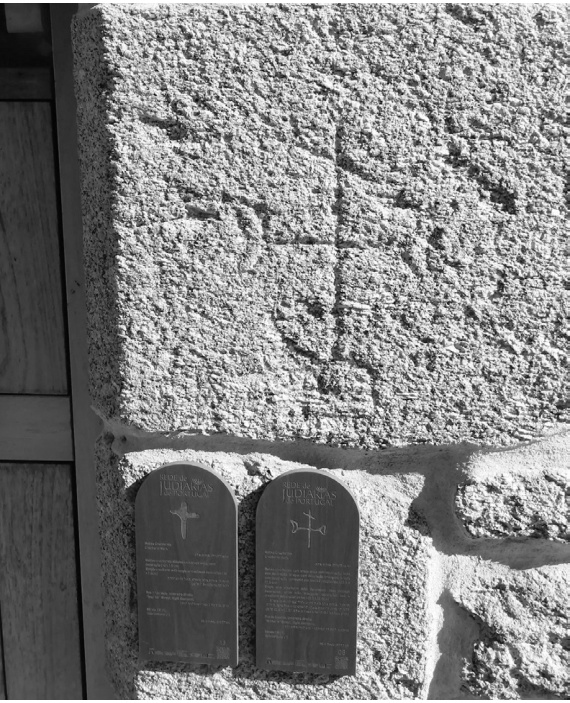
In fact, at Belmonte — as in so many other places in Portugal — the most visible presence of Judaism is its absence.24 A Jewish museum was founded in 2005 (renovated in 2017). There one finds a mezuzah which, instead of being affixed to the doorpost, is portable (see image 1). In the streets, near certain doors, one can see crosses carved in stone (see image 2) — a way used by the Marranos to avoid arousing suspicions about their crypto-Judaism. A square has, since 2018, borne the name of Samuel Schwarz, where his statue is erected (see image 3). Finally, the law that came into force in 2015, granting nationality to descendants of the Sephardic Jews of Portuguese origin — would it not be a last avatar of the Portuguese Marranos?
If possible, I will place the 3 images here (before the epilogue). Thank you.
Image captions:
1 Portable mezuzah, used by the Marranos in Portugal in the 16th–18th centuries. © Museu judaico de Belmonte.
2 Cross sign near house doors in Belmonte. © Museu judaico de Belmonte.
3 Largo Samuel Schwarz with bust, work by Pedro Figueiredo. © João Schwarz.
Epilogue
Beyond the invisible: Marrano memories
We are in the 2000s. The place: remote regions of Mexico, of Peru, and of the Brazilian Nordeste (mainly Pernambuco, Paraíba, and Rio Grande do Norte). The action: numerous inquiries conducted by the historian and anthropologist Nathan Wachtel among the descendants of New Christians from the colonial period. The denouement: the publication of a series of works in which the historian-anthropologist leads us into the labyrinth of memory and the meanderings of the recollections of his witnesses. Page by page, story by story, Wachtel majestically unveils another stratum of Marranism — which would be a Marrano inheritance, conscious or unconscious, and which he designates as “Marrano memory,” composed of “two antithetical movements: on one side, persevering fidelity; on the other, a will to fusion and a search for oblivion (which does not mean total disappearance from the field of memory).”25 Thus these descendants of the Marranos, although still Christians, maintain to this day various rites and practices that they hold to be simple family traditions: endogamous unions, proscription of pork, specific slaughtering of animals, funerary rites, candles lit on Friday evening “in honor of the angels”… But there are also, among Wachtel’s witnesses, those who approach Jewish communal institutions, those who have undertaken a true return to Judaism, even Aliyah, and have settled in Israel; and still others who cultivate a genealogical memory in a cultural mode. It is through art, craft, or poetry that their singular identity is expressed, as these verses extracted from the poem of Odmar Pinheiro Braga, an inhabitant of Recife, show:26
Diaspora
Marrano, Marrano!
When you were born,
The furious Inquisition at the going down of the sun
Covered your face
With the black mantle of night,
And the protective shield of David
Disappeared into exile.
The prayer
Of the next moon
Must heal my wounds,
Like the secret
Counting of stars
That announce
The Shabbat.
Wachtel at the beginning of the 21st century, just as Schwarz at the beginning of the 20th, renders as perceptible as it is sensible the meaning of the unforeseeable resurgence of Portuguese Marranism.
One of the most common mentions, indeed associations, is that of “the expulsions of the Jews of Spain and Portugal” — whereas the Jews of Portugal were not expelled, but converted by force, and even, at the beginning, forbidden to emigrate (see below). Cf. Les Juifs dans l’histoire. De la naissance du judaïsme au monde contemporain, edited by Antoine Germa, Benjamin Lellouch, and Evelyne Patlagean, Champ Vallon, 2011, pp. 266, 291 and 871. Anthologie du judaïsme, 3000 ans de culture juive, edited by Francine Cicurel, Nathan, 2007, p. 332. Encyclopédie de l’Histoire juive, Le peuple juif à travers les âges, Liana Levi/Scribe, 1986, p. 79. Juifs d’Orient, une histoire plurimillénaire, edited by Benjamin Stora, Nal Alouda, Elodie Boufard, Gallimard/Institut du monde arabe, 2021, pp. 84 and 92. It is also found at the ANU Museum, museum of the Jewish people in Tel Aviv, or again in a historical frieze at the Museu Nacional Machado de Castro in Coimbra.↩︎
Samuel Schwarz, La découverte des marranes, Chandeigne, 2015, p. 69.↩︎
Ibid., p. 82.↩︎
See Andrea Zanardo, “Il criptogiudaismo portoghese contemporaneo, Un ipotesi antropologica,” Materia giudaica. Periodico dell’Associazione Italiana per lo Studio del Giudaismo, IV, 1998, pp. 54–60; Natalia Muchnik, De paroles et de gestes. Constructions marranes en terre d’Inquisition, Éditions de l’EHESS, 2014, pp. 53–57.↩︎
The book is published in Portugal in 1925 by the Portuguese archaeologists’ association, of which Samuel Schwarz was a member. The French version, written by Samuel Schwarz the same year, would appear from éditions Chandeigne in 2015 (see note 2).↩︎
Samuel Schwarz, op. cit., p. 109.↩︎
Ibid., pp. 78–79, 109.↩︎
Nathan Wachtel, Preface, ibid., p. 13.↩︎
Maria-Antonieta Garcia, “O Renascimento do judaísmo na Beira,” Revista de estudos judaicos, 2004, p. 49.↩︎
See Yosef Hayim Yerushalmi, “Le massacre de Lisbonne en 1506 et l’image du roi dans le Shebet Yehudah,” in Sefardica. Essais sur l’histoire des Juifs, des marranes et des nouveaux-chrétiens d’origine hispano-portugaise, Chandeigne, 1998, pp. 35–173.↩︎
Miriam Bodian, Hebrews of the Portuguese Nation. Conversos and Community in Early Modern Amsterdam, Indiana University Press, 1997.↩︎
See in particular Arturo Farinelli, Marrano: storia di um vituperio, Geneva, 1925.↩︎
Martine Leibovici, “La rêverie marrane de Jacques Derrida,” in Les marranismes. De la religiosité cachée à la société ouverte, ed. Jacques Ehrenfreund and Jean-Philippe Schreiber, Demopolis, 2014, pp. 253–278.↩︎
Carl Gebhardt, Die Schriften des Uriel Da Costa, M. Hertzberger, Amsterdam, 1922, p. XIX.↩︎
Cecil Roth, Histoire des marranes, translated from the English, Liana Levi, 1992, p. 148; Nathan Wachtel, Mémoires marranes, Seuil, 2001, pp. 249–271.↩︎
See Frédéric Brenner and Yosef Hayim Yerushalmi, Marranes, La Différence, 1992.↩︎
Samuel Schwarz, op. cit., pp. 253–261; Inácio Steinhardt, “Prières,” in F. Brenner and Y. H. Yerushalmi, op. cit., p. 114.↩︎
Ibid., p. 253. Excerpt.↩︎
A traveling exhibition on the Portuguese Jewish diaspora has been offered since March 2022 by éditions Chandeigne. https://editionschandeigne.fr/exposition-diaspora-juive-portugaise/.↩︎
Natalia Muchnik, “La mise au ban de Spinoza : délitement communautaire ou sécularisation du judaïsme,” in Histoire des Juifs. Un voyage en 80 dates de l’Antiquité à nos jours, ed. Pierre Savy with Katell Berthelot and Audrey Kichelewski, PUF, 2020, p. 293.↩︎
Shmuel Trigano, “L’invention sépharade de la modernité juive,” in Le monde sépharade, I, Histoire, ed. S. Trigano, Seuil, 2006, pp. 243–278; Claude B. Stuczynski, “La diaspora séfarade d’origine marrane : une affaire de modernité ?” in S. Trigano, La Civilisation du Judaïsme. De l’exil à la diaspora, Éditions de l’Éclat, 2021, pp. 277–294.↩︎
Nathan Wachtel, Mémoires marranes, op. cit., p. 339.↩︎
F. Brenner and Y. H. Yerushalmi, op. cit., pp. 134–135.↩︎
In 1989, President Mário Soares delivered a speech symbolically asking forgiveness from the Jews for the persecutions of the Inquisition. A whole series of memorials of Portuguese Jewish history would subsequently come into being.↩︎
Nathan Wachtel, Mémoires marranes, op. cit., p. 12.↩︎
Nathan Wachtel, La foi du souvenir. Labyrinthes marranes, Seuil, 2001, p. 369.↩︎