Excerpts from Shalom Libertad ! Les Juifs dans la Guerre d’Espagne 1936-1939 (Shalom Libertad! The Jews in the Spanish War 1936–1939) by Arno Lustiger (Éditions du Cerf, Paris, 1991), with the kind permission of the author.
On August 13, 1936, the “International Committee for Coordination and Information for Aid to Republican Spain” (CICIAER) was founded in Paris. Victor Basch became president of this central body for international aid to Spain. The first conference brought together delegates from nine countries, in Paris, on September 9, 1936. On October 10 and 11, 1936, another European conference was held in Paris, gathering delegates from eleven States. A later international conference of this committee sat in Paris on January 16 and 17, 1937.
…On March 12, 1937, the executive committee of the CICIAER sat in London. Besides important English and French delegations, Germany, Australia, Belgium, the United States, the Netherlands, Norway, and Palestine were each represented by one delegate. On behalf of the Histadrut, Palestine was represented by “Goldie Myerson,” future secretary general of the Histadrut and Prime Minister under the name of Golda Meir. It was decided to found an international hospital comprising a thousand beds and sponsored by the Paris Committee. In addition, the aim was to intensify the sending of children to France.
Victor Basch, president of the International Committee
Victor Basch was president of the International Committee from beginning to end. He was born in 1863 in Bratislava. He was the son of a Jewish journalist. When his father was sent to Paris as correspondent for the Wiener Neue Presse, Victor was three years old. He pursued his studies in Paris and obtained a degree in letters. He was called to teach at the universities of Nancy and Rennes before the Sorbonne called him back to Paris, creating a special chair for him. He was a co-founder, and became, in 1926, president of the Ligue des Droits de l’Homme (League of the Rights of Man), and committed himself to other progressive organizations. During the summer of 1936, he went to Barcelona and took part, upon his return, in the founding of the International Committee. After the fall of the Republic and the occupation of France by the Nazis, he settled in the vicinity of Lyon, in the free zone, and took part in the Resistance by drafting manifestos and pamphlets. Despite his eighty years, he accepted the presidency of the clandestine National Movement against Racism. In January 1944, Klaus Barbie launched a large-scale operation against the Resistance. Victor Basch and his wife, of the same age, were abducted by French collaborators of the Milice and murdered on January 10, 1944.
Paris, center of the volunteers and of Jewish aid to Spain
The Jews of the whole world distinguished themselves by their spirit of self-abnegation on behalf of Spain, struggling for its existence. One finds them in the front line among the initiators and the founders of the aid organizations. Paris was the gathering place of all the volunteers who pressed forward to go to Spain. From there, the future Jewish fighters in Spain were, among others, supplied with what was needed and directed toward Spain. The large Jewish community of France, which had a strong consciousness of its identity — reinforced after the First World War by the political exiles and the émigré workers from Eastern Europe — was active on every terrain of social and cultural life. There were political parties of every tendency: communist, socialist, Bundist, anarchist, Zionist, with various shades from the right to the far left, as well as the apolitical organizations of émigrés from the East. The so-called “patronage” associations offered aid and protection to threatened Jews, notably to political prisoners. The vast social infrastructure of the French Jewish community proved very useful in the organization of aid. The Jewish trade unions of Poland, England, the United States, Palestine, etc., were organized in a similar manner. Although the Jewish communists played a leading role in the recruitment and equipping of the volunteers, other social groups, less politically motivated — such as, for example, the organizations of émigrés from the East and the Jewish religious communities — took part in the aid actions.
The Judeo-Spanish Aid Committee
During the summer of 1937, the Judeo-Spanish Aid Committee (Yiddish-Spanish Hilf-Komitet, JSHK) was founded in Paris. By that moment, there were already many dead, many widows and orphans. Jewish invalids and the gravely wounded were evacuated to France and were in French hospitals. To care for, and moreover to aid, the Jewish volunteers fighting in Spain constituted an enormous task. The money was gathered through the issuing of support stamps, fundraising collections, charity concerts, and donations from individuals and organizations. In many towns of France, local sections of the JSHK had sprung up. In Paris, there was a local urban committee for each “Jewish” arrondissement. These arrondissement committees worked in the 3rd, 4th, 10th, 11th, 13th, 18th, 19th, and 20th arrondissements. The central organizing committee was composed of seven people. The Jewish women were particularly active in this field.
In December 1937, a collection drive was launched. Its aim was to send to Spain three thousand parcels for the international Jewish volunteers. David Diamant recounts that the results of this drive had exceeded all hopes. Each Jewish fighter in Spain had received a parcel. This drive was of importance not only for the supplying of the volunteers but also for sustaining the morale of the soldiers fighting in grueling conditions.
After this drive, which had succeeded so well, sponsorships were organized for particular volunteers and for the units comprising Jewish soldiers. Instead of an anonymous parcel, a personal relationship was thus established.
After the harsh fighting in Aragon and Catalonia in the spring of 1938, the French government declared itself ready to take in two thousand of the gravely wounded and to care for them in French hospitals. A good number of them were Jews. To improve their living conditions, the JSHK undertook a targeted drive among the Jews of Paris and the provinces. The objective was to gather fifty thousand francs.
In December 1937, when the Jewish Botwin unit was at last created — after lengthy hesitations that had lasted a year and a half — this event made possible the merging into a single committee of the many Jewish groups in which, besides the communists, Jewish socialists, Bundists, and Zionists also collaborated. The two hundred Botwin soldiers had to be equipped with pullovers, coats, leather jackets, boots, undergarments, gloves, etc. Thanks to the “pan-Jewish” character of this drive, all the Jewish organizations, sports clubs, cultural associations, associations of émigrés from the East, and Jewish trade unions took part in it. When the money was gathered and the equipment was ready, a large truck set off in April 1938 for Spain, hailed by a sizeable crowd. It bore a banner: “From the Parisian population to the Botwin soldiers. Gathered by the single committee of the three workers’ tendencies: the Jewish communists, the Poale Zion of the left (Zionists), and the Medem association (Bundists).”
The Yiddish newspaper Naïe Presse (New Press), the organ of the Jewish section of the French Communist Party (P.C.F.), played an essential role in the organization and the conveyance of aid for Spain. This newspaper was, at the time, one of the many Yiddish Jewish newspapers of France. It appeared, during the war, clandestinely, and accompanied the Jewish resisters in their struggle against the occupying power.
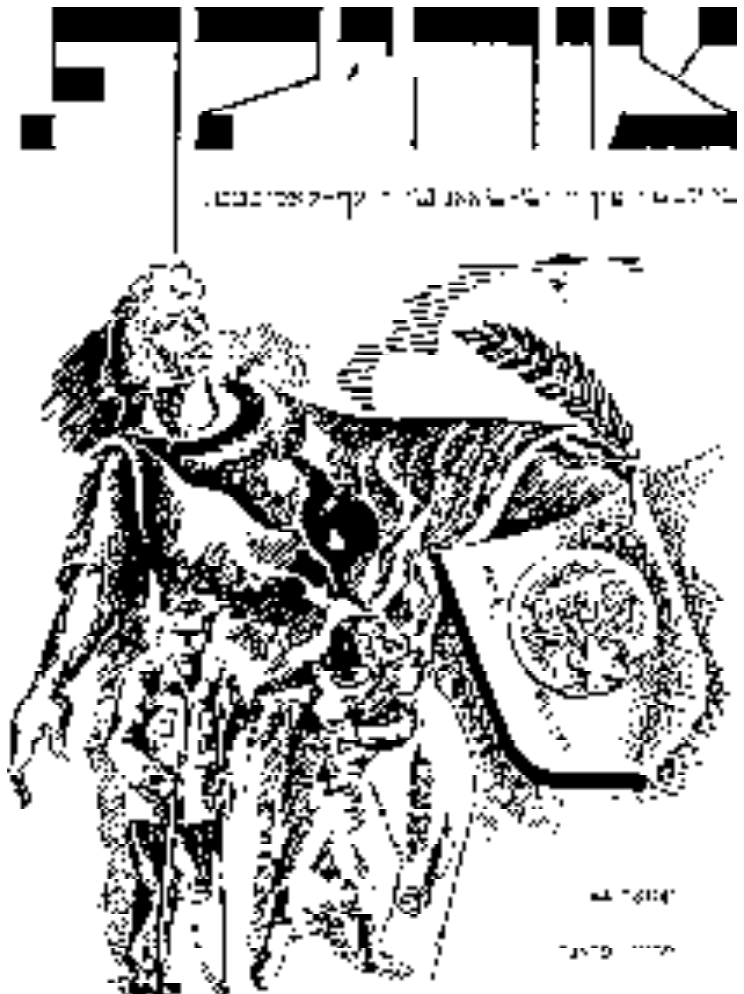
The JSHK had its own organ, the Yiddish bulletin Zuhilf (To the Aid).
The Bulletin of the JSHK
The January 1939 edition carried a quantity of information spread over eighteen pages.
On page 2, one finds an article by the sculptor Nahum Aronson, photographed next to the monument to Pasteur that he had made:
Each time I think back to that unforgettable evening in the hall of the Mutualité, when thousands of people were cheering those two hundred young Jewish men who, a short time before, were still in the Spanish trenches facing the greatest enemy of the Jewish people, Nazism, my heart fills with a feeling of joy and pride. As a Jew, I am proud that my people, after two thousand years of submission, produced so many courageous fighters for whom enslavement is worse than death. For me these fighters are the ones who carry on the work of the Maccabees. In the presence of these heroes who have shown such courage and such a spirit of self-abnegation, I feel very small. But what astonishes and irritates me is that there are still Jews who have not yet understood the grandeur of the gesture these fighters have made for all our futures.
What nobler duty than to aid those who have given their blood, their arms, and their legs for the dignity of the Jewish people?
The most important contribution in the matter of aid was furnished by Gina Medem. She was nicknamed the “Jewish ambassadress,” for she went from country to country to organize and coordinate aid for the interned Jewish fighters from Spain. At numerous mass gatherings in New York and other American cities, she set up, together with the Jewish trade-union organizations, aid committees. The organizations of émigrés from the East likewise took part in these actions. Gina Medem’s report, she having been in Spain from the very start of events as war correspondent for the American Yiddish newspapers, is entitled “The Aid Actions for Spain in the Jewish Quarters of the Whole World.” She writes:
The founding of the Jewish Botwin military unit created a close bond between the Jewish popular masses and the Republic. Obviously, the echo is greater in the cities with a large Jewish population, such as Paris, New York, Buenos Aires, and Antwerp — cities that are kept informed by the Jewish workers’ press. The Jews of the Netherlands, of Sweden, of Denmark, and of England take part in actions on behalf of Spain and have created their own aid organizations for this purpose.
Gina Medem explains the difficulties of Jewish aid to Spain by the growing number of the victims of the antisemitic persecutions in Germany and Poland, the many refugees coming from Germany, Austria, and Czechoslovakia, and the victims of fascism in Romania and Hungary, who too must be aided.
After the fall of the Republic, on April 1, 1939, thousands of Jews and other international brigadists were interned in camps in deplorable conditions in the South of France. An even heavier burden then came down upon the aid committees, particularly for the Jews. The great majority of the Jewish internees could not in fact be repatriated to their lands of origin. In Germany, in Austria, and in Czechoslovakia, the Nazis were in power, and in Poland, Romania, Hungary, and other countries, the fascistic regimes would have prosecuted those who returned home.
The central Jewish aid committee was at work in Paris while the Botwin committee was active in the United States. The two organizations were in close contact with each other and with the internees of the camps of Gurs, Le Vernet, Argelès, Les Milles, and others.