EXCERPTS OF TEXTS
ON THE UPRISING OF THE WARSAW GHETTO
Contents of this montage
- Emmanuel Ringelblum — Chronicle of the Warsaw Ghetto (“The construction of the ghetto”)
- Michel Borwicz — The Warsaw Ghetto Uprising (“Slaves for industry”)
- Michel Borwicz — The Warsaw Ghetto Uprising (“The spread of the clandestine press”)
- Marek Edelman and Hanna Krall — Memoirs of the Warsaw Ghetto (“The creation of the Jewish Combat Organization”)
- Marek Edelman and Hanna Krall — Memoirs of the Warsaw Ghetto (“The first major action of the J.C.O.”)
- Bernard Mark — The Warsaw Ghetto Uprising (“April 20, the fight”)
- Bernard Mark — The Warsaw Ghetto Uprising (“The last organized battles”)
- Isaïe Spiegel — poem “Give Me the Memory”
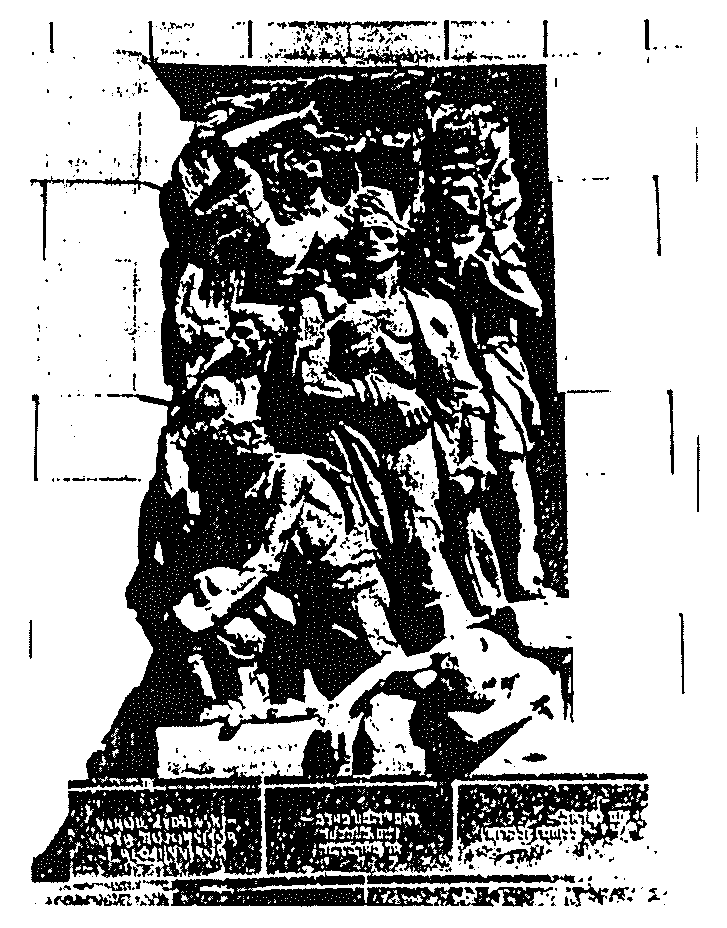
- Monument to the Heroes of the Warsaw Ghetto (photograph)
- Michel Borwicz — The Warsaw Ghetto Uprising (“The suicide of S. Zygelbojm”)
The construction of the ghetto
“The construction of the Warsaw ghetto took up the greater part of the year 1940. At first, the ‘Jewish quarter’ was placed under quarantine and surrounded by barbed wire and palisades. But, in September, a wall nearly 2.50 m high began to rise around the Jewish quarter (it was not completed until the summer of 1941). When it took shape, it enclosed a rectangle nearly 2 km long, isolating, in addition to the medieval ghetto, the long, straight streets of the industrial quarter north of the railway station. To the northwest, the Wall almost touched the Vistula; it was crossed by the great railway line leading to Poznania and Berlin. At first, the ghetto comprised 1,500 buildings grouped into about a hundred blocks. In October 1940, the 80,000 Christians living in the quarter under quarantine had to leave it within two weeks; their dwellings were occupied by the 140,000 Jews who had resided outside this quarter. The transfer to the ghetto was an event foreseen and dreaded. What people feared above all was being cut off from the place where they earned their living. (Nearly half the Jews of Warsaw were artisans, a quarter were engaged in trade, another quarter practiced the liberal professions, about 5% were industrial workers.) How were they going to live? The only hope was that this ghetto would be an open ghetto, that is, that its inhabitants could leave and enter freely through its twenty-two gates. On November 15, 1940, the Warsaw ghetto was condemned. Guards were posted on both sides of the Wall, Jewish police on the inside; those who could justify the absolute necessity of their movements could obtain special passes (Ringelblum mentions the difficulties the doctors of the Jewish hospital, located in the ‘Aryan’ quarter of Warsaw, had in obtaining passes). Meanwhile, the ‘phony war’ that had followed the invasion of Poland had ended in disaster. Germany had set out to conquer the world. The Netherlands and France were swiftly invaded by the German army. The British had to count themselves lucky to be able to evacuate Dunkirk. At the mercy of the Third Reich, Western Europe was governed by puppet governments, which readily acquiesced to the persecutions of the Jews demanded by the Germans. In Eastern Europe, the massacres of Jews began with the invasion of Poland. Now Western Europe’s turn had come. The Vichy Government promulgated a ‘statute of the Jews,’ antisemitic measures were put into effect in the Netherlands, German troops entered Romania, the turn of the Balkan countries was approaching. Everywhere the Germans installed themselves, the Jewish badge, forced labor, the Jewish quarters and the ghettos, and finally deportation and death followed one another in an immutable sequence. When the Jews of Warsaw were shut up in the ghetto, the situation seemed hopeless. They knew, as RINGELBLUM repeats again and again: ‘Only a miracle can save us: the swift end of the war.’ A few optimists believed in that outcome. The others expected the worst.”
Excerpt from: Emmanuel RINGELBLUM: “CHRONICLE OF THE WARSAW GHETTO” Éditions Robert LAFFONT - Pages 83 to 85.
Slaves for industry.
“The ghetto was an integral part of the economic machinery of the Nazi war apparatus. Germans, such as Toebbens, set up, within the ghetto itself, gigantic workshops where military and civilian clothing was made from excellent-quality fabrics stolen by the Germans throughout Poland. A German from Danzig (Gdansk), Schultz, who before the war had done business with Polish Jews, opened several workshops on Nowolipie Street where leather and fur were worked (…) A commercial company composed of Germans, of Volksdeutsche (ethnic Germans), of Poles and of Jews, undertook the manufacture of brushware. The raw material was supplied by the German authorities. The output was generally used for military needs. (…) In these factories, only Jews from the ghetto worked. Their number rose to several tens of thousands. At Toebbens’s, the workforce exceeded, at the start of 1943, 15,000 workers. Wages were derisory. Each worker was entitled to 2 liters of soup a day (…), his condition was that of a slave (…). Some workers — about 3,000 to 4,000 — were employed in the ‘Aryan’ zone, on the railway, in war factories, in military installations. Each day, at dawn, they gathered not far from the gates of the ghetto. From there, a military escort led them to their workplace, then brought them back in the evening. Barter of goods was carried out through these workers. (…) By all sorts of tricks, they smuggled out objects that they exchanged in the ‘Aryan’ zone for articles unobtainable in the ghetto.”
Excerpt from: Michel BORWICZ “THE WARSAW GHETTO UPRISING” - Éditions JULLIARD Archives Collection - (1966)
“The spread of the clandestine press”
“DROR (the youth movement of the socialist party POALE-ZION), the most dynamic of the organizations of the Warsaw ghetto, had to its credit a ‘Hakhshara’ (agricultural training) with 350 participants, the founding of the clandestine secondary school, of a library and of a drama circle. Through its special emissaries, it maintained liaison with the other ghettos; it published clandestine periodicals: Dror (‘Freedom’) and Yédiess (‘News’), which were added to those of the Poale-Zion party: Unzer Wèg (‘Our Path’), Befrayoung (‘Liberation’) and Nowe Tory (‘New Tracks’). The scout movement Hashomer Hatzaïr (of Zionist-socialist obedience) placed, in the education of its members, the emphasis on personal valor and courage. Its mutual-aid activities were among the finest in the ghetto. It clandestinely published Negèd hazérém (‘Against the Current’), the monthly El-Al (‘Upward’), the weekly news bulletin Jutrznia (‘Dawn’), the periodical Przedwiosnie (‘Early Spring’), as well as a daily bulletin (edited by S. Braslau) giving news of the war fronts (thanks to the radio receiver hidden at M. Anielewicz’s). The Gordonia association (likewise of Zionist-socialist obedience) issued the periodicals Ofsdauyère (‘Endurance’) and Slowo Mlodych (‘The Word of the Young’), which were added to the sporadic publications emanating from the Directorate. The left Poale-Zion Party which, despite all obstacles, celebrated the workers’ festivals and the anniversaries, published the periodicals Prolétariché Gedank (‘Proletarian Thought’), Youduent-Rouf (‘The Call of Youth’), Avant-garde (‘Vanguard’) and Nasze Haslo (‘Our Watchword’). The Zionists of the center (with their youth organizations: Hanoar Hatzioni and Akiba) put out Unzer Hofnoung (‘Our Hope’). The youth organization of the ‘revisionist’ party (Zionists of the right) Betar advocated the idea of resistance in its publications Magen David (‘The Shield of David’) and Hamédinah (‘The State’). Moreover, a place of choice belonged to the socialist party Bund (hostile to Zionism), which kept in contact with the Polish Socialist Party, and had its own youth organization: Tsoukunft and its scout movement SKI, as well as numerous press organs; it published Biolétine (‘The Bulletin’) and Youguent-Stimmé (‘the Voice of Youth’), a theoretical organ Tsait-fragen (‘The Problems of the Time’) and, from July 1941, the periodical Za nasza i wasza wolnosc (‘For our freedom and yours’). Thanks to peddling carried out by Polish socialists, this last was distributed even outside the ghetto, especially in intellectual and working-class circles. The communists, disoriented and compromised by the German-Soviet pact, long remained scattered. The turning point came for them at the beginning of 1942, with the founding of the clandestine P.P.R. (Polish Workers’ Party) and its G.L. (People’s Guard). From January 1942, the P.P.R. weekly that appeared in the ghetto, Morgen-Fraïheit (‘The Dawn of Freedom’), became a daily. Arrests followed by execution decimated not only the militants and the people who ran the clandestine press, but also its peddlers. Apart from the individual arrests carried out at various times and moments, the German police made a surprise raid into the ‘Jewish quarter’ during the night of April 17 to 18, 1942: torn from their homes, several dozen people were executed on the spot, in the streets of the ghetto. The date of this massacre indicates that it was already, if not the prelude to the ‘liquidation,’ at least a ‘cleansing.’ Meanwhile, most of the clandestine organizations listed above had formed, in March 1942, the ‘Antifascist Bloc,’ with a view to preparing for an armed response. It was then that the genocide came down upon the Jewish community of Poland, already tried by three years of inhuman oppression.”
idem - Pages 21/24
The creation of the Jewish Combat Organization
“Around October 20, a coordinating commission is created, in which representatives of all the existing Jewish parties take part. Our representatives are Abrasza Blum and Berek - Adam Sznajdmil -. At the same meeting, the command of the Jewish Combat Organization (JCO) is formed, with Mordechaï Anielewicz (Hashomer) as commander. Marek Edelman represents the Bund. The Coordinating Commission delegates to the ‘Aryan’ side Doctor L. Fajner (pseudonym Mikołaï) of the Bund. At the same time the presidium of this Coordinating Commission is set up and a Propaganda Committee in which we are represented by Abrasza. Since the ghetto is divided into different sectors, practically cut off from one another, the Jewish Combat Organization must adapt its work accordingly. We take charge of the brushmakers’ sector (Grylak), of that of the Toebbens Workshops (Paw), and of that of Prosta Street (Kersz). We manage to create a few combat groups which are made up essentially of members of the SKIF. Thus, in the central ghetto, B. Pelc and Bernard Goldsztein take the lead of two groups of five fighters; Jurek Blones and Janek Bilak do likewise at the brush factory, A. Fajner and N. Chmielnicki at Schultz’s and Welwl Rozowski at Roehrich’s. Once again, we build a large organization, but this time, we are no longer alone and we unite our efforts. Once again, the question of weapons arises. There are practically none in the ghetto. It must not be forgotten that in 1942 the Polish resistance is still in its cradle, that the maquis is known only by hearsay and that the first armed action will not come until March 1943. There is therefore no cause for surprise if our efforts with the Government Delegation to acquire weapons, and with other organizations, meet with many difficulties and yield few results. We nevertheless manage to obtain a few revolvers from the People’s Guard. Two assassinations are then carried out within a month: on November 29 against Lejkin (Commander of the Jewish police) and on November 29 against J. First (Representative of the Jewish Council at the Umsiedlungsstab). The Jewish Combat Organization becomes popular. Other terrorist actions are organized targeting Jewish foremen particularly savage toward the workers. During one of these punitive expeditions, at the Hallman carpentry workshops, German Werkschutz capture three of our fighters and lock them up at the police station. The following night, the group of the Roehrich sector, commanded by G. Frysdorf, disarmed the German guards and freed the prisoners.”
MAREK EDELMAN and HANNA KRALL
“MEMOIRS OF THE WARSAW GHETTO”
- Éditions du Scribe (1983)
Excerpts pages 46/47
The first major action of the J.C.O.
“At the end of December 1942, we receive our first delivery of weapons from the AK Command. There are very few of them: ten revolvers. This nevertheless allows us to prepare our first major action. We set it for January 22: it is to be an operation of revenge against the Jewish police. But on January 18, 1943, the ghetto is sealed off and the second great roundup begins. This time, the Germans cannot carry out their plans with impunity. For the first time in the ghetto, four entrenched groups resist them with weapons in hand. The Jewish Combat Organization receives its baptism of fire in a great street battle at the crossing of Mila and Zamenhof Streets. We lose the best there. The commander of the JCO, Mordechaï Anielewicz, gets out by a miracle and thanks to his heroic attitude. This battle proves too costly. We are not ready for it. We do not have the proper weapons. So we change tactics and four major skirmishes then take place in the buildings at 40 Zamenhof Street, 44 Muranowska Street, 34 Mila Street and 22 Fanciszkanska Street. In the Schultz workshops, the partisans attack the S.S. who are taking part in the roundup. Engaged in this action, our comrade A. Fajner meets his death there. One of our combat groups is taken by the Germans even before having received its weapons, and it is led to the Umschlagplatz. At the door of the wagon, B. Pelc speaks a few words. These words are so powerful that not one of the sixty people who are with him gets into the wagon. Van Oeppen, the commander of Treblinka, shoots them all down himself on the spot. Pelc’s group shows the Jews that everywhere, under any conditions, one can and must oppose the Germans. Of fifty combat groups, only five took part in the January clashes. The others, which had not established quarters, were caught off guard and could not reach the weapons depots in time.
Once again, as during the first great roundup, we lose four-fifths of the Jewish Combat Organization.”
MAREK EDELMAN and HANNA KRALL “MEMOIRS OF THE WARSAW GHETTO” - Éditions du Scribe (1983) pages 48/49.
April 20, the fight
“On April 20, the fight unfolded in four different places: Muranow Square, in Mila and Sapiezynska Streets, on the grounds of the brushworks, on those of the ‘shops.’ The Germans had set up light-artillery batteries on the outskirts of the ghetto, at Krasinski Square, not far from Nowiniarska and Bonifraterska Streets. From the morning, Stroop’s detachments launched the attack on the blocks of buildings at 7 and 9 Muranow Street and on the building that stood at the corner of Muranow and Nalewski Streets. The flags riddled with bullets still flew on the roofs. A shipment of weapons had reached the insurgents through the tunnel that connected number 7 to number 6.
The fighting was fierce. Stroop himself acknowledged it in his report, in which he insisted on the presence of Polish patriots in the ranks of the Jewish fighters. He also stated that a severe struggle took place around the flags that had been raised over the Jewish positions: a German officer, Untersturmführer Dehmke, was killed there. Stroop avenged this first German officer killed on the territory of the ghetto by having about a hundred Jews executed. The insurgents were nevertheless forced to retreat. Some of them reached 6 Muranow Street, carrying the body of one of their own, Leib Rodal. This first group of fugitives reached the Otwock line. The enemy, having discovered its existence and pursuing it, it had barricaded itself in an abandoned villa, in the forest, which was soon surrounded by the German gendarmes and the navy-blue police. There was a fight. The Hitlerites had the last word. The Jewish fighters died with weapons in hand. The local gendarmerie reported this on April 23, 1943. Seven men had remained on Muranow Street. They left it on the 21st, taking care to block the tunnel. Arriving at number 6, they reached the attics and hid there waiting for the liaison agents who would have led them to the forest. But they were denounced by a tenant of the building, a certain Rysiek, an agent of the Gestapo and a member of the organization ‘Miecz i Plug’ (The Sword and the Plow). On April 22, the gendarmerie and the navy-blue police surrounded the building. The insurgents defended themselves. Two or three managed to flee across the roofs; the others perished. Some groups of defenders of Muranow Square had been able to withdraw to Nalewki Street. The grounds of the brushworks were an irregular square bordered, on the wall side, by Bonifraterska and Swietojerska Streets meeting at a right angle and, on the inside, by Franciszkanska and Walowa Streets. There was there a separate sector held by combat groups of the J.C.O. and by ‘free’ groups. The population had been prepared for the fight. During a meeting, Slawek, a representative of the P.P.R., had expressed what was on everyone’s mind: the events of July will not be repeated; every shelter must turn into a fortress and, if need be, into a tomb; children will no longer be torn from their mothers and husbands from their wives… For a long time the underground passages and corridors had been arranged. On April 20 the non-combatant population was able to hide easily. Only the armed resisters remained in the courtyards. The little square onto which Walowa Street opened the entrance gate of the ghetto had been mined. Its access could be watched from the observation post installed on the third floor of number 3 Walowa Street. Three combat groups had posted themselves on the third and fourth floors of the buildings running from 28 to 38 Swietojerska Street. Stroop, present on the spot, launched the attack at three o’clock. Three hundred men entered the little square. The mine exploded. There were twenty-two dead. The rest of the troop fled. It came back two hours later but in scattered order and hugging the walls. It was met with grenades and Molotov cocktails. It withdrew again, leaving other dead on the ground. The enemy then concentrated a powerful fire on the insurgents’ positions. The insurgents replied with their feeble means. And an extraordinary thing happened: the Hitlerites sent toward the fighters envoys bearing white cockades, who proposed to stop the fight for a quarter of an hour. It is true that at the same time S.S. were setting fire to houses. The request was rejected. The fusillade resumed harder than ever. Stroop’s men, realizing that they could not overcome the ghetto by direct attack, undertook to reduce it by systematic artillery fire. The cannon could be heard a dozen kilometers away. Fires that no one thought of extinguishing filled the sky with thick smoke. The struggle was becoming more and more unequal. The insurgents could not have held their positions for long; they would have been doomed to total annihilation if the People’s Guard had not, on the other side of the wall, attacked the Germans and forced their cannons to fall silent. Night was coming. Stroop stopped the fight: he was afraid of the dark. The insurgents spent the night of April 21 to 22 changing positions. After evacuating part of the non-combatant population, they went to settle at 30 Franciszkanska Street, in the shelter of the supply service where a P.P.R. combat group was already to be found. A detachment commanded by Jurek Blones of the Bund group covered the movement. A well-aimed shot fired by the fighter Romanowicz had shattered the enemy searchlight. An enemy patrol had been decimated. Only one soldier of the J.C.O., Berek Szaïdmil, had been hit by a grenade. Many insurgents had met their death in these fights: Renia Niemiecka, Michel Klepfisz… Young people had distinguished themselves: Szanan Lent, son of the tram-worker Hersz Lent, himself an insurgent, Lusiek Blones, brother of Jurek. Lusiek, during a fight, had caught a German grenade in mid-flight and thrown it back at the Hitlerites. The very young Szlamek Szuster was part of the group of the best marksmen. All, men and women, were animated by the most complete spirit of sacrifice. They fired from the roofs. A witness recounted this: a Jew, posted behind a chimney, was firing on the Germans; he fired for two solid hours; finally his body, struck mortally, fell from the roof. During this second day the insurgents held Mila Street. They thus covered the sector lying between Swietojerska Street and Muranow Square. They constituted a threat to the Hitlerites. So Stroop entrusted the task of attacking Mila Street to seasoned units. The fights took place in the afternoon of Tuesday, April 20. The combat groups of the JCO were composed of politically aware elements, of metalworkers, weavers, tailors, dockers, ‘red’ athletes. To mark clearly the meaning they gave to their fight, they had hoisted a red flag in a building: Stroop will boast on the 21st to Slobonick of having been able to remove this trophy. On Mila Street, nine bunkers resisted to the death. The details of this struggle have unfortunately not reached us. The grounds of the ‘shops,’ the ‘productive ghetto,’ comprised Nowolipie, Nowilipki, Smocza Streets and the even numbers of Leszno Street. The odd numbers of this last street were on the ‘Aryan’ side: the wall cut the thoroughfare in two lengthwise. The sector had the form of a rectangle slightly inclined from east to west on the long sides (Leszno Street to the south, Nowilipki Street to the north) and cut in two along its greater dimension by Nowolipie Street. It enclosed the Toebbens, Schultz, Hallmann and Roerich factories. (…) On the 19th, nothing had happened. The Germans had undertaken nothing. All remained calm. The industrialists Toebbens and Schultz were still trying to convince the Jews that it was in their interest to let themselves be deported. Wasted effort: there was not a single volunteer for the transport. The entire population was living underground. The JCO was watching. The Germans could let themselves be deceived by the calm that reigned over the ‘shops’: it was only the calm that precedes the storm. The JCO was watching, it had its plan. In the night of the 19th to the 21st, the final preparations are made. The munitions were distributed. Roza Rosenfels spoke to the (…). On the morning of April 20, there was still no German detachment on the grounds of the ‘shops.’ Toebbens lived in the illusion that the Jews would end up taking of their own accord the road to the embarkation square. At six o’clock in the morning, music in front, followed by tanks, a German column was parading along the side of Leszno Street. The surprise occurred. Setting out from numbers 74 and 76, passing over the wall, gunshots, Molotov cocktails, grenades, threw disarray and death into the German column. Like a trail of burning powder, the action thus set off spread from building to building. It extended from number 42 to number 82, to the east, as far as Zelazna Street. A witness expressed himself thus: ‘The hand grenades fell thick from the windows giving onto the street. The wounded soldiers were heard moaning. On both sides, the fire became violent. Our people fought as best they could. The women passed the grenades. Among us we were sternly resolved. I watched the calm faces of the women, faces without tears, without fear, the faces of people resolved to die with dignity. I will never forget either that moment or those faces…’ Eight Germans had been killed. At the signal given by Leszno Street, the territory of the ‘shops’ bursts into flame. A Hitlerite column was assailed by the groups of Smocza Street. The tank that preceded the column went up in flames. Stroop reacted violently. His detachments finally got the better of the fighters of Leszno and Smocza Streets. Mad with rage, they blew up the houses and the cellars and they shot their inhabitants. Toebbens, Schultz and Hoffmann took fright: they feared the vengeance of the insurgents, they feared for their machines and for their merchandise. They intervened with Stroop to make him put a stop to the destruction and pledged to supply, for the following day, April 21, 4,000 to 5,000 workers fit for departure. Stroop accepted the bargain but he was at pains to stress that if this pledge were not kept, he would do to the ‘shops’ what he had done to the brushworks. It is just to cite here those of the fighters of Leszno and Smocza Streets who knew how to set an example: Ryva Szmutke, Eliazar Geller, who were the first to throw the explosive bottles and the grenades onto the marching column, Isaac Lewski, Sewek Nulman, Ignacy Podolski, Tauba Davidowicz, Wolf Rosowski, Cwi Rotman, Alessandrowicz. Others behaved with just as much heroism: they carried their names into their graves, suffering and time have effaced them from the memory of the few survivors. One of these unknown heroes was fighting on Smocza Street. He came out onto the gateway of his building and shouted, raising his hands: ‘Number 5 Smocza Street surrenders!’ The Hitlerites, seeing and hearing this, advanced openly toward the house; when they were within good range, the fire from the windows decimated them. They had however had time to shoot down the one who had caused their loss. Another fighter came out onto the sidewalk; the Germans having seen him, he fled, plunged into the gateway of his building, climbed the stairs four at a time, pursued by an officer and three SS. And all at once, he vanished from the eyes of his pursuers; he had slipped into a hole with extreme rapidity. The Nazis, uneasy, hesitated to go further.”
Bernard MARK
“THE WARSAW GHETTO UPRISING”
Excerpt from pages 146 to 153:
The last organized battles.
“Berlin was anxious to see things dragging on. Himmler telegraphed Stroop to finish as quickly as possible. Stroop decided to burn everything, the residential buildings and the armament factories themselves. He also had the shelters blown up with dynamite. The resistance continued amid the flames. No one laid down their arms. No one surrendered at the embarkation quay. In the gateway of a burned house, 39 Nalewki Street, there were dead, there were wounded. One of the latter stirred and spoke: ‘I jumped from the window, I’m in pain.’ He had a broken spine, a thread of blood was running from his mouth. He asked: ‘Tell me, has Tunis been liberated?’ He asked again: ‘The Russians, when will they arrive?’ Another wounded man broke in: ‘What does it matter to you? — It will be easier to die,’ replied the dying man, who expired soon after. Despite the fires and the explosions, contact was maintained between the different combat groups of the J.C.O. This was confirmed on April 24. There was fighting at 41 Nalewski Street, 74, 76, 78 Leszno Street, 67, 68 Nowolipki Street. There was fighting and the evacuation of the population toward the least threatened shelters was carried out. Toward the end of the day, a German detachment invaded Niska and Muranow Streets. It removed the goods of the Wetterfassung, then it set fire to the buildings. The insurgents did their duty well, but they could not master the situation; they were dealing with an adversary who could only prevail by numbers, armament and combat experience. They had to withdraw and fall back to Nalewki Street, where they joined a local group. The fire was raging. The German artillery and air force pounded the ghetto. The General Staff of the insurrection ordered a shift from the tactic of open struggle to that of guerrilla warfare, this second tactic requiring a systematic defense of the shelters. The groups no longer went out except at night. The men were dressed as Germans; they had their feet wrapped in rags. Their mission was threefold: to gather intelligence, to destroy as many Germans as possible. It was thus that German patrols were decimated in Kurza, Mila, Dzika, Sczisliwa, Swietojerska, Walowa and Leszno Streets. The night was full of gunfire. On the 25th, a painful loss occurred for the J.C.O.: a group of liaison agents heading toward the ‘Aryan’ side ran into an enemy detachment and was annihilated in an unequal struggle. From the 25th to the 27th the defense of the shelters grew fierce. Ordered by the J.C.O., often spontaneous, it bore witness to the will to resist of all. On the 26th, Stroop threw new forces into the battle. He noted in his report of that day: ‘All the units without exception report the resistance encountered. It appears more and more that the most determined of the Jews and the Polish bandits have now intervened in the struggle.’ Three hundred sixty-two Jews were killed. On the 27th new fights took place in Nowolipki, Leszno, Nowolipie and Niska Streets. They were especially hard at numbers 39, 41 and 40 of Nowolipki Street, whose shelters the Germans had learned of following a denunciation. In the shelter at number 40 the Jews had only three pistols: they resisted as long as they could. When the Germans entered the shelter, some of the fighters poisoned themselves with cyanide while Hélène Sterling, a woman of 36, threw herself at the Hitlerites with a club in hand and was killed at point-blank range. The survivors were murdered or taken to the embarkation square. At the same moment the shelters at 67 and 69 Nowolipki Street were falling. On Leszno Street the shelter at 74 was flooded. The insurgents were able to change place several times. It was during these fights that a heroic death was met by Roza Rosenfeld, Hersz Kawe, Halinka Rochman, Adek, Roza’s brother, Zocha Brzezinska, Tosa Cebularz, Sara Kleiman, Lew Rudnicki, Szymon Heller, Ryba, Aron Alter, Chawa Brander, Leib Czerniakower, Chana Plotnicka. The latter, a liaison agent, was killed at the moment she was crossing the wall. At Toebbens’s and Schultz’s, again on April 27, the deputy directors of the factories tried once more to persuade the workers that it was in their interest to present themselves voluntarily for departure. Jewish fighters appeared in the courtyard where the assembly was being held; they threatened with their weapons the zealous servants of the Germans. The workers scattered. The fusillade broke out between the Jewish fighters and the German soldiers mounting guard around the courtyard. The unforgettable leader that was Jakub was killed during this operation. To reduce the posts on Niska Street, Stroop committed 320 soldiers and officers. There again the Jews resisted to the last cartridge then, not wishing to fall alive into the hands of the Hitlerites, they threw themselves from the windows and the burning balconies, their mouths full of curses and insults addressed to the Germans, to the Führer and to his soldiers. On one balcony a woman appeared carrying a child in her arms. She cried out, addressing Stroop, who was in the vicinity: ‘I do not ask you for mercy but remember that you will not escape punishment for everything you are doing today.’ The fire had reached the balcony. The woman took the child in her arms and, with a cry, threw herself onto the pavement of the street. At Muranow Square one of the last groups still fighting managed to cross over to the ‘Aryan’ side. It was a relatively well-armed group. Polish patriots had helped in its breakout. According to Stroop’s account, it was composed of 120 fighters with 3 rifles, 12 revolvers, 100 hand grenades, 27 German steel helmets, 300 cartridges. Stroop was informed of this movement by an anonymous letter. He was very worried by it: the presence of this Polish-Jewish group outside the perimeter of the ghetto could only raise fears of that extension of the struggle which the Germans and the men of the London Delegation so dreaded. Stroop entrusted the lieutenant of the Schupo-Diehl with the mission of annihilating this dangerous detachment. In the fight that ensued, 24 insurgents were killed, others were taken prisoner, others managed to save themselves. The police carried out arrests of suspect Poles. On Wednesday, April 28, the tenth day of the insurrection, the fights unfolded chiefly at the northern and southern extremities of the ghetto, near Sapiezynska Street, and on Leszno Street, where groups had re-formed. In the north the Germans lost men. On Leszno Street, the situation had in part evolved. The personnel of Toebbens, composed of petty-bourgeois elements who could no longer bear suffocating in the shelters, had let itself be taken and deported. The properly working-class element, which had complete confidence in the J.C.O., continued to hide and to resist. At numbers 76 and 78 of Leszno Street, in Schultz’s workshops, the fighters and the workers fought fiercely, to such a point that Stroop found himself obliged to send reinforcements to overcome the resistance of the Jews. In the night of the 28th to the 29th the German air force carried out merciless bombardments. On the 29th, Schultz’s workshops were still resisting. Stroop, in his report, attacked the German industrialist who had done nothing, he wrote, to carry out the evacuation orders that he, Stroop, had given as early as the second day of Easter. During these fights of April 28 and 29 one hundred and ten Jews had met their death. Other fights had taken place on the grounds of the ‘shops’ and on Nowolipki Street, in Hallmann’s workshops, at numbers 53 and 82: one hundred and eight Jews had been killed. On Leszno Street resistance was becoming difficult against an enemy superior in every respect. The physical strength of the insurgents was running out. In agreement with the People’s Guard, it was decided to evacuate part of the fighters. The communist Franciszek Leczycki mounted the operation, which was carried out under the direction of the lieutenant of the People’s Guard Wladyslaw Gaïk (‘Krzaczek’). Forty men were led by the underground route to the corner of Ogrodwa and Zelazna Streets, from where they reached the tracks of Lomianki: they were to wait there for the rest of their group before joining the partisans. The passage through the underground had been arduous: the sewers were largely flooded; on the viscous waters floated corpses. When this sinister passage had been accomplished and it was a matter of emerging into the free and pure air beneath the stars, Regina Fuden and Salomon Barzynski set off again. They were never to be seen again. Stroop very quickly learned of this expedition. He had sewer vaults blown up and exits out of the ghetto sealed off. The road to freedom was momentarily cut. On April 30, the sewer mouths were guarded militarily. Searches took place in the surroundings of the Traugutt Fort. On the ‘Aryan’ side, observers expressed their admiration for a struggle carried on under such extraordinary conditions. They thought, however, that this struggle was nearing its end. ‘The fire continues to spread,’ wrote Ludwik Landau, ‘the armed resistance weakens little by little, exhausted, before enemy forces vastly superior.’ And the same chronicler added that since the festivals there had no longer been any unity in the struggle, that there was no longer any liaison between the positions still holding out and that the groups, each on its own side, thought only of crossing the cordon of German forces. These last observations are not in conformity with the truth of history. At the end of the twelve days of incessant and very hard fighting, the unity of organization and command had on the whole been maintained. Even in the defense of the shelters, immediate as it often had to be, there had existed a tactical coordination. For all the reasons that hold to the conditions under which the insurrection had been prepared and under which it unfolded, there could not exist a centralization of command and a unity of execution such as can be achieved in an ordinary army. Between the General Staff, which kept to the central ghetto, on Mila Street, and the sectors of Leszno Street and its surroundings, the liaison could only be loose with the groups defending the shelters. But the dispersion of forces was only apparent. All converged toward the same goal; the same spirit animated them all; each knew why he was fighting; the ideological preparation of the insurrection, patiently undertaken, had brought about the rising of the greatest number and realized that moral unity which allows each one to know what he has to do as a function of the work undertaken by all. The antifascist Zygmunt Frydrych who, on April 28, reached the ‘Aryan’ side with a J.C.O. group by taking the underground route, declared that the group that had remained on Leszno Street had itself decided to pursue the struggle despite conditions becoming harder and harder. And it is true that if by day the streets belonged to the Wehrmacht, by night it was another matter. The armed detachments of Jews made their sorties, attacked the German sentries and patrols and transmitted the orders to the population of the shelters. The insurrection was not dead. The observers became convinced of this on May 1.”
“THE WARSAW GHETTO UPRISING” (Bernard MARK) Excerpt from Pages 168 to 174
Isaïe SPIEGEL
Born in 1906 in Lodz (Poland), has lived in Israel since 1951. He made his debut in the 1930s, was a bookkeeper in the Lodz ghetto. Deported to Auschwitz and to Terezin. His only collection — for Spiegel is first of all a great novelist — is a moving testimony to the universe of separation, of annihilation, but also of the revelation of the human, whose secrets and irreducible presence he recovers, through poetry, even in hell. Work: And There Was Light, Lodz, 1949)
GIVE ME THE MEMORY:
Of so many dead give me the memory, Of all those who have turned to ash, Of a generation give me the memory Its last fury, its last sorrow.
Of hair singed by the red flames, Of naked flesh in the fire of hell, Of so many dead give me the memory And give me, sacred, the avenging words.
And the eyes by the millions shut in with you, And the prayer stifled in the mouth, Of so many dead give me the memory, Of the furnace and the gallows and the horror.
Hands by the millions in the wind pursue me Setting the nights ablaze, the frightened dawns, Of so many dead give me the memory That I cannot weep with words.
For mute are the words like the sands When into them the blood has slipped, Of so many dead give me the memory And their breath upon the path of the tortured.
Let upon my lashes at least one tear Bead from all those open eyes, Of so many dead give me the memory With the deeps of all the seas.
Beheaded, lo, a whole people has passed That was poisoned and that was massacred, Of so many dead give me the memory O give me the avenging words, the sacred words.
The suicide of S. Zygelbojm
The last message of S. Zygelbojm. It is addressed to the President of the Polish Republic in exile, Ladislas Raczkiewicz, and to his prime minister, General Ladislas Sikorski.
“The last act of a tragedy that has no equal in history is now unfolding behind the walls of the ghetto. Responsibility for the crime of the total extermination of the Jewish populations in Poland falls in the first place on the perpetrators of the massacre, but it weighs indirectly on humanity as a whole, on the peoples and the governments of the Allied nations which have so far undertaken no concrete action to stop this crime. (…) I must note that the Polish Government has not stirred public opinion with sufficient vigor, even when it has tried to do so. Its overtures, in fact, have been wholly out of proportion to the drama that has unfolded in Poland. (…) I cannot remain silent. I cannot go on living while the last remnants of the Jewish people of Poland are being exterminated, a people to which I, too, have the honor to belong. My comrades of the Warsaw ghetto fell in the course of a heroic struggle. It was not granted to me to die as they did, nor among them. I belong to them, however, to them and to their common graves. By my death, I wish for the last time to protest against the passivity of a world that looks on at the extermination of the Jewish people, and tolerates it. I know the infinitesimal worth of a human life in the times that run, but having been able to accomplish nothing during my life, I may perhaps by my death help to break the indifference of those who have the possibility, the last perhaps, of saving the last Polish Jews still alive. My life belongs to the people of Poland and that is why I make it a sacrifice to them. (…) May 11, 1943, Samuel Zygelbojm.”
Michel BORWICZ “THE WARSAW GHETTO UPRISING” excerpt pages 194/195