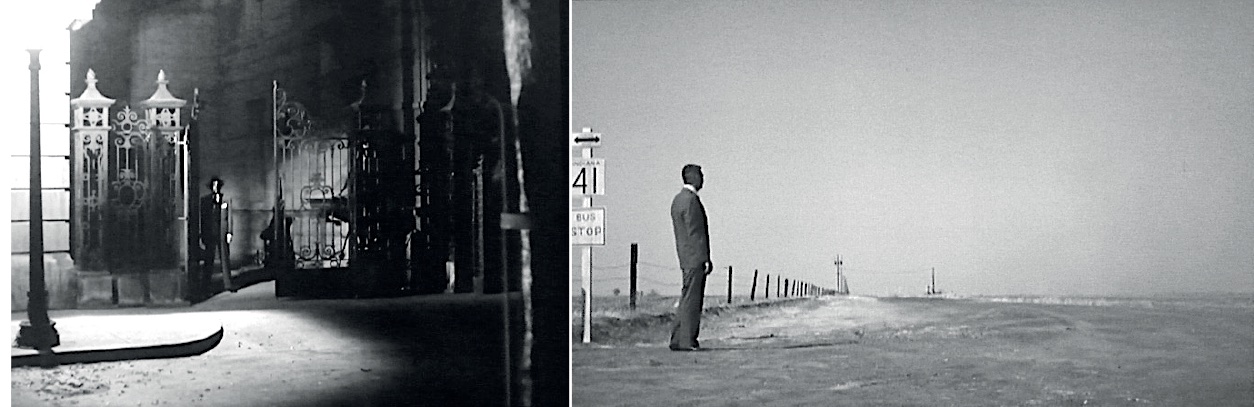
- Robert Walker in Strangers on a Train. 2. Cary Grant in North by Northwest.
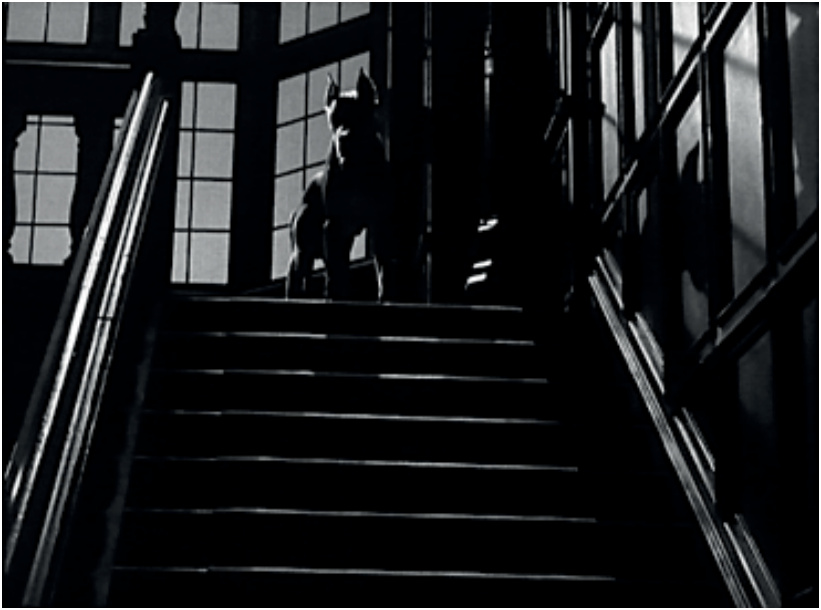
- The dog in Strangers on a Train.
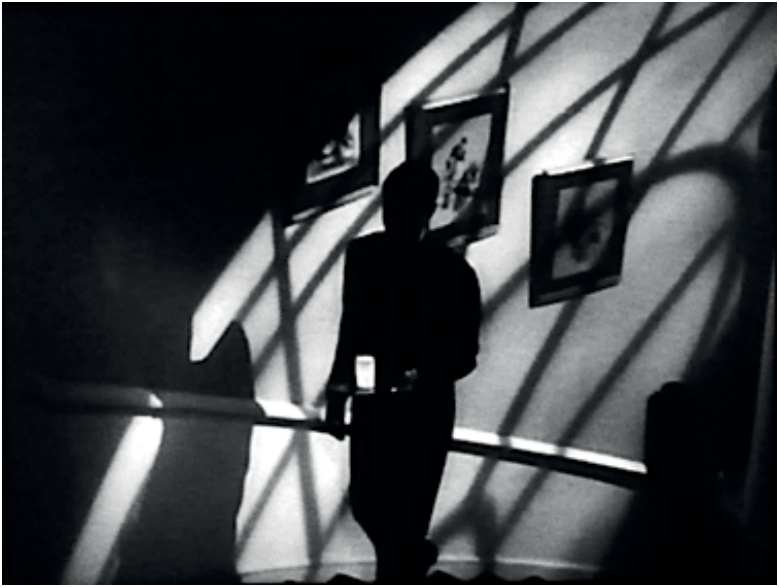
- Cary Grant in Suspicion (1941).
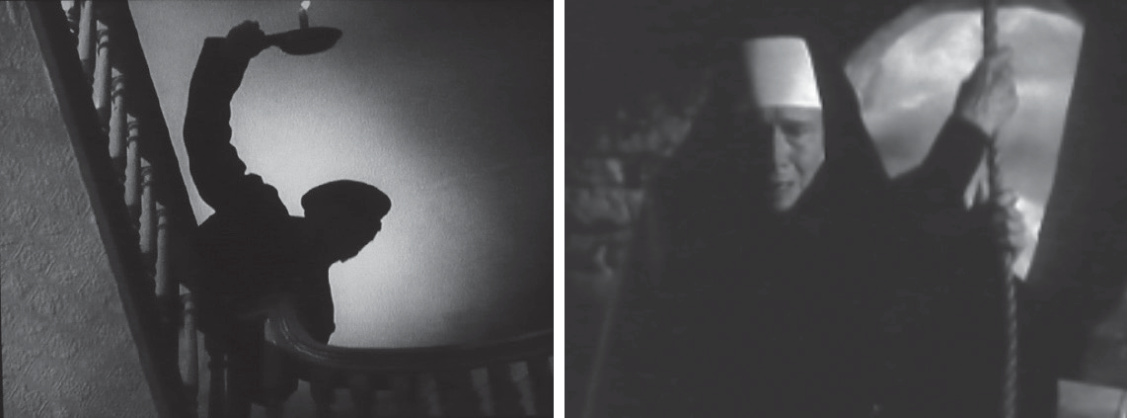
- Leon M. Lion in Number Seventeen (1932). 6. The nun in Vertigo (1956).
Foreword
“I believe it all begins when a child is three months old: the mother goes ‘boo!’ The poor child gets the hiccups from it, but the next instant he recovers from his shock, he smiles, the mother smiles…”1
The stories told by Alfred Hitchcock reactivate in us the childish taste for fear and for the tales that produce it. The filmmaker compared himself to a frightened child singing in the dark. “A child in the dark, gripped with fear, comforts himself by singing under his breath […] Lost, he takes shelter as best he can, or orients himself as well as he can with his little song. The song is like a rough sketch of a calming and stabilizing, calm and stable, center in the heart of chaos,”2 writes Gilles Deleuze. The risk that the song may break apart in the face of chaos remains present at every instant, yet “there is always a sonority in Ariadne’s thread. Or the song of Orpheus.”3
The darkened theater, by sending us back to our chaotic and terrifying origins, impels what Hitchcock analyzes as the act of Enjoying Fear4. Rather than seeking danger in our personal lives, do we not seek it by proxy at the cinema? The spectacle on the screen, like that of the gladiators in the arena, procures the cathartic effect the filmmaker intended: “In the darkened theaters, people identify with fictional characters who experience fear, and they themselves experience identical sensations (the quickening of the pulse, palms by turns dry and damp, etc.), but without paying the price.”5
In fiction, fear is a source of pleasure, for we await (in complete safety!) the hero who will stop the electric saw approaching the heroine, foil the workings of the plot, or punish the villain. We venture conjectures of happy endings, we imagine soothing and liberating resolutions for our repressed instincts, transcended by art and culture.
How does Hitchcock attain his ends? What visual and aural means, what strategies, does he deploy to make us feel fear in the depths of ourselves?
From Jack the Ripper to the Apocalypse
“From Jack the Ripper to the Apocalypse, the distance is in fact rather small, death and fear quite naturally furnishing the link that exists between the entertaining film and the work of reflection.”6
The mythologized memory of Jack the Ripper is already exploited by Hitchcock in Les cheveux d’or (The Lodger, 1927), a silent film inspired by the novel by Marie Belloc Lowndes. The Ripper has become The Avenger; a serial killer of young blonde women is at large in the London fogs, terrorizing the population. It is then that a strange man (Ivor Novello) presents himself at a boarding house. Quickly suspected and arrested by the police, he manages to flee, but in scaling a fence he is left hanging by his handcuffs, arms raised and gaze turned toward the sky. The Christ-like posture made the image famous. The character is the expiatory victim of a frenzied mob and the “savior” of humanity: the true murderer will be identified shortly afterward.
This fascination with Jack the Ripper resurfaces surreptitiously in L’homme qui en savait trop (The Man Who Knew Too Much), a theme sketched out in 1934 and developed in 1956 in a second version.
The crucial sequence, the assassination of an ambassador, takes place at the prestigious Albert Hall. We are invited to two programmed executions: at the end of the concert, the cymbal crash of a proxy killer is to cover the revolver shot of a professional assassin, the plan being known to the spectator alone. The powerful time bomb set off at the beginning of the cantata (a terrifying murderous countdown) oppresses us throughout the musical and filmic movements, developed in exemplary coincidence. A malfunction occurs in extremis: strident as Lulu’s death cry under the blows of Jack the Ripper in Alban Berg’s opera, the cry of Jo McKenna (Doris Day) rips through the aural space and upends the course of time. The trigger man, a poor musician intent on watching for a memorized signal, deflects his shot while the cymbalist remains imperturbable. Held for a few seconds, the dissonant note (a cry of a musical nature) is quite naturally followed by the expected cymbal crash.
The suffering of the heroine, faced with the cruel alternative of choosing the death of a stranger or that of her son, makes of her a tragic character; fatum is at the heart of the creation. The musician and the filmmaker retain from ancient tragedy the idea of awaiting a fatal blow that is no less fearsome for it; the final episode in the opera and in the film provokes an effect of surprise all the more terrible for being expected and for satisfying an unconscious desire that the creators have given rise to in us. The mirror framings and the spatial découpage into cells (all different save one, which paces the narrative weave by a return to a crucial point, the cymbalist’s position) relate to dodecaphonic writing. The dissonance is not limited to the cry that disrupts the tonal system and diverts the fatal blow; it manifests itself in the following sequence in a new fatal and musical coincidence. The McKenna couple is invited to a reception by the saved and grateful ambassador. The latter begs the heroine to sing: accompanying herself at the piano, she introduces into a worldly salon the famous Que Será Será, a popular song. A popular song in an elegant salon is as incongruous as a cry in a concert hall. The young woman’s voice rises to the floor above, to her son held prisoner: the child whistles the song back and reveals his presence. The descending voice and the ascending voice are superimposed in perfect harmony.
The images thus affirm the redemptive power of music, while celebrating dissonance. The entertaining form of the narrative (a popular singer scandalizes an audience of music lovers, the ambassador beats the tempo, the child gets out thanks to the song) overlays the problematic of ugliness in the face of “the Art of fine singing,” suggested by the confrontation of genres as in Berg’s opera7. Beyond the parody (the heroine is a blot, jars in a stuffy world), a bond is woven between the characters: Lulu is presented as an expiatory victim of the vices of a sick society, confronted with the loss of meaning that the work of art alone is capable of reconstructing through new networks of signification; Jo plays the role of catalyst within a deaf and blind society, to which the drama and the music that carries it entirely escape. The social satire seems easy, stereotyped, and entertaining, while it conveys a real question.
From film to film, the deadline of the Apocalypse is postponed; one must wait for Les Oiseaux (The Birds, 1963). A decade before Spielberg and Jaws (1975), there is Hitchcock and The Birds.
The end of the world looms over the peaceful port of Bodega Bay, where a dreadful and unexplained phenomenon arises: the attack of humans by aggressive birds. Is the avian undertaking a matter of revenge? A pair of Lovely Birds shut in a cage appears to have triggered the catastrophe: Melanie Daniels (Tippi Hedren) suffers the first assault while transporting the cage. The attacks pace the narration up to the paroxysm of violence: the death of a farmer (his eyes gouged out by the birds) and that of the schoolteacher (after the attack on the children at school). The Birds sets off a primitive fear, that of being attacked at any moment, without apparent or discernible reason. This fear is visualized in the cry of Mrs. Brenner (Jessica Tandy) after her discovery of the dead farmer: the long mute cry, the mouth open for the entire duration of the sequence without the slightest sound managing to come out of it, summons Munch’s The Scream (1893) as much as Lulu’s Todesschrei under the knife blows of Jack the Ripper in Berg’s opera. Hitchcock refers to Ezekiel (Chapter VI) by way of a drunkard leaning at the bar in a café where Melanie recounts the terrifying events: “It’s the end of the world! Behold, I, even I, will bring a sword upon you, and I will destroy your high places.” Lucid and resigned, the character is not taken seriously by his audience.
A fantastical narrative delivers a keen gaze on the diversity of human behaviors in the face of fear, centered on the heroine’s initiatory journey: a gradual renunciation of her frivolity and her selfishness leads her to sacrifice herself.
Fear “of” nothing and fear “for” nothing
“What would you have? For my part, the heroes themselves must be of good cheer, and laugh in the face of every danger!”8
The Hitchcockian heroes resemble the “merry fellows of heroism” of Barbey d’Aurevilly, whose troubling universe is close to that of the filmmaker. From the cheerful tramp who is afraid of his own shadow (Leon M. Lion) in Numéro dix-sept (Number Seventeen, 1932) to the facetious businessman (Cary Grant) propelled unawares into the perilous adventure of La mort aux trousses (North by Northwest, 1959), by way of the cynical and burlesque psychopath (Robert Walker) of L’Inconnu du Nord-Express (Strangers on a Train, 1951), the image of the hero is revisited, redefined with humor. The “stagings of fear” are thus constantly reinvented and the stereotypes pulverized.
One may wonder by what visual and aural means we are led to share and to feel the characters’ fear.
Take two radically opposed devices, yet conceived to instill the same disquieting atmosphere. The waiting is staged from two different points of view, the one subjective and the other omniscient. The framing chosen for Strangers on a Train focuses the gaze in the depth of the image, on a figure motionless in a dark street. Hitchcock attributes to us the anxious gaze of Guy Haines (Farley Granger) upon Bruno Anthony (Robert Walker), the dangerous criminal who harasses him day and night. While the set, the violent chiaroscuro, and a music with dramatic accents pay homage to Expressionist cinema, it is nonetheless not the victim who waits, but the murderer!
By contrast, in North by Northwest, the victim is exposed in full light in a vast, desert-like expanse. Our gaze, oriented toward the perspective of an uncertain horizon, loses itself: from where could the enemy spring forth in this dead calm? Alfred Hitchcock explains himself on this point: “I wanted to work against an old cliché: the man who has gone to a place where he is probably going to be killed. What is the usual practice? A night ‘as black as pitch’ at a narrow city crossroads. The victim waits, standing in the halo of a streetlamp […] I asked myself: what would be the opposite of this scene? A deserted plain, in full sunlight, no music, no black cat, no mysterious face behind the windows.”9 In these two films, the characters fear nothing, the one by choice and perversity, the other by necessity and innocence: in Strangers on a Train, Bruno proposes to Guy an exchange of murders, to kill his wife in exchange for the murder of his own father; and he carries it out. This type of the reckless and sardonic hero appeared in La Corde (Rope, 1948), where Brandon (John Dall), murderer of a young man deemed unworthy to live on account of his banality, declares: “To ignore fear distinguishes us from other men.”
Taken for someone else, Roger Thornhill is propelled into an affair of espionage where he must confront innumerable dangers to escape death: “[…] the more he loses his identity, the more the hero is transformed into a designated victim, obliged to throw himself into a headlong pursuit.”10 The headlong pursuit, where fear and irony are combined, energizes numerous films, among them Downhill (1926), Les Trente-neuf marches (The 39 Steps, 1935), Cinquième colonne (Saboteur, 1944), and Le Rideau déchiré (Torn Curtain, 1966); brought to the fore is the idea that “death is, in sum, there only to provoke fear, and the latter serves only to render more evident the rigor of destiny.”11
An effective strategy consists in frightening us “for nothing” before the real fear: the suspension of the tempo functions like the “release” of a spring that propels the spectator into dread. Developed in North by Northwest, the device is exploited with virtuosity in La Maison du docteur Edwardes (Spellbound, 1945) or in Pas de printemps pour Marnie (Marnie, 1964).
In Strangers on a Train, when Guy enters the Anthony house by night, revolver in his pocket (to warn Bruno’s father, or to do away with him?), we glimpse before he does a Great Dane of powerful musculature, posted on the landing of the first floor; the low-angle framing confers on the animal a terrifying aspect. Guy (whose point of view we share) freezes at the foot of the steps before venturing onto the staircase.
Hitchcock has taken care to indicate to us the length of the path to be traversed to reach the father’s bedroom, by the slow tracking of a beam of light over the plan of the house. A second tracking shot, of an unbearable slowness, is used to film the dreaded ascent: it ends with a close-up of the head of the mastiff licking Guy’s hand!
By contrast, in North by Northwest, we watch for an enemy liable to spring up anywhere in the immense desert where Thornhill has a rendezvous. The successive passages of three vehicles alert us, gratuitously disturbing the inertia of the visual and aural fabric: the image quivers for an instant and returns to its initial flatness. The camera insists on “the nothing”; it plays with our nerves by filming inaction. The empty tempo makes the narrative mark time (hence the character’s “standing still”) while harrying the spectator, who is hungry for action. The narration and the orchestration of the sequence work out of step with each other.
Spellbound contains a variation of the device: the filmmaker stokes our anguish by delaying showing us the object that provokes the heroine’s sudden fright. We have witnessed the nocturnal visit of the amnesiac hero (Gregory Peck), an open razor in his hand, pointed toward his host. The sequence ends on the white monochrome of the milk absorbed by John Ballantyne… and by the spectator! This immaculate shot “cuts” the narrative fabric while communicating to us a sensation of unease, since we have drunk from the same glass. In the morning, Constance (Ingrid Bergman), distraught at her lover’s absence, rushes down the staircase while dressing: but she freezes, paralyzed by a spectacle to which access is still forbidden us. Her distress is signified by a tilted architectonic framing. The descent resumes in slow motion for a few interminable seconds: “the spectator remains serene only thanks to the speed of the camera’s passage through the images. If the camera slows down or stops, the unease begins,”12 writes Daniel Rocher. The awaited reverse shot is at last granted: slumped in his armchair, the old man is… fast asleep! The “fear for nothing” is associated with the “suspension of time”; the filmmaker here takes a mischievous pleasure in slowing the tempo, rejecting methods such as acceleration or parallel editing.
The “fear for nothing” is staged in Marnie with a mischievous irony. Marnie (Tippi Hedren), an experienced kleptomaniac, must change her identity and appearance after a burglary; at the closing of the offices, she shuts herself in the restroom of her new employer. The camera opts for a subjective vision: we vibrate with Marnie by adopting her gaze during her furtive movement toward the safe. As if animated by a spring, the camera executes a violent reverse tracking shot and propels us to the ideal spot to witness an anguishing and funny duo: a silent ballet, a pas de deux on the theme of “cleaning” (of the floor and of the safe) takes place in a geometrized scenic space. A wide shot is divided into two cells offered to the spectator’s gaze; the principal dancer is in place before the safe at the moment the second comes into play in the depth of the image. Strictly aligned in the partitioned image, the two women coordinate their movements: the burglar and the sweeper bend, straighten, pivot on themselves, their attributes in hand (gloves and bag for the one, broom and bucket for the other). The choreography is exemplary. In the front row, the spectator witnesses the theatricalization of the two rituals under the neon of the footlights.
According to the rule of decorum dear to the filmmaker, we are warned of the danger well before the heroine, and we fear for her. When she becomes aware of a presence, Marnie improvises a strategy of soundless flight: slipping her shoes into her coat pocket, she heads slowly toward the exit. We start at the fall of a shoe, made audible visually; the space tips into a shot edited as a cut, an “out-of-series” framing that points to a violent break in this absolute silence that has filled us with anguish for the whole duration of a sequence, for nothing: the employee continues her activity in complete tranquility, being deaf. Deafness takes on a very strong symbolic meaning in a narrative sequence entirely governed by the orchestration of silence.
Configuring fear
“How many times, in a dark passage of the Bourse quarter, have I not stopped at the foot of a staircase whose sumptuous spiral coils with a haughty nonchalance and sets off on a voyage into the shadows!”13
Alfred Hitchcock does not hesitate to define himself as a specialist in fear: “Fear in the cinema is my particular domain, and I have divided cinematic fear into two great categories — terror and suspense. The difference is comparable to that which separates a V1 from a V2.”14 The filmmaker then explains that the time separating the noisy starting of the engine from the explosion corresponds to the silent descent of the buzz bomb, a time of suspense. By contrast, the V2 making no noise before exploding, to hear it and survive it implies the knowledge of terror.
The anglicism suspense, borrowed from the word “suspens,” designates the state of what is suspended, the anguished waiting or the moment that gives rise to it. It would be reductive to catalogue Hitchcock as the “Master of suspense” in view of the richness and complexity of his films, but one must indeed acknowledge that it is a “suspended” architectural element that he uses and manipulates as the mechanism of the most perilous actions: the staircase.
Captivated by the plot and submerged by our emotions, do we pay attention to this configuration, ostensible as it is from the very first films? Appropriating this major element of the Expressionist set, the staircase, Hitchcock endows it with a terrifying power. In his film on Jack the Ripper, the lodger goes out at night; filmed from a high angle from the top of a great staircase, a white hand descends into the darkness and slides furtively along a sinuous banister. The image is eloquent: is the hand gloved in view of an imminent strangulation? Does each of the steps cleared bring us closer to a new crime? Considered by the filmmaker as his first film, The Lodger inaugurates the use of the staircase as a dynamic15, a privileged mechanism of fear. Declined with numerous variations (in 47 of 53 films), the structure in movement will never cease to transport the characters toward unsecured extremities and the spectator toward terror, to generate that suspense we are so fond of.
Strategies
Hitchcockian suspense proceeds not from editing as in Griffith or Welles, but from découpage. The duration undergoes neither acceleration nor violence: on the contrary, natural time is slowed down. The mechanism of suspense is not “parallel or alternating editing, but the shot/reverse-shot, which sets the gaze in play,”16 writes Pascal Bonitzer.
L’Ombre d’un doute (Shadow of a Doubt, 1943) presents a staircase scene in which the intensity of the shot/reverse-shot is exemplary: Charlie Oakley (Joseph Cotten) bounds joyfully up the family staircase at the announcement of his exoneration; he has almost reached the landing when he stops and turns around, his face anxious: below, the reverse shot of this shot is a framing of his niece, prolonged by her oversized shadow. The hostility of her gaze and her withdrawal into the light are eloquent: she knows that her uncle is The Merry Widow Murderer and she despises him; he understands that she has become a menacing and indelible shadow over the picture of his existence. A rapid ascent and a suspension of time are allied in the staging of a thwarted situation.
The characters venture onto the staircases, advancing toward the unknown, with placidity. In Soupçons (Suspicion, 1941), Cary Grant’s ascent with a glass of milk is of an exasperating slowness.
The luminous punctum exalted by the powerful chiaroscuro, from which all spatial directions radiate, focuses our gaze, and doubt gnaws at us: does the glass contain poison17? The milk rises at the same time as the tension. The secret blackness of milk, of which Paul Valéry spoke, is it accessible only through its whiteness?
In Sueurs froides (Vertigo, 1958), the ascents of Stewart and Novak to the top of the bell tower of the Spanish mission function as a mirror: the slowness of the acrophobic hero forbids him to follow the heroine in her mad race; but during the reconstruction of the crime, the heroine slows her ascent toward an inescapable death. In Psychose (Psycho, 1960), the detective Arbogast is savagely stabbed at the top of the stairs after a placid ascent. Melanie is attacked by the birds after her cautious climb to the attic, and so on.
The shadow-body
The inscription of a mass of shadow in a staircase, a “shadow-body,” forms in Hitchcock a configuration tirelessly declined and reinvented. A mass of shadow coinciding with a figure constructs it as a menacing apparition; according to Jean Douchet, it is “immediately felt, in its anguishing plenitude, as a hostile and overwhelming presence.”18 But this mass can mislead: the sinister silhouette leaning over the banister of a dismal staircase (Leon M. Lion) reveals a likable tramp. The mass growling at the top of Bruno Anthony’s staircase envelops a friendly dog. The form of the menace is doubled by the power to deceive; invested with the function of a screen, the shadow halts the “light,” delays the emergence into day. Appearing, defined by Martin Heidegger as a “not showing itself,”19 implies “an invisibility” terribly anguishing, partaking of uncertainty.
The coincidence between figure and shadow is all the more disturbing in that it presages an imminent dissociation, for better or for worse. The “phantom” of the bell tower in Vertigo, springing up from a trapdoor like a jack-in-the-box, is only an inoffensive nun; she nonetheless makes us scream with fear and brings about the fatal fall of the heroine.
- Autonomy and organicity
The staircases, endowed with a terrifying power, gradually come to life; the staging confers on them an organic and untamable aspect, in the image of the mad staircases engraved by Piranesi. Thus the spell enchanting the descents of Madame de Winter in Rebecca (1940) or of Henrietta Flusky in Les amants du Capricorne (Under Capricorn, 1949), both radiant with happiness, turns into a curse when they go back up the staircase: after the humiliation inflicted by their respective lovers, the point is to disappear as quickly as possible, and the sumptuous gown becomes a handicap in this frantic flight. The fairy tale turns into a nightmare. Any ascent of a hostile staircase is risky: it leads to the disappearance of the heroine (on two occasions) in Vertigo, and the staircase/digestive tract of the McKittrick Hotel swallows up the hero duped by the woman he loves.
Alfred Hitchcock’s audacity culminates in Frenzy (1972), where the staircase filmed in ascent accompanies the assassin and his presumed victim, then descends alone, step by step in a reverse tracking shot, slowly and silently down to the murmur of the street, perfectly autonomous. In the final sequence of the same film, the staircase is rendered alive by the shot alone: the hero ventures cautiously up the staircase toward the killer’s apartment, caressing the banister as if to coax the sleeping monster: “This fatal staircase banister seems to come alive with a will of its own, which the apparent innocent inertia running through it makes still more insidious and, thereby, malevolent,”20 writes Jean Funck.
There are no fabulous creatures and sets in Hitchcockian cinema, but a way of filming the everyday that results in the metamorphosis of our gaze upon the world.
The fear of oneself
The fear we have of ourselves is perhaps the most harrowing. Hitchcock’s unfailing strategy for producing emotion is to implicate the spectator (the point is to “keep one’s eye fixed on the target”21) in order to make him an accomplice, and more still, to make him live the drama. A paroxysm is reached when, at the end of Psycho, Bates’s criminal schizophrenia is brutally revealed to us. We are stupefied: is it even conceivable that we could have taken part in the character’s psychosis for the whole duration of the film? Is a monster, then, lurking in each of us?
Notes
A. Hitchcock, The American Cinematographer (May 1949), cited by Bruno Villien, in Hitchcock, Paris, 1985, Rivages/Cinéma, p. 69.↩︎
G. Deleuze, F. Guattari, Mille plateaux (A Thousand Plateaus), Paris, Les Éditions de Minuit, 1980, p. 382.↩︎
Ibid.↩︎
After the title of an article by Hitchcock published in Good Housekeeping (February 1949), p. 39, 241-243, reprinted in Hitchcock on Hitchcock, University of California Press, London, 1997, p. 116-121.↩︎
Translated by Pierre Guglielmina [“Jouir de la peur”], in Hitchcock par Hitchcock, edited by S. Gottlieb, Paris, Flammarion, 2012, p. 221-227.↩︎
R. Prédal, “La peur et les multiples visages du destin,” in Études cinématographiques 84-87, Paris, Minard, p. 86.↩︎
In Lulu (1928-1932) Berg brings together Erdgeist (Earth Spirit, 1893) and Die Büchse der Pandora (Pandora’s Box, 1901) by Wedekind, where the circus, the grotesque, and the serial are dissonances that stand against the cultural value of the work, welcoming what is judged “non-artistic.”↩︎
B. d’Aurevilly, Le Chevalier des Touches (1864), Gallimard, coll. Folio classique, 1976, p. 101.↩︎
Hitchcock/Truffaut, Paris, Ramsay, 1983, p. 216-217.↩︎
B. Villien, Hitchcock, Rivages/Cinéma, Paris, 1985, p. 28.↩︎
R. Prédal, Études cinématographiques 84-87, op. cit., p. 85.↩︎
D. Rocher, “L’insolite est quotidien,” in Études cinématographiques, no. 84-87, op. cit., p. 33.↩︎
J. Green, Paris, Paris, Seuil, coll. “Points Essais,” 1983, p. 62.↩︎
Hitchcock par Hitchcock, op. cit., p. 223.↩︎
See L. Decobert, L’escalier dans le cinéma d’Alfred Hitchcock, une dynamique de l’effroi (The Staircase in Alfred Hitchcock’s Cinema: A Dynamics of Dread), Paris, L’Harmattan, 2008.↩︎
P. Bonitzer, Cahiers du cinéma, special issue Alfred Hitchcock, 1980, p. 14.↩︎
It contains a light bulb: “the audience had to look at nothing but that glass” [Hitchcock/Truffaut, op. cit., p. 117.]↩︎
J. Douchet, “Le symbolisme hitchcockien,” in Hitchcock, op. cit., p. 193.↩︎
M. Heidegger, Être et temps (Being and Time), translated by Emmanuel Martineau, Paris, Authentica, 1985, p. 42-49.↩︎
J. Funck, “Fonctions et significations de l’escalier dans le cinéma d’Alfred Hitchcock,” in Positif (no. 286), Opta edition, 1984, p. 33.↩︎
B. Villien, Hitchcock, op. cit., p. 68-69.↩︎