Contrary to what the end of the century might have led us to believe, the Wandering Jew is still on the road in literature — not as a vagabond reducible to Mr. Brown or Everyman, but precisely on account of his wandering itself, curiously taken up by his own people as a contemporary fatality: witness the recent exhibition on Ahasverus at the Musée d’Art et d’Histoire du Judaïsme1… Ever since an anonymous pamphlet that appeared in Germany in 16022, reported by a cleric, Paul von Eitzen, we have known the outlines of the silhouette of the poor “walker,” a cobbler by trade under the name Ahasverus, who became one of the most famous vagabonds of Christendom; for having failed to recognize Christ as the Messiah on the road of the Passion, he finds himself condemned to a destiny that is the inverse of the human destiny, since he cannot die and must walk here below until the time foretold by the Apocalypse. This text, born in a Lutheran context, recounts the encounter and its consequences: the distress of the “poor wandering Jew” who does not know “what God meant to do with him, to keep him so long in this wretched life,” a distress that may in part explain the variations around wandering, whether it be error or straying3.
Before him, a certain Cartaphilus, declared to be the doorkeeper of Pontius Pilate, was born in the Middle Ages out of the tales of clerics, for whom to speak of the repentant vagabond amounted to figuring the incredible survival of the Jewish people after twelve centuries of evangelization. But in the narrative grain of these first texts, an aggregate of contemporary texts, one sees at work a certainty of faith that is no longer found in the logic of the character of Ahasverus, recreated by the Reformation in the features of the penitent. When the Ballade brabançonne of 1774 spreads, to a familiar tune, “the great misery of the poor wandering Jew,” it is the voice of the collectivity that pities the wanderer, without yet calling into question either the notion of repentance, or the agents of punishment, or the compensatory data summed up by the three pennies of eternal subsistence. Yet these questions, latent, do not fail to surface at the dawn of Romanticism, and the curse that condemns the character to wander throughout the world until “the end of time” is rich enough in mythic potential to lend itself to extensions other than that of the pious legend. Not only does the notion of a “final,” eschatological time, of the redemption of humankind, open onto speculation within this legend, but so too does the place of the encounter, or again the identity of the aggressor, that of the victim, and finally the exact nature of the insult: which is to say, data essential to any narrative, in its spatio-temporal dimension and in the symbolic stakes of a dialogue perceived as central to both individual and collective destiny. It is at the dawn of European Romanticism that the Jewish world seeks to rewrite the legend of exclusion that pursues the figure of the penitent along almost every road of the world, and will inflect its meaning… at the very moment when the Christian world reconsiders the accusation of deicide and, by dint of humanizing the wanderer, restores to him the right to die.
What happened on the side of the Jewish rewritings? The question is obviously too simple to be settled in a single sentence. The figure of the Jewish pilgrim has existed for a long time: in the time of the Crusades, in 1173, a Castilian Jew set off on a journey, Rabbi Benjamin of Tudela, who sent letters to the Jewish communities of the East as any number of religious orders might have done, without thereby creating a character. Nonetheless, one may see in this a favorable terrain: the first text of the Christian legend concerning Cartaphilus or Buttadeo came into being around 1220, and the account of the Jewish traveler would be very well known to Jewish and Christian scholars of the thirteenth, fourteenth, and fifteenth centuries45.
When the legend of Ahasverus is born, in the seventeenth century, the first Hebrew edition of the Rabbi’s itinerary had taken place in 1543. But unlike the pilgrim, a credible figure, the extension of the legend of Ahasverus posed, around the “surviving” vagabond, a question of land, of time, of identitarian interlocution. In what terms, then, can the Jews appropriate a fiction that wrongs them? The Jewish rewriting of the legend could of course be explained as a kind of legitimate counteroffensive. Stranger is the way in which the Jews begin to remodel the character who makes them the stars of a curse, without thereby changing the narrative givens. Before the twentieth century and the return of the Jews to their land after the Second World War, a century of poems and various narratives, written by German Jews, prepared this sort of Judaization of the legend, by reconstituting a messianic tradition detached from the strictly prophetic and biblical sphere. An attempt to identify the Jew with the Wandering Jew of the European world did indeed manifest itself in the nineteenth century — in a constrained accord with the figure held out by that world, a figure that had become complex: a mirror-figure of exclusion, but also of redemption through identification with the myths of revolt, such as that of Prometheus.
A first remark already imposes itself within the mythic canvas handed down: the tracing of the narrative duration onto the time of Christ’s Passion, that is, three days of narrative for nineteen centuries of trials and walking. A second often follows: the identity of the narrating storyteller is none other than that of the victim incriminated by the legend, a wandering word for a wandering Jew around the world, lending itself to every mask and to many a metamorphosis. This word is increasingly founded on the amplification of a misunderstanding, starting from a promise ceaselessly recalled as unfulfilled by Christ, namely the redemption of evil. This question implies for them another, absolutely essential one: who is Christ — in other words, the incarnation of God for the Christian world, but considered an impostor Jew by the Jews themselves? On this question depends the ambivalence of a journey that asserts itself, over four centuries, in the twofold dimension of the character’s errance (wandering), blessing and curse, and this as much for the Jewish writers as for the Christians.
Might there be, in this Wandering Jew whom Romanticism humanized by seeing in him the mythic symbol of the people, indeed of humanity, a gradual convergence between two ways of understanding Jewish wandering? Thus arises the question of the progressive appropriation of a text of condemnation by the Jewish literature of the last century, with regard to the evolution of the world, and — remarkable thing — of a narrative far more centered, since the nineteenth century, on the character himself as actor and narrator of the condemnation to wandering: the Wandering Jew tells his own story and becomes individualized. What does he reveal to us about himself, as a Jew, in the partial conversion of this mythic image through his word about himself? The nature of the wandering and the identity of the character in his relation to himself as to Christ, the literary metamorphosis of the Jew’s journey, a function of a historical metamorphosis of his place in the world, or the disguised permanence of the founding mythemes? It is on these points that we will try to open a few avenues, starting from contemporary Jewish novels, more particularly those that are grounded in the Jewishness of the character.
The ubiquity of the wandering Jew: indefinite expansion and return to the Street of Bitterness
From the very first texts of the Middle Ages, Ahasverus calls into question the “sphere of ambulation”: a traveler he is not, since a hand always pushes him forward, forbidding him to linger in any one place. A wanderer? His fate does not condemn him to wander aimlessly, but to crisscross space until the end of time, wandering in expectation. This expectation, finalized by an eschatology, thus corresponds, in the founding version, to a wandering determined by the return of an Other, and not by his own: hence the prohibition against returning to Jerusalem and to his house. (One sees, then, that beneath the steps of the wandering Jew, the space traversed is necessarily metamorphosed by the history of the centuries. The metamorphosis of places has as its corollary also that of Ahasverus’s bond to the person of Christ, since the end of his torment depends on Christ’s return. Specific then to the major unknown that links human space to an indeterminable time, that of the Apocalypse.)
Now, beginning in the nineteenth century, Jewish writers began to novelize or to versify the story of Ahasverus, at the moment when it became secularized… It is then that the German Jewish writers take up the legendary narrative, to express the desire for a possible alliance between the spirit of Israel and that of the West, indeed to propose an assimilationist thesis! At the heart of Romantic lyricism, Ahasverus came to embody the fate of every man wandering upon the earth, having lost the bearings the Christian universe had given him: at the end of the eighteenth century, the “poor wandering Jew” of the popular ballads becomes a metaphor of the soul, and not only a chronicler for travel novels. Yet the Jewish world is not indifferent to this metaphorization of the character. But, a specific datum, the awakening of Jewish national consciousness gives full density to the mytheme of the return to the land; with Judaism strained toward the accomplishment of the earthly Jerusalem, the contemporary Jewish writers return ceaselessly to the sites of the condemnation, they ceaselessly rewrite the site of the origins… of the legend. A return to the Street of Bitterness?6
Thus the Jewish people, emancipated in the West since 1791, rehabilitates in fiction the sites of the legend, in order to rise up against a distorted vision in which its curse had been forged. Ahasverus, thus sung, makes himself the sign of an election, or, far from symbolizing the past alone, figures the future of his people, of all peoples. So it is that, at the beginning of the twentieth century, when Edmond Fleg writes, in 1933, Jésus raconté par le Juif errant (Jesus Told by the Wandering Jew), the Street of Bitterness is still the one the character walks: it is by returning to Jerusalem that the narrator, Fleg, claims to have met this elusive shadow, while he himself was making his way to Gethsemane; it is with him that he once again travels the sites of the torment, revised and corrected by this Jewish witness condemned to “walk.” At the end of this novel — an interview cast as memoir — the narrator finds himself in the same place, against the door of a Coptic convent from which the wandering Jew does not wish to depart, but where he cannot remain. A mythic tension between election and curse… that dramatizes this impossible hospitality of the Jew to himself: contrary to the utopian versions of the nineteenth century, this wandering Jew has not arrived, but rediscovers the street of the torment, only to leave it at the end of the three days prescribed by his legend.
This tension we find at work again in Fleg’s collection of poems written in 1939, L’Évangile d’Ahasvérus (The Gospel of Ahasverus), where the intervention of “the Wanderer” is made in relation to the past: “He saw again the garden beyond the Kidron, The courtyard of the blows, the thorns upon the brow, And the cross rotting on the accursed hill” But it is also the future that “surges forth” beneath the steps of Ahasverus, even though the traveler then retraces Christ’s halt before his door7. There is thus a dichotomy between the prescribed text and the lived text. In Alexandre Arnoux’s novel, Carnet de route du Juif errant (Travel Journal of the Wandering Jew), there appears the desire to contradict the previous versions: “the great event of my existence has been told in a hundred ways, all inaccurate”8. But the setting of the encounter with Christ is rigorously the same, as is the site of the confrontation: while he tells his own story along the course of a wandering between East and West, he presents himself as the cobbler of Jerusalem, whose history began on the threshold of his shop9. The motif of the door is therefore both upstream and downstream of the narrative: it is between two doors that his novel is constructed.
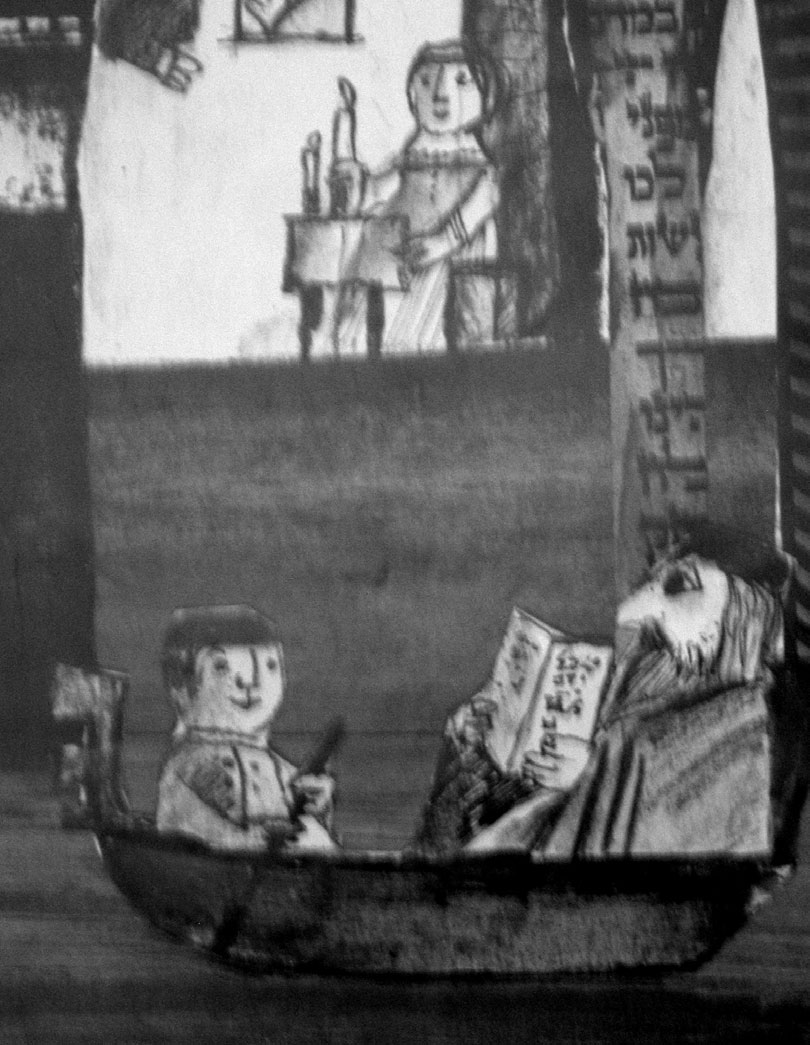
Finally, in a novel that in no way resembles a defense and illustration of the Jewish religion, Ahasver (1981), the German Jewish novelist Stefan Heym presents the story of Ahasver as inseparable at once from his legend, from the History of Christ, and from the history of mankind: in the course of the novel, all the sites of the Passion are evoked (57), from the Last Supper to the famous scene of the fatal street, but along a vertical dimension that situates the character both here below and in the beyond, in a timelessness… symbolic of his myth. - The account of the encounter with Christ perpetuates the human dimension of the sacred, as if the extension of the sites and the stakes were inversely proportional to the real time of the dialogue. Indeed, Ahasver finds himself intimately bound to the founding history: the three days according to the Gospels gradually become, in the rewritings of the curse, the duration permitted for his sojourn in a city; as if the halt of the Wandering Jew were meant to eternalize Christ’s walk toward the cross! It remains that, over twenty centuries of human history traversed, Ahasverus has had the time to humanize himself; the extraordinary vogue of the legend can be perceived in the Jewish rewritings. At once man and superman, the wandering Jew has become so, and his affective life, in all its aspects, has become “novel”: the passional life of the Wandering Jew interests the Jewish writers as much as his encounter with Christ, in keeping in this with the character of the ballads, which had sometimes endowed him with a hundred and twenty-three wives… a figure deemed consistent with his longevity. A psychology of the Passion that thus integrates the passion of love: the play on words had been attempted by more than one novelist, even to the feminization of the character10. Down to Jean d’Ormesson’s novel, which in 1990, after that of Fruttero and Lucentini (1984), had endowed the repentant vagabond of the Middle Ages with an eternal present in matters of amorous experience: “I walk, I drink, I screw” (Ormesson, 149).
However, while sensuality gives a picaresque and satirical relief to the character in Stefan Heym’s novel11, it remains — in the novels where the Jew speaks in his own name — a kind of epiphenomenon. The space in which he arises may well be eroticized into a “comfortable bachelor pad above his shoe store”12, yet the time of passion remains subject to the time of waiting, even after the Six-Day War, that is to say, to a beyond of human time that reinscribes sacred time within the time of a love affair, a time that wears down, weakens, or trivializes the character’s loves. Moreover, the act of recounting the principal stages of Jewish History within Christian history may valorize now one aspect — the death of Christ (Paulsen) — now another — the decisive encounter with heresy (Heym) — whether it be that of the high priests or of that Christian society at which the hero gazes with an irony… (Arnoux, Fleg, Heym) that always sends him back to himself, which is to say to the Street of Bitterness. Over time, the sites chosen for rewriting the passion are therefore above all symbolic of a concentration of Jewish micro-histories: Venice, Prague, Rome… Thus the Jewish novelist Leo Perutz, evoking in Prague the apparitions of the character, concentrates in him the history of the ghetto. Likewise Arnoux, even if his character wanders from East to West, nonetheless attaches him to the founding scene, and refuses a name to the anonymous one cursed by every proscription. Fleg’s hero, when he prepares to tell his story, must be helped by the author, for he collapses from weakness against the door of the Coptic convent in the full twentieth century… Only Stefan Heym’s Ahasver seems to vanquish time itself, placed as he is upstream of the Adamic Creation, and beyond the ultimate battle of the time of Armageddon. Even in this case, the ultimate signifies only a phase of transition, in the expectation of another world: in other words, nothing is finished, anywhere, nothing is vanquished, and least of all Evil, so much so that the timelessness corresponds to that of an indefinite fall into the void, where God, the Rabbi, and the Wandering Jew merge (Heym, 223).
Whether there is a concentration of sites in a single one, or an indefinite expansion of the site of the curse into a succession of “reportage” stories over time, the narrative of Ahasverus, rewritten by himself, refuses to envisage an end. Who, then, is eternalized? The eternal Jew seems to want to pose himself as an eternally necessary question, with no glorious ‘end’ then… for anyone, no place of arrival, anywhere. Extension of sites, concentration on the street of sufferings, change in the nature of the wandering: this no longer signifies repetitiveness, as in the ballads where the refrain laments an irreversible sanction13, but a metaphorical configuration of a mastery of time and space ever fixed and ever deferred. For this is no doubt the most remarkable thing in this new distribution of roles. Christ was given, in the Christian legend, as the victor. Now, even if between the thirteenth and the seventeenth century we witnessed a diversification of the wandering Jews, this did not really call that superiority into question. A probable consequence of the Age of Enlightenment, the Wandering Jew became secularized like his story, to the point of espousing the interests of mankind, and the visionary dream of an indefinitely progressive History. Faced with the great utopias of the nineteenth century, the Wandering Jew sometimes becomes the mythic incarnation of the people (Sue). Yet this transfiguration is never, in the Jewish version, detached from an accomplishment here below, from a relation to the sacred that means to be visionary of a “dawn,” in this instance that of Zionism.
So much so that space-time does not appear limited beneath the steps of this Wandering Jew, whereas the character of the Christian legends always presents himself as one whose fate cannot change. He is condemned by the very nature of his sanction to repeat himself, or else he is the one who is recognized because he has been seen to disappear: such is the whole force of the fantastic tales, and Perutz takes up this essential mytheme: the Wandering Jew is presented as such because he repeats himself as absent or in the process of disappearing (Fleg), or because he reduces to a quite schematic vision the mythology of the Apocalypse and its horsemen, like the vision of the heavenly Jerusalem! “in this tohu-bohu, Ahasver had disappeared, as if the earth had swallowed him: indeed no one saw him pass through the door”14.
There is therefore no possible narration of an end to the wandering in this appropriation of the wandering Jew’s sites of origin, because there is no answer to the mystery of the end, no figurable answer at any rate, and this is the meaning that the Jew’s wandering takes on in these rewritings, a question posed against a door that is a frontier. Not only the frontier of human knowledge. The Jewish version faithfully recalls the incessant departure of the Jew because it bears witness to a metaphysical necessity, ironic as much as anything, with regard to every creed. Counteroffensive: the Wandering Jew leaves Jerusalem but returns there to show both its limits and its inscription ad vitam aeternam in time and space. Thus the return to the Street of Bitterness is not to be confused with the possible vision of an end to Evil, and this would explain the symbolism of Ahasver’s wandering, which, in this last novel by Heym, is endless mobility, from the origins of the world to the hypothetical end of a time — something scanned by the very rhythm of the repetitions in Heym’s novel: “We are falling,” ch. 1, “We are floating,” ch. 17, “We are searching,” ch. 26, “We are falling,” ch. 29.
The heightened importance of the original dialogue with Christ: what do you say?
But who is this “we” of Heym’s Ahasver? Paul von Eitzen’s account reported, in dialogue form in 1602, the Jew’s words: to this Ahasverus who has just thrust him away “with insults,” Christ replies: “I will stop and rest, and you will walk”15. In the Jewish rewritings issuing from Romanticism, this founding scene subsists, enriched by the form of the memoir-narrative, which lends a more developed lyricism to the hero: it is he who relates Christ’s word, and who “corrects” the previous versions. The lyricism of the character, always centered on the question of the message and of knowledge, takes on growing importance in the Jewish narration. It authorizes the character a syncretic journey between the space of origin, Jerusalem, and the whole earth, just as it facilitates, on a symbolic plane, the dialogue between the philosophies of the past and those of the present, between anachronism and progress, putting to the test of the time that has rushed into it the dialogue mentioned at the outset.
The first poems that sing of Ahasverus lent the solitary an exemplary vocation, that of representing the duration of his people’s sufferings: he was presented as the icon of a collective tribulation, and this function is, in sum, his redemption (Pfizer, 1831, Der ewige Jude — The Eternal Jew)16. But this image accuses his tormentors instead of taking up directly the scene of the legendary condemnation. This prepares another version, in which the Wandering Jew appears under two aspects that are twinned and contradictory: in the Zwei Ahasvere (The Two Ahasveruses) of the poet J. G. Seidl, we are shown, under that name, a sinister old man who serves as a buffoon to drunkards, while there arises the fantastic apparition of an authentic Jew, gaunt but unalterable. Now it is the latter who bears on his brow the mark of Christ, for he declares himself the true image of Him. From the “you” to the “we.”
Thus the humanization conferred upon the Wandering Jew by the Romantic palingeneses is taken up to the benefit of a dialogue that inverts the structure: the Wandering Jew tells his own story, or else escapes the narrative. Speech is restored to him, literally, in the exchange of replies with Christ, named very diversely by him as Yeshua, Rabbi, Jesus, since in the Jewish versions Ahasverus grants himself mastery of the discourse: Arnoux’s “Journal” of the Wandering Jew, Fleg’s “Jesus Told by” the Wandering Jew. There is genuinely here a rewriting that transforms the figure of the penitent into a chronicler of himself or of Christ. This key element of the narrative will contribute to the plasticity of the character. Already Ahasverus presents himself as a seeker of the truth of his own history, hence of that of Christ (Fleg, Heym), and this second term is new: the scene of the Passion is perceived through his eyes, which in the narrative interweave episodes of past time and present time. Certainly, on the model of the historical novel, he could content himself with bringing to life, for the narratee, the places and times of which he speaks: a witness he has been since the origins, and the Jewish writers take this word literally; a witness, therefore the only credible one. But he is no longer the “passerby,” the one who merely undergoes the events related by the legend or the historians, or who withdraws from them to the point of refusing to take on the narrative of the curse, like Apollinaire’s Passant (Passerby). On the contrary, he presents himself as a full-fledged actor in a drama, like his counterpart condemned or redeemed in the nineteenth century, universalized in the twentieth… but unlike these “admirable conversions,” the Jew bears witness above all to himself, to his people, all while holding himself up to derision: the motif of Christ’s double is constant, in varied forms. This is certainly not peculiar to the Jewish rewriting; the parody of Christ makes of Apollinaire’s hero a kind of “heartbreaking Christ”17 and of sarcastic speech. But unlike this version, Arnoux’s text, which wields self-derision in the form of caricature and parody, has recourse to the motif of the double in order to denounce its own duality, and the symmetry between epilogue and prologue makes the character replay the same scenario for two thousand years: as if time could only deepen in him two postulations: “Even God does not escape my irony and my submission…”18 The confession-speech of the Wandering Jew comes to invert fates, to the point of dramatizing an exchange of fate and of fault, as the novelist Paulsen does, whose Wandering Jew takes Christ’s place on the Cross, and Christ that of the Jew along the roads. Curiously, in a painting of 1938, Chagall places Christ on the cross as a metaphor for the sufferings of the Jewish people, with the rather mysterious subtitle: “The White Crucifixion”19.
Thus the speech of the Wandering Jew consists in keeping the last word, and this speech seduces by reason of its ambiguity. It is therefore at the beginning and at the end of the narratives, even in the narrative structures that alternate the omniscient narrator and the character’s speech, as in Heym’s novel. The founding “refusal,” that of a word of rejection in the face of Christ’s request for help, is neither denied nor ignored, as is the case in Apollinaire. This refusal is mentioned, but it is not ratified, in the sense that it is modified in one of its most decisive components: the explanation of causes. In other words, the hypotext always shows through, explicit or not, but in order to modify the reader’s gaze: for Arnoux, Christ “uttered nothing” (“it has been claimed that he sighed…”). One passes, then, from legend of allegorical value to the reality… of an accusation. Paulsen, for his part, centers his narrative on the ambiguity of the passage from an attitude of love to an attitude of hatred and reciprocally. The novelist insists on the fact that the one is very close to the other: hence the reinforced ambivalence of the character and of his situation. Contrary to the Christian legend, the character of the Jew in Fleg, a paralytic healed by Christ, never ceases to highlight Christ’s goodness and the faith with which he awaited him as the Messiah, so much so that he constantly repeats to the author, his interlocutor and his narratee, “I do not understand…”. To restate the accusation thus takes on an amplifying value for the Jewish faith: it amounts also to stating the intensity of an expectation disappointed by the permanence of Evil, which obliges the Wandering Jew to walk, in order to bear witness: “Is the sin of man, my sin, more powerful than the Almighty?” (Fleg, 34) he wonders before being healed20. Now this sequence is placed squarely at the center of the novel, as the onset of the character’s skepticism: after the fervor of expectation, doubt begins, which will lead the character to detach himself from the one he loves, all while blaming Judas’s betrayal.
The theater of the Passion: Heym insists on the ludic dimension of the event, which is first played out on stage before being evoked in its historical dimension: Ahasver recounts having offered to relieve Christ of his cross… not without recalling Peter; Christ would have contented himself with telling him the necessity of his sacrifice, asking him only to rest, which provokes the reply of rejection, “Be gone.” The Jew thus argues the uselessness of this sacrifice before the one who suffers and who, in his eyes, multiplies the faces of Christ (89). The disagreement therefore remains proportionate to the very generosity of the Wandering Jew, who would wish to save the Messiah… from himself. The central sequence of the myth is thus revised and corrected in light of this essential misunderstanding, which dramatizes above all the dialogue, by foregrounding the goodwill of the Jew as much as his lucidity. An inversion of faults? - There are no longer two wandering Jews in a single character, as in the texts evoked in the nineteenth century. If the Antichrist speaks within him, as Arnoux’s Wandering Jew acknowledges, he ends up rather setting in perspective two Christs, the one the Jews awaited, and the one history delivered: the man suffering from all the contemporary defeats. The Wandering Jew of Arnoux’s Carnet acknowledges that he uttered words he knew to be false, but the better to refute the words attributed by the legend: the legendary condemnation is a “lie” (33). The development of the dialogue thus opposes the one who awaits another image of the Messiah, and a Messiah whose word is repeated in order to be internalized, and as if uttered by the Jew himself, who brings Christ back to his Jewish/human dimension. There is therefore a kind of appropriation of the Word, by which the two characters merge to the point of forming but a single being. Everything indeed turns on the expectation of the Messiah, which the Gospels do not come to accomplish, since Evil subsists. An old theological quarrel. But with the rewriting, we emerge from it to the benefit of a new ambivalence: the goodwill of Fleg’s Wandering Jew seems patent, it is demonstrated by the very narrative of the events of the Passion, but to the point that this narrative effects a transfer. To retrace Christ’s word leads to a confusion of subjects and of voices. That of the Rabbi becomes that of the Wandering Jew (or the two voices of the two testaments, 248): which, instead of attenuating the force of the myth, reinforces its ambivalence, as if the verbal commentary sufficed to resurrect, or rather to incorporate literally the Jew-Christ into the Wandering Jew: “…the one I saw, whom I heard, whom I followed, whom I loved, my Jesus IN me, a Jew from top to bottom” (310). Now, a few pages earlier we read: “my Jesus, MY own”…(304). The actualization of this voice in the mouth of the Jew of the present time, at the period of Nazism in particular, thus transforms the character into an inspired voice; the figure of the penitent becomes the spokesman of the victims, whatever the masks. Two voices laying claim to a single art of loving… So much so that, after his departure, it is this “double” voice that the narratee-author hears resonate, as the only possible excipit (Fleg, 314), and whose very duplicity is flexible.
In Heym’s version, Christ’s voice becomes the accomplice of Ahasver’s, of whom he is the other face, so that to rewrite the scene of the rejection is to inscribe it within the rereading of an entire human history, which becomes the hypotext of that of the Jew invited to understand it by beginning to doubt it. Hence the interweaving of several voices within that of the Wandering Jew. That of the centuries juxtaposes, in the narrative, the voice of the origins: Ahasver, in the first chapter, is the one who can speak of the Creation of the world, for having heard the voice of Yahweh create man (7)! He is indeed prior, along with Lucifer-Satan, to the creation of Adam, and this highly original rewriting totally transforms the character’s dimension; he is, indeed, in his own terms, “in the likeness of no one,” bound to a timelessness that frees him from the sole sphere of the Passion, but also from the voice of the sixteenth century — the voice of the legend — or from that of the scholars Beifuss and Leuchtentrager of the twentieth century; a voice impossible to define, since the character dies but reappears… merged under other faces, at once present and elusive. Striking episodes of his metamorphosis: Ahasver was put to death by the torture of the strappado (Heym, 189), and in the twentieth century, Christ is the one to whom Ahasverus opened his door, begging him to enter (Heym, 195). In this last novel in particular, the constantly deceptive speech of the character merges with the disappointed speech of the narrator-author, who hesitates to believe or not to believe the one he thinks he has seen, rejoining, in its Jewish version, the fantastic indecision aroused by the character in Der Marques de Bolibar (The Marquis de Bolibar) by Leo Perutz, that doubtful Wandering Jew (1919). Thus Heym’s novel juggles the voices attributed to the character by hybrid traditions, but readily inverting the roles. And adds, like any novelist, a shadow to the shadow of his truth.
In these rewritings, a constant emerges, to the benefit of a speech constantly reoriented toward a refutation of the legend, in its very spirit, all while taking up the bequeathed scenario. Nothing more mythic than this speech that tracks you down, all while becoming unrecognizable. Nothing more common to the Jewish rewritings than this transfer of words, which conceals a possible transfer of identity, and like a transfer of cross by transfer of voice, Christ being able to become, in Heym’s ironic novel, a necessary principle of negation in the face of the old man Yahweh. Where we find again Chagall’s painting… Everything proceeds as if the exchange of responsibilities were at the heart of the rewriting. An exchange of identity?
The impossible disintegration of an identity: who are you?
Between Judas, whom Ahasver lectures, and John, whose visions he mimes and who sees the Apocalypse accomplished in the arms of Christ (Heym), the Wandering Jew of the Jewish novels is at the center of various reincarnations! A historicized being, who remains “marvelous,” and like the Spirit of the human quest interrogating itself about its destiny. Witness to a curse: but which one? In returning to this character, Jewish writing takes back up the epic of the Creation of the world: this is Heym’s most recent and most novel version, which consists in placing Ahasver alongside Yahweh, as a witness to the initial fall: “We are falling” (Heym, 7), such are the first words of the novel, spoken by this Ahasver, and which correspond to the penultimate words, but with a considerable metamorphosis nonetheless; in this “we” Lucifer is no longer included, whose laughter resounds in the distance, in keeping with the books of the Apocalypse — he who had refused to bow before the man of the origins; it is Christ who comes to embrace Ahasver. Now, the name of Ahasver would have been given to him by the Creator-God, with the fanciful etymology of “the beloved.” The narrative then passes from a fall of the original Light to an a-temporal fall into a love that, in the last chapter, takes up the word of curse in a fusional gesture. A strange alliance, and a curious resolution of the initial conflict. Nevertheless, they seem to take into account all the Jewish rewritings of the curse and to recreate, in the fall itself, the lost unity.
Ahasverus is presented here as a being of the origins who refuses to worship man at the express demand of Yahweh. The first curse is therefore modified — not that of welcoming the son of the Creator, but that of bowing before the creature. And it is always in relation to this creature that the character of Ahasverus places himself in the Jewish rewritings: Ahasver cannot bear to bow before this man-Christ who merges with man, all while calling himself the Messiah (Fleg). The fantastic dimension of the legendary character, who resembles everyone and no one, therefore does not dissolve, but takes on its full meaning in this negation. Ahasverus is assimilated to Satan (Perutz, Heym) but distinct from him; he is assimilated to man but distinct from him by immortality (Fleg, Heym). He places himself between the yes and the no to love (Paulsen, Heym), between eternal glory and the endless fall, and this from the very Creation: “God withdrew from us His right hand, in which we were gathered, and let Adam fly off toward Paradise in a chariot of fire…” (Heym, p. 9). Indeed, in this original refusal of the misfortune to come for man, one understands the vertical space of the initial Fall, at the center of man’s interrogations on his relation to salvation, and the horizontal space of the Scriptures; the writing of the novel seeks to “change” the chronological order of the narrative, indeed the Order itself! Hence this constant play on the linearity of human time, which becomes a sinusoidal time. An ambiguity, however, of this re-creation, in which the creature Ahasverus frees himself from a chronology in order to unveil the permanence of another time, which effaces the time of the curse by effacing the time of the Man-Christ… all while seeing him resurrected in Ahasver, who reappears “young as on the first day” in Heym’s novel (ch. 28)!
- A Jew, more than ever, the Ahasverus of the Jewish artists is situated indeed “between” the Yes and the No. The Romantic and post-Romantic rewritings had merged or brought together the Wandering Jew with several other myths in order to express, in more universal terms, his revolt: emulator of Prometheus (Shelley, Quinet), rival of Sisyphus (Isi Collin, 1911), rival of Zeus… what was proper to the first Jewish rewritings21 situated him between the absolute and the relative. The works most ludic with respect to the legend (Meyrink, Perutz) assimilate him to the Golem, a legendary being created by the Maharal of Prague in the sixteenth century, Rabbi Loew, as a creature of spiritual essence, tortured by the dualism between mastery of the world (Faust) and the imitatio Dei22. This tropism is manifest in the parody of the Creation by Heym’s Wandering Jew, which is always written between two times, that of God and of Satan, as between two attitudes of the Creator himself before his creation: repentance and exaltation. Nothing shows it better than the last chapter of the novel, when Christ, after the parodic Armageddon, merges with Ahasver’s revolt to the point of denying the well-foundedness of this creation, which does not even open onto the heavenly Jerusalem, and deplores the incapacity of the “Old One”! (ch. 29). It is then that the new identity of the Wandering Jew takes shape.
A spirit of fusion without possible confusion: the Spirit Ahasver embodies a kind of contradictory reason that cannot overcome the contradiction by a third term, but that advances precisely by virtue of that. Placed between several fabulous identities, Ahasverus is at the center of the questions, between being and non-being, love and the falling-out of love. This characteristic, instead of being considered a weakness on the plane of mythic narration, becomes an advantage: all while remaining placed between several identities, including that of Christ, whom he converts to his way of seeing and to his revolt, he embodies a single Spirit, indeed the Holy Spirit if one goes to the end of Heym’s parodic reading. But Fleg already had his character say as much, evoking his history in these terms: “It begins, and in two thousand years, it will begin again!… try rather to choose what interests you”23.
The last word of Heym’s novel brings the character back to a “dream as necessary as it is philosophical.” Pastiche, parody, Ahasver is the intuition of the ever-possible renewal of death into life, within the very heart of that unpronounceable word that, for the Jews, is the word God. Escaping death, the character is the one who makes works fecund and thus finds his own logic: he cannot and must not die. Unlike the most recent non-Jewish rewritings, for which to escape the accusation of deicide is to be able at last to die24, this Ahasverus merges with the voice that the engineer Hauberisser hears in Meyrink’s Das grüne Gesicht (The Green Face): “Help, as I do, the future generations to build a new world from the debris of the old, so that the day may come when I too will be able to smile”[^28]. The Ahasver of the Jews therefore disappears only with the novel, which attests to the possibility finally won for the character of declaring himself eternal without believing himself cursed.
One could read, in these most recent rewritings of the myth by Jewish artists, a reorientation of the eternal walk toward its most fundamental signification: Ahasverus embodies, placed as he is between the human spirit, the corporeal form, and the Holy Spirit, a twofold curse. That of the origins — an imperfect Creation — is added to that of the salvation in Christ, a salvation perceived as imperfect, “enough to make you slap your thighs” (Heym). In this text reread and corrected, the five pennies of the Wandering Jew count for very little, even were they mentioned as a compensatory concession of the punishment bequeathed by the legend. More than an obsession with wandering, it seems that the character has, for the Jews of today, the vocation of proclaiming the one God as a question that must remain without answer: that of the mystery of a creation that proclaims God without defining him, like an infinite reality filling the void of the origins (Heym). As if the repentance that Ahasverus was meant to evoke in his walk around the world across the ages were that of the Creator, before an ever-imperfect creation, as much as that of the creature, who, in self-hatred or self-complacency at writing himself, cannot help but write Him.
Notes
Musée d’art et d’histoire du Judaïsme, exhibition on “Le juif errant, un témoin du temps” (The Wandering Jew, a Witness of Time), 26 October 2001 – 24 February 2002, p. 6: “The Shoah will revive the Jewish artists’ questioning of the fate of their nation, reawakening in the image of the Wandering Jew the specter of wandering as fatality.”↩︎
Kurtze Beschreibung und Erzählung von einem Juden, mit Namen Ahasverus…, 1602, a letter reported under the pseudonym Chrysostomus Dudulaeus.↩︎
Marie-France Rouart, Le Mythe du juif errant (The Myth of the Wandering Jew), José Corti, 1988, p. 17 ff.↩︎
This itinerary is presented in the nineteenth century as a period document on the geography of the world “that every student ought to know,” according to the English publisher (1840), and “there are few people who have traveled more than he” according to the French publisher (1830).↩︎
The French title alone enriches the imposture of the legend: “Voyages de Benjamin de Tudelle autour du monde” (Travels of Benjamin of Tudela Around the World). An abridged translation, or a botched job? This journey of the Jew is said to have been one more call for the conversion of his Jewish brethren. The interweaving of the various centers of interest was not long in coming: the religious, human, and social pretexts came to flesh out the already very rich literary fabric of the wanderer.↩︎
The name given in several popular versions to the street of the encounter with Christ, probably in memory of the Latin version of the Via Dolorosa.↩︎
Fleg, L’Éternel est notre Dieu (The Eternal Is Our God), Gallimard, 1940, pp. 157, 161, 163.↩︎
Alexandre Arnoux, Carnet de route du Juif errant, Paris, Grasset, 1931, p. 30.↩︎
Ibid., p. 23.↩︎
Eugène Sue had set this palingenesis in motion by creating the character of the Juive errante (the wandering Jewess) in the guise of Herodias, sister of the Wandering Jew, who awaits her brother on the American continent (1844). A serial novel translated into 35 languages, one may think that it took root there, judging by its various exogenous offshoots!↩︎
S. Heym, op. cit., p. 130.↩︎
Cf. the song by Béranger, which espouses, in its very rhythm of the “tour” (circuit) of the earth, the “toujours” (forever) that scans the condemnation, adapting the well-known laments.↩︎
Stefan Heym, op. cit., p. 145. See also chapter 29.↩︎
E. Knecht, Le mythe du Juif errant (The Myth of the Wandering Jew), P.U.F., Grenoble, 1977, p. 25.↩︎
M. F. Rouart, op. cit., p. 103.↩︎
Guillaume Apollinaire, “Le passant de Prague” (The Passerby of Prague), in L’Hérésiarque et Cie, 1910, Stock, Livre de Poche Biblio, 1967, p. 15.↩︎
A. Arnoux, op. cit., p. 82.↩︎
Reproduced in black and white in “The Arts,” in The New York Times, 2003, from an exhibition at the Grand Palais of a canvas by the painter owned by the museum of Chicago, the Art Institute. Kindly communicated by M. Jean-Claude Martin.↩︎
E. Fleg, Jésus…, pp. 34 and 147.↩︎
See G. K. Anderson, op. cit., pp. 302–314.↩︎
Marie-Lise Paoli, “Golem et Création: histoires de repentir?” (Golem and Creation: Stories of Repentance?), in Florent Montaclair, Écritures du fantastique. La Littérature et les arts, vol. I, Besançon, Presses du Centre Unesco, 1998, pp. 195–196.↩︎
E. Fleg, Jésus raconté par le Juif errant; see in particular pp. 305–306.↩︎
By Lagerkvist, Ahasverus Död, Stock, Paris, 1961, trans. Marg. Gay, Gerd de Mautort.↩︎
Meyrink, Le visage vert (The Green Face), p. 262. ↩︎