For many long decades, the strong participation of Jewish volunteers in the Spanish Civil War was one of the least-known facts of recent history. David Diamant’s book Combattants Juifs dans l’Armée Républicaine espagnole (Jewish Fighters in the Spanish Republican Army), from 1979, was the first readily accessible documentation on this subject. The book was slanted according to the communist policy of that time, which stripped the Jews of their national identity in the struggle against fascism. Many Jewish figures of the International Brigades, such as Manfred Stern, were not even mentioned in this book. That was one of the reasons why I undertook to research the unknown facts concerning the struggle of the Jews for the Spanish Republic and against the fascist alliance of Franco, Hitler, and Mussolini. This event was, in fact, a prelude to the Second World War, which brought death and destruction to the Jews of Europe. In writing the book Shalom Libertad, whose first edition appeared in 1989, I tried to preserve the memory of the forgotten Jewish fighters who took up arms against the fascist menace, and the part played by Jews on the fronts of Spain and in humanitarian and political aid to the Republic.
The first volunteers of the Spanish Civil War
Most of the men who rushed to Spain to enlist in the International Brigades were internationalists by conviction. In no way were they motivated by nationalist interests. Nevertheless they were assigned to national groups, units, and brigades; the front-line newspapers were published in different languages, and the soldiers were proud to defend the Spanish Republic in the name of their peoples and nations. This applied equally to those of Jewish origin or nationality. The first international unit of the Spanish Civil War was the “Thälmann Centuria,” which consisted of 18 volunteers, the majority of whom were Jews.
How many Jews fought in the Spanish Civil War?
Dr. Josef Toch, a Jewish writer and journalist from Austria and himself a volunteer, classified the participation of the Jews as follows: Poland 2,250, USA 1,236, France 1,043, Great Britain 214, Palestine 267, Hungary, Austria, Czechoslovakia, Yugoslavia, Canada, Italy, Scandinavia, Germany 1,093, other countries 1,602, Soviet Union 53, total: 7,758. The Spaniard Alberto Fernández presents, in his article in the periodical Tiempo de Historia in 1975, an even greater total of 8,5101. My own cautious estimate is that there were around 6,000 Jewish volunteers, since many of them came to Spain under assumed names and were often counted twice. There were enough Jews in Spain to form a Jewish International Brigade.
The fascist campaign against the Jewish volunteers
From the outset, the fascists recognized the implications of the Jews’ commitment to the Spanish cause. In 1937 the Niebelungen-Verlag publishing house in Berlin had published Das Rotbuch über Spanien (The Red Book on Spain), which includes a chapter entitled “Von Juden mit Juden!” (“With the Jews for the Jews”), dealing with the contribution of the Jews to the war. In 1944 the Welt-Dienst-Verlag published a small book by Erich Schwarzburg entitled Jewish Bolshevism and Freemasonry as the Instigators of the Spanish Civil War2. In 1943 Georges Virabeau published a 31-page pamphlet entitled Du sang sur la Cité — Les complicités judéo-maçoniques dans la Révolution Rouge d’Espagne (Blood on the City — Judeo-Masonic Complicities in the Red Revolution of Spain). One of its chapters is entitled “The Jewish Republican Army.” In this pamphlet, the author claims that the entire General Staff of the medical corps of the inter-brigades was composed of Jews.
We are therefore confronted with the surprising fact that the fascists were the only ones who recognized, “in real time,” the massive support the Jews brought to the Spanish Republic, while this was ignored by millions of people across the whole world because of the influence of Soviet historians and journalists, or of historians and journalists close to the communists.
The Jewish “Botwin” unit
In 1937 a book written by Gina Medem, a war correspondent for Jewish newspapers in the USA, was published by the Office of the Commissar General of the International Brigades in Madrid. Its title was Jewish Volunteers for Liberty. A Year of Struggle in the International Brigades3. The book marked the first anniversary of the International Brigades. The Commissar General of the Brigades, Luigi Longo, wrote a moving preface in honor of the Jewish volunteers who had been killed. Here is an excerpt from this text:
“As a fighter for Liberty, I felt, at that moment, a great debt toward the Jewish heroes who had distinguished themselves so magnificently in the history of our Brigades. It is regrettable that they were unable to fight together in a Jewish formation.
And yet we, fighters of all the Brigades and of all nationalities, must gather the generous example of the spirit of sacrifice and of the heroism of the Jewish fighters and offer them to the admiration of the world, as that young Jewish comrade wished — he who fell among the first in the defense of Madrid.”
On December 12, 1937, a unit of the Palafox Battalion of the XIIIth Dombrowski International Brigade was named the “Botwin Jewish Unit.” Here is the translation of the order of the day, published in Yiddish on this occasion:
Order of the day of the staff of the XIIIth Dombrowski Brigade on the Aragon front
Comrades, soldiers, officers, and commanders of the Dombrowski Brigade! Jewish volunteers! Today, December 12, 1937, the Botwin Jewish company has entered our glorious family of antifascist fighters. Since their arrival in Spain, all our volunteers (first within a company, then a battalion, and today a brigade) were and remain one great family that unites Polish, German, Ukrainian, White Russian, Jewish, Hungarian, Spanish, and other fighters.
The struggle side by side, the blood that has flowed, have brought us still closer together and have taught us to love and to esteem one another. We, the antifascists, whatever our nationality and our political convictions, are united by one great goal: the struggle against fascism, the fight for a free Spanish people and for the liberation of humanity from the servitude of the fascists. In the struggle “for your freedom and ours,” the antifascists of the whole world have joined hands. Among the volunteers of the International Brigades and, in particular, within the Dombrowski Brigade, the Jewish volunteers distinguished themselves by their heroism, their ardor in combat, and their spirit of self-abnegation. At Madrid, Guadalajara, Huesca, Brunete, Saragossa, everywhere our Brigades fought the mortal enemy of humanity, fascism, the Jewish volunteers were in the front ranks, setting an example by their courage and their antifascist conscience.
Taking into account the great number and the importance of the presence of the Jewish volunteers within the Dombrowski Brigade, and in memory of the fallen Jewish fighters, we decide that the 2nd company of the heroic Palafox battalion shall henceforth bear the name of “Botwin Jewish Company.” The memory of Naftali Botwin is dear to us all.
Botwin is the name of a young Jewish worker from Poland who sacrificed his life in the struggle against fascism and reaction and who, condemned to death by fascist justice, fell as a hero.
His name is an example and a symbol in the struggle of the Jewish popular masses for your freedom and ours, a symbol of international solidarity and of the fraternization of peoples.
December 12, 1937.
Political Commissar of the XIIIth Dombrowski Brigade / Commander of the XIIIth Dombrowski Brigade
- STACH MATUSZCZAK.
- JANEK BARWINSKI.
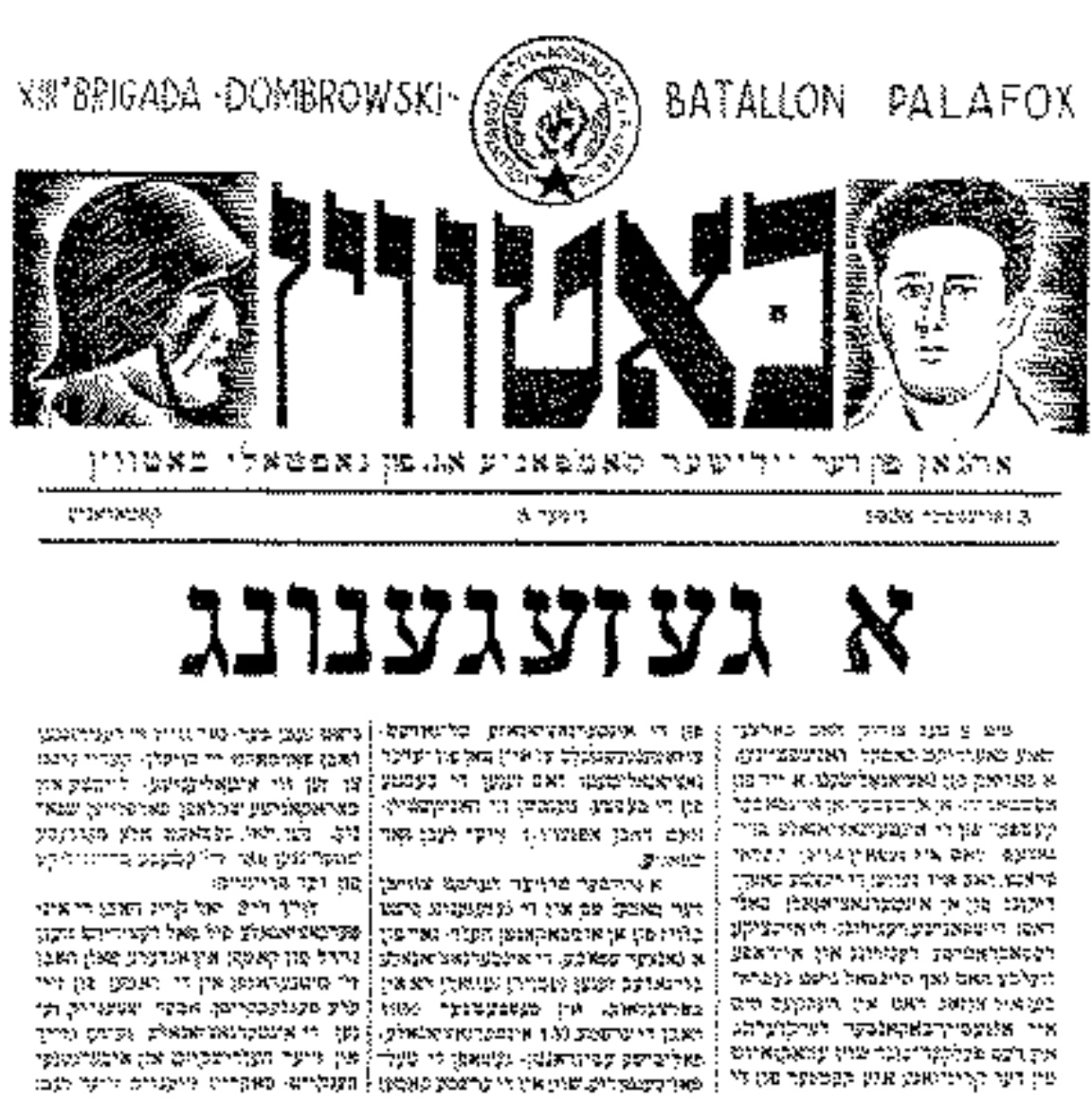
Its first commander was Karol Gutman, who was killed in action in February 1938. His successor was Leon Rubinstein, who was seriously wounded and replaced by Michal Sapir, who died in a military hospital in 1938. His successor, Israel Halbersberg, was killed in action in 1938. The next commander, Emmanuel Mink, was also wounded in action and replaced by Alter Szerman, whose successors were Tadeusz Szlachta4 and Samuel Alkalai; both fell during the offensive on the Ebro. Szerman and Mink survived owing to the fact that on September 21, 1938, one of them was wounded and the other had been appointed to another unit.
So in the nine months of this military unit’s existence, eight of its commanding officers had been killed or wounded. Today one of them, Emmanuel Mink, is still alive, in Paris. The Jewish unit had its own front-line newspaper, called Botwin, which was printed in Barcelona by the General Staff of the International Brigades. Here is an excerpt from the first issue:
“Not only the Botwin Unit, but hundreds of volunteers belonging to other companies, are waiting to read this publication. From all four corners of the Jewish world, volunteers have come to Spain to help fight fascism. Not all could be integrated into the Jewish Unit, and many among them did not wish to be separated from their fellow countrymen from their lands of origin. Nevertheless, these volunteers have not forgotten their Jewish heritage, nor that in fighting fascism they also defy the barbarity of antisemitism, as well as that accursed regime which brought us the Nuremberg Laws, the ghettos, and the pogroms.”
The Jews in the medical corps and in the aid to the Spanish Republic
Along the front line, there were 47 military hospitals. In the rear, there were 97 hospitals with 36,000 beds. Three main organizations had founded and coordinated the medical assistance offered by humanitarian groups and individuals from across the world: the “International Sanitary Center for Aid to Republican Spain,” chaired by Professor Victor Basch and based in Paris; the Ayuda Médica Internacional, the International Medical Association in charge of the medical Hospitals of the inter-brigades. The “Medical Bureau to Aid Spanish Democracy” in New York had been founded by Dr. Edward Barsky, who later became chief surgeon and commanding officer of the Medical Corps of the International Brigades. In all these organizations, which saved thousands of human lives — those of national or international soldiers fighting for the survival of the Spanish Republic — Jews from across the world played an eminent role as founders, doctors, and nurses. 72 of the 173 doctors working in the front-line hospitals were Jews; 54 Jewish doctors worked in the Brigade bases. 47 of the some fifty Polish doctors in the inter-brigades were Jews.
The end
In October 1938 the International Brigades were dissolved, and the majority of the volunteers were repatriated to their countries of origin, among them Americans, Britons, Frenchmen, Jews from Palestine, and others. This was not the case for the Germans, the Austrians, the Czechs, and the Jews among them, for they had to expect to be sent to concentration camps if they returned to their countries of origin. The Polish, Yugoslav, and Bulgarian soldiers, like the Jews, had expatriated themselves from their respective countries.
Barcelona was taken by Franco’s troops on January 26, 1939. The republican defense collapsed and hundreds of thousands of refugees streamed toward the French border. In this desperate situation, a few officers regrouped the international volunteers for the second and last time. On January 26, the 4,500 remaining members of the Dombrowski, Thälmann, and Lincoln brigades volunteered to join the international unit Agrupación Internacional under the command of the Polish Jew Henryk Toruńczyk, the former commander of the XIIIth Dombrowski Brigade. The head of operations was the Jewish officer Julius Hibner, who later fought within the Polish-Russian army, received the highest order, that of “Hero of the Soviet Union,” and became a Polish general.
The Jewish volunteer Chaskel Honigstein, from Lublin in Poland, was the last international soldier of the Spanish Civil War to be killed in battle. The Spanish government ordered, in his honor, a national funeral in Barcelona on November 1, 1938.
The Spanish poet Petere had composed a poem in his honor, a poem that was dropped like a leaflet from the republican planes.
At the time of the Spanish Civil War, Palestine had a total population of 450,000 people. About 300 Jewish Palestinians and four Arab Palestinians fought for the survival of the Spanish Republic. The Lavon Institute organized a commemorative ceremony on the occasion of the 50th anniversary of the International Brigades on September 29, 1986, in Tel Aviv. President Chaim Herzog, himself a veteran of the Second World War, took the occasion to honor the Jewish volunteers.
In March 1988 several hundred people gathered in the military section of the Fuencarral cemetery in Madrid to commemorate the monument in honor of the Jewish volunteers who were killed in the defense of Madrid in November 1936. In March 1990 a great monument in honor of the fallen Jewish volunteers was erected and consecrated on Montjuïc in Barcelona, where the leaders of the Spanish Republic are buried.
Appendix: List of Jewish officers in the International Brigades and the Republican Army
General Manfred Stern — Emilio Kléber, Austria/USSR, commander of the XIth Thälmann Brigade, defender of Madrid 1936, died in the Gulag, 1954.
General Lukács — Máté Zalka — Béla Frankl, Hungary/USSR, commander of the XIIth Garibaldi Brigade, fell in Spain.
General Wacław Komar, Poland, founder and commander of the 129th International Brigade.
Colonel Henry Toruńczyk, Poland, last commander of the XIIIth Dombrowski Brigade and of the Agrupación Internacional.
Lt. Colonel John Gates — Solomon Regenstreif, USA, chief commissar of the XVth Lincoln Brigade.
Major Milton Wolff, USA, commander of the Lincoln Battalion, XVth Brigade.
Major Boris Guimpel, France, chief of staff of the XIVth La Marseillaise Brigade.
Major Alexander Szurek, Poland, staff officer of the 35th Division.
Captain Sewek Kirszenbaum, Poland, staff officer of the XIIIth Brigade, killed at Auschwitz.
Colonel Eugeniusz Szyr, Poland, political commissar of the XIIIth Dombrowski Brigade.
Major Juliusz Hibner, Poland, chief of staff of the “Agrupación Internacional.”
Soviet Jewish military advisers and commanders:
General Grigori Stern — Grigorevich, chief Soviet military adviser in Spain, “Hero of the Soviet Union,” killed by Stalin 1941.
General Yakov Smushkevich — Douglas, head of republican aviation, head of Soviet aviation, twice “Hero of the Soviet Union,” killed by Stalin 1941.
Colonel Selig Joffe, head of the technical services of aviation.
General Simon Krivoshein, commander of the armored forces, later one of the conquerors of Berlin.
Abram Abramovich, tank commander, “Hero of the Soviet Union,” fell in Spain.
General Aleksandr Orlov, head of the secret police, organized units of republican partisans, transferred Spain’s gold reserves to Moscow, took refuge in the USA.
General Walter Krivitsky, leader of the secret police, took refuge in the USA.
Senior Jewish officers of the Spanish Republican Army
General Ruben Abramov — Miguel Gómez, Bulgaria, head of the corps of commissars.
Colonel Vittorio Vidali — Carlos Contreras, Italy, chief commissar of the Quinto Regimiento.
General Julius Deutsch, Austria, Commander of the Coastal Defense.
Commanders of the Jewish “Botwin” unit
- Karol Gutman, fell in Spain.
- Leon Rubinstein, wounded, survived the Spanish War, died young in Poland.
- Michal Sapir, fell in Spain.
- Israel Halbersberg, fell in Spain.
- Emanuel Mink, survived the Spanish War and Auschwitz, lives in Paris.
- Alter Szerman, survivor, died in Brussels.
- Tadeusz Szlachta, fell in Spain.
- Samuel Kamhi Alkalaj, fell in Spain.
Notes
See also G.E. Sichon, “Les volontaires juifs dans la guerre civile en Espagne : chiffres et enjeux” (Jewish volunteers in the Spanish Civil War: figures and stakes), in Les Temps Modernes, no. 507, Oct. 1988, 46–61.↩︎
Der jüdische Bolschewismus und die Judäo-Freimaurerei als Urheber des spanischen Bürgerkrieges.↩︎
Los Judíos Voluntarios de la Libertad — Un año de lucha en las Brigadas Internacionales.↩︎
Who was not Jewish.↩︎