The Admirable Lightness of Being: Marc Chagall
by Itzhak GOLDBERG
A man sets himself the task of drawing the world. As the years pass, he peoples a space with images, with figures that whirl about — red cows and violinists on the roofs of peasant houses, characters with detached or upside-down heads, rabbis with green faces, lovers who take flight, roosters and donkeys that inhabit the sky, the dead lying in the middle of a village, newborns sporting a beard. Irrational, Chagall’s world, illogical, fanciful? And what if the upside-down world were, in reality, the one where balance and stability dwell, while the universe capsizes on every side?
The Russia of the early century, in which Chagall lives, is a world in ferment. Upheaved both socially and artistically, the country opens to the West. The discovery of new systems of representation arouses among artists the at times frenetic will to “catch up.” Malevich, Tatlin, Lissitzky, Rodchenko thus engage in a plastic escalation that swiftly leads to abstraction. Faced with this escalation, Chagall’s work holds itself in an in-between. This universe, which remains figurative and refuses the disappearance of the subject, is peopled with characters who escape the laws of limitation. His canvases tell us singular legends, bound to the daily life of the Jewish village.
Chagall spends his childhood in the small Russian town of Vitebsk, where the life of the Jewish community is deeply imbued with religious traditions. The painter’s origins might have constituted the principal obstacle to his artistic vocation. Indeed, painting, sculpture — everything that touches on the image, on representation — are rejected by Hebrew culture, which flourishes essentially through literature and music. In deciding to become a painter, Chagall enters into conflict with his immediate circle. In his memoirs, the artist writes: “my uncle is afraid to hold out his hand to me. They say I am a painter. If I were to start drawing. God does not allow it. Sin.” The very act of translating reality into plastic terms excludes him from this world, which he can only describe from the outside.
Directly issuing from the tradition of his people, Chagall’s pictorial fables seem to transgress a fundamental prohibition of that very tradition: the prohibition of representation. Yet the painter makes a very subtle reading of the biblical prohibition, which allows him to circumvent it while ensuring his impunity. The representation that the Old Testament condemns is the one that tends to petrify the creature, to turn it to stone, to make of it an “idol.” Weightlessness, the dematerialization of the solid universe, the infinite freedom of movement, the admirable lightness of being clearly remove Chagall’s red cow from any suspicion of the golden calf.
But Chagall’s world, this imaginary world of the shtetl, is not without relation to the recent changes in the mental universe of Judaism. The Jewish intelligentsia, seeking to emancipate itself from religious tradition, becomes imbued with the ideas that will revolutionize the Russia of the tsars. The renaissance of a Yiddish literature or theater manifests the will to affirm the existence of a culture proper to this minority. It is no accident that Chagall begins to paint in 1905, the date of the first revolution. The Jewish village, “a world within a world” folded back upon its traditions, loses its certainties. Chagall draws close to the traditional figure of the storyteller, but he is conscious of the fissure forming in the familiar and reassuring world around him. His characters, who depart from convention, seem woven from the “stuff of dreams,” all the while revealing a fundamental process touching contemporary reality: “Then these elements began to disintegrate. God, perspective, color, the Bible, I made paintings upside down. I cut off heads and broke up figures into pieces that, in my paintings, flew through the air” (1963, Discours en Amérique [Discourse in America]).
Paradoxically, it is in Paris, where he arrives in 1910, that Chagall finds the “solutions” to the restrictions imposed by the Old Testament. As often, Chagall arrives late in a center of modernity, but he manages very quickly to adapt the new pictorial forms to his needs. Fauvism, cubism, partial abandonment of the subject — Chagall appropriates a great part of the discoveries of modernity, all the while preserving form, lines, traditions, the so-called humanisms, love, family, the prophets, and Christ himself, serving his identity as a Russian Jewish painter. The weightless bodies, the chromatic kaleidoscope, the deformation are like a concession to the Mosaic prohibition, which answers at the same time the demands of a modernity that invents its own laws, far removed from those of nature. The language he invents is “alogical,” closer to that of Surrealist poetry than to that of Malevich.
Chagall’s whole art, the whole soul of the shtetl
But Chagall’s own style begins to assert itself before his arrival in the capital of modernity. Le mort (The Dead Man) (1908), painted during his period of training in Petersburg, shows a village in the primitivist style dear to Malevich or Larionov. With Chagall, however, this vision, which draws on popular art, remains enigmatic. The violinist who plays on the roof of a house, his head in the clouds, is the first appearance of an emblematic figure in the artist. More unusual: in the middle of a dark street, a body lying down, surrounded by candles, as if for a strange wake. This macabre “detail” may be considered a key to Chagallian imagery. One need not know Jewish iconography to grasp the somber atmosphere of this representation. But the painter’s plastic richness often rests on a coded language, reserved for the initiated. According to Ziva Amishai-Maïlès, this painting draws on a Yiddish expression: a deserted street is a “dead street.” The black corpse is the pictorial and verbal metaphor of sadness and emptiness.
Chagall’s culture is rooted above all in a language that, like his work, is a language of mixing. More than a source of inspiration, it is the very structure of this language that serves as metaphor for Chagall’s art. Formed from Hebrew, Yiddish welcomes other languages, which it blends into a mixture where each component keeps its savor. The impossibility of classing the painter’s style among the “isms” of the 20th century, his borrowings from the various avant-garde tendencies, the deliberate “collage” of heterogeneous elements drawn from different religions and cultures (a Christ on the cross dressed as a traditional Jew, robust peasants and a violinist between heaven and earth) are in the image of a language that unifies the pure and the impure without break in continuity.
These neighborly relations are not surprising, for Yiddish has a predilection for the vivid proverb, the poetic metaphor, the incongruous expression, the humor founded on nonsense, which acts as a defense process in the face of reality. Self-mockery, so frequent in Chagall’s canvases, is, in Yiddish, a figure of style. Let us beware, however, of the naïve interpretation that would make of certain Chagall canvases the simple transposition of proverbs. Chagall is not a “literary” painter. His relations with the syntax and logic of Yiddish are far more subtle than those of translation. Chagall holds that if Yiddish constitutes his true mental ground, it is because “these locutions and these proverbs, at bottom, became popular because thousands of people like me had recourse to them every day to express their thought. If a pork butcher uses them, these images, it is not literature.”
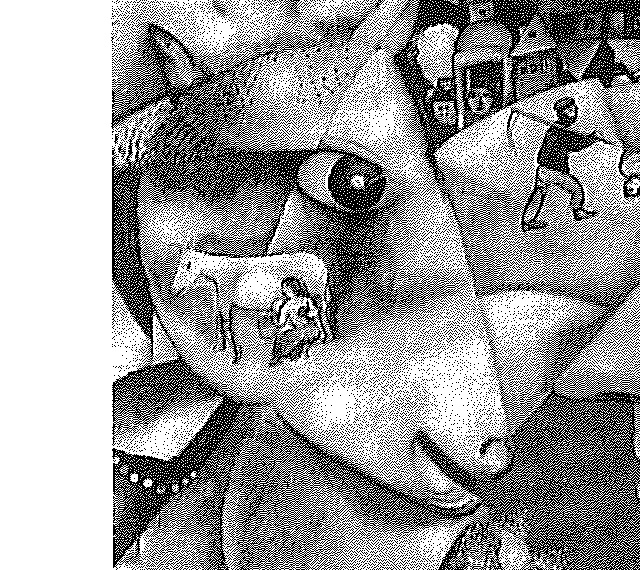
Arrived in Paris, the painter brings in his baggage his entire native land. À la Russie, aux Ânes et aux Autres (To Russia, to Donkeys and to the Others) (1911), Moi et le Village (I and the Village) (1911), L’Autoportrait avec sept doigts (Self-Portrait with Seven Fingers) (1912) are images where his past takes on the airs of a fable and that mark his attachment to naïve popular imagery. Here a farm woman, going to milk a cow on a roof, takes flight and loses her head along the way. There, the green face of a peasant and an animal’s head, both of disproportionate size, stand out against a background where tiny colored isbas, some with the roof pointing downward, climb to the sky. Elsewhere, the space of the village even enters Chagall’s Paris studio. The painter, a palette in his right hand, caresses with his left hand — endowed with seven fingers! — a canvas representing his native land, as if in miniature. He turns his back on the emblem of modernity seen through the window, the Eiffel Tower. It is only a year later, with Paris vue par une fenêtre (Paris Seen Through a Window) (1913), that the cityscape of the capital, treated in Delaunay’s Orphist manner, in transparent colors, becomes the center of the painting. But memory and nostalgia persist; two Hasidim, dressed in black, float on the right of the image. “Paris, you are my second Vitebsk,” the painter declares.
The specificity of Chagallian language resides in the close bond it weaves with the culture of his origins.
The “exoticism” of Chagall’s painting, like the “naïveté” of the work of the Douanier Rousseau, immediately seduced contemporary artists. Deliberately or not, the painter exploits this situation: Vitebsk, which was in reality a relatively important urban and cultural center, linked by railroad to Moscow and Petersburg, thus takes on more and more the air of a village lost in the immense Russia, indifferent to the rumors of the contemporary world. As often, Chagall goes from the periphery toward the center, all the while preserving the imprint of the periphery. The artist thus manages to impose a nostalgic stereotype that exerts a powerful charm on the cosmopolitan milieu of the avant-garde of the great metropolises.
The “Luft-Mensch” is the allegory of the entire work of the Jewish painter, tragic but smiling.
Chagall’s magical visions will seduce the Surrealists. But the artist’s imaginary world remains anchored in a precise time and space. The specificity of Chagallian language resides in the close bond it weaves with the culture of his origins. The flying figure, who constantly defies the laws of gravity, is a traditional figure, found in the expressions of the Jewish language and in the literature of the end of the 19th century. It is the “Luft-Mensch,” the man who floats, literally “the man of air,” staged in the plays of the pioneer of Yiddish literature, Sholem Aleichem — Chagall creates the costumes and sets for them. A despairing “opssimist,” tireless builder of castles in Spain, this man has “his feet in Vitebsk and his head among the stars” (Alexandre Kamenski). In the manner of Gogol’s characters, who endlessly push back the frontiers of the real — Chagall illustrates The Government Inspector — the Luft-Mensch is a provincial in quest of epic, a mixture of stagnation and flight, of tragedy and comedy, of good sense and nonsense. A great connoisseur of biblical expressions, which he deforms and updates as he pleases, he firmly believes in the possibility of adapting reality to his dreams. The Luft-Mensch is the comic, sometimes grotesque, version of the man without ties, of the acrobat in search of balance, of the wandering Jew. Unjustly accused of being without roots… His roots are quite simply aerial, like those of certain rare plants. The Luft-Mensch is the allegory of the entire work of the Jewish painter, the figure of style of an art detached from the ground. Tragic but smiling lightness of exile…
Au-dessus de Vitebsk (Over Vitebsk). Executed in Russia in 1914, a moment of a certain return to order, this rather realistic view is contradicted by an old man, a bundle on his shoulder, who takes flight behind the church. A Luft-Mensch, but also a beggar, commonly designated in Yiddish as “the one who walks over the town.” Beggars, but also rabbis who carry a citron on their head, scrolls of writings in the sky, acrobats clad in a tallit (a shawl used for prayer) — Jewish themes run through Chagall’s work. Not that he was the first to show the life of his coreligionists. Others, such as his first master, Pen, applied themselves to presenting everyday scenes of this people, but always in an academic manner. Chagall transformed these characters into visual symbols where the magical borders on the natural. The feeling of exaltation that emanates from the most ordinary gestures feeds on the legends that enchanted his childhood. His fantastic wandering draws on Hasidism, a spiritual and popular movement born in the 18th century in Eastern Europe. Contrary to official Judaism, Hasidism believes that ecstasy, enthusiasm, song, and dance bring man closer to God. “The Hasid maintains bonds of complicity with the whole of creation, beginning with the animal kingdom” (Michel Makarius), whence the bestiary that peoples Chagall’s entire work.
If Chagall often seems on intimate terms with religious subjects, it is because Hasidism is a belief reinterpreted in the sense of an extreme proximity to the divine. When Chagall undertakes to render the very particular atmosphere of Jewish spirituality centered on the reading of the Book (La Prisée, 1912), or when he approaches a highly coded Christian subject, the Christic transfiguration in the crucifixion (Golgotha, 1912), he inscribes transcendence within immanence. Chagall here keeps a freedom close to that of the hermeneutic tradition. We know indeed that the interpretations of the Bible, which can draw together fragments or episodes distant in time, play with chronology. The painting of the Russian artist likewise refuses temporal linearity, and the comings and goings between the archaic universe of Vitebsk and the modernity of the avant-garde world are very frequent.
This temporal voyage is often accompanied by a spatial voyage. The Jews of the diaspora have always maintained an ambivalent relation to space. There is the territory of reality, functional space, and the territory of the imaginary, “promised” space, where all desires and all aspirations are borne: “next year in Jerusalem”… These two spaces coexist, the territory of the imaginary nonetheless exerting an irresistible ascendancy over consciences. The celebration, in the very middle of the Russian or Polish winter, of Sukkot (or Tabernacles, as one sees with Le Rabbin au Cédrat [The Rabbi with the Citron], 1914), a festival whose ritual requires the consumption of fruits and vegetables of the promised land, illustrates this situation to the point of absurdity. A situation where the bearings in space and in time collide. Chagall’s floating figure thus takes, in its apparent lightness, a giant’s stride, a step that allows him to situate himself in the in-between.
There exists a place where all the ingredients of this art can mingle, a place where the characters move freely in time, space, and where bodies are modeled at the whim of fancy. It is in the theater that the artist will explore, in the 1910s, the limits between art and reality, arriving at a total work of art. “To work for the theater was always my dream,” writes Chagall; the numerous sets he executes throughout his career are the witnesses of the realization of his dream, but also of his greatest failure.
The painter attends for the first time the preparation of sets alongside his teacher Bakst, who works in 1910 for Diaghilev’s Ballets Russes. Four years later, Chagall in turn designs sets for a cabaret show in Petersburg, where he demands that the actors paint their faces red and their hands green. From his beginnings, the painter feels the soul of a director and goes so far as to subject bodies, faces, and morphologies to his plastic ideas. Chagall conducts himself in the theater like a painter before his canvas, as a sovereign. Conversely, the canvas is sometimes transformed into a stage: in Self-Portrait with Seven Fingers, the face is a theatrical mask. Subsequently, the painter executes the costumes and sets of several plays by Gogol, his literary alter ego. The preparatory sketches allow one once again to draw this work close to the pictorial work of the same period (Le Saint Voiturier [The Holy Carter], 1912).
After several aborted attempts, Chagall undertakes his masterpiece: the sets of the Moscow Jewish Theater, inaugurated after the Revolution, which is meant to consecrate the renewal of Jewish culture. The project is important because, beyond the sets for a play by Sholem Aleichem, the artist also has the task of decorating the theater. Entirely painted by Chagall, the interior architecture of this theater becomes a veritable scenic environment. The spectators’ attention is drawn both by the stage and by the surrounding space, where Chagall has figured several actors of the troupe.
The painter’s work meets with rapid success. Its influence “manifested itself not only in the sets, the technique of makeup, and the costumes, but in the acting of the players” (Lioubomirsky). The place will be renamed “Chagall’s box.”
The painter seeks to combine the achievements of the Paris period (multiple viewpoints, colored geometric forms cutting up space in an arbitrary way, transparencies) with numerous motifs of Jewish folklore. The seven panels (preserved clandestinely for nearly fifty years, they were recently rediscovered) represent allegories of the different arts; the theater holds the leading role among them. The principal panel, Introduction to the Jewish Theater, represents dancers, acrobats walking on their hands, musicians, and other figures of the world of spectacle. In the other panels of the cycle, one finds again the figure who symbolizes the Jewish theater, the public entertainer, the badchan. Just as the violinist at his side, the badchan amuses the guests during the festivals of the community. Above all, the badchan is, as Avram Kampf explains, the precursor of the tradition of the Jewish theater. It is during the Purimspiel (the plays of Purim), whose history goes back to the Middle Ages, that the badchan, a sort of local troubadour, appears. At the festival of Purim, this Jewish carnival, the badchan becomes a versatile actor who acts, dances, mimes, tells comic stories, and animates the one festival where it is not only permitted but strongly advised to drink alcohol. Indeed, in disguise, the participants of the feast must reach a state of inebriation such that one can no longer “distinguish between a Jew and a gentile.” A symbol of unbridled theatrical imagination, the badchan is like the double of the painter himself, who transforms life into a joyous pictorial carnival.
But the success is short-lived. The Jewish theater no longer calls upon Chagall. The painter is accused of usurping his function as set designer by Effros, the adviser to the director, who observes that the artist understands nothing of perspective and of the organization of scenic depth. Chagall, who builds his sets as he would paint a canvas, in reality emerges victorious from his confrontation with the stage. The theater bends to the laws of painting. This accusation is thus, despite itself, the greatest homage one can pay to Chagall’s work.
A few years earlier, on the occasion of the first anniversary of the Soviet revolution, Chagall metamorphoses the landscape of Vitebsk. At the instigation of the poet Mayakovsky, who wants the streets to become brushes and the squares palettes, the artist gathers all the house painters to entrust to them the task of decorating the entire town. “Vitebsk one day became the fabulous kingdom of modern painting: the tramways, the shop windows, the houses arrayed themselves in dazzling colors” (Anatoli Strigalev).
Two apparently contrary experiences: to give the theater the illusion of life, to give reality the adornments of illusion. Chagall the director, for his part, never made the difference.
I.G.