For my father, who came from Poland. For my mother, whose father came from Spain.
when, at sixteen, young Karl Rossmann sailed into the port of New York on the now-slowing boat, the Statue of Liberty, which he had long been watching, appeared to him in a sudden burst of light. It was as though the arm brandishing the sword had been raised at that very instant, and the free air blew around that great body
Franz Kafka Amerika
With the typography characteristic of the scansion of his own text, this is the slightly modified excerpt from Kafka’s novel that Perec quotes in Ellis Island, after a citation — set as the epigraph to the second part — taken from Motl, fils du chantre (Motl, the Cantor’s Son) by Sholem Aleykhem, a classic of Yiddish literature. Kafka, who never went to America but who sees in a dream the port of New York even before conceiving the character of the young emigrant Karl Rossmann, synthesizes, in this splendid novelistic opening, the two principal sides of emigration narratives: if the promise of a new life haloes with beauty the very symbol of America in the eyes of the new arrival, it is at the cost of an optical illusion proper, according to Perec, to the emigrant experience:
to be an emigrant was perhaps very precisely this: to see a sword where the sculptor believed, in all good faith, that he was placing a lamp and not to be completely wrong1
A literature of transition
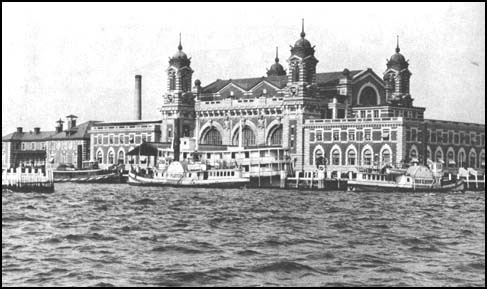
Jewish emigration to America at the end of the nineteenth century and the beginning of the twentieth has a dual dimension, individual and collective, the product of the dream but also of misery and oppression. It is particularly characteristic of a millennial experience of minority status, of wandering and of messianic utopia. The rupture, exemplified by the sword of the Kafkaesque text, manifests an obligatory stage in the path that leads the emigrant from the utopian dream to the reconstitution of a new identity, in a scheme akin to a symbolic death followed by a second birth. The numerous emigration narratives, whether autobiographical or fictional, arrange a series of narrative passages around the notions of rupture and continuity, at the term of a trajectory initiated by constraint and by desire, leading to the necessity, for each individual, of renegotiating his identity by the measure of reality and of historical experience. The crossing of the ocean, often preceded by manifold difficulties, is from then on comparable to an initiatory ordeal, which Jewish culture — like the first Puritan pioneers — codes in symbolic terms borrowed from the Bible: from the “House of Bondage” marked by Russian oppression, to the Exodus and to the problematic discovery of the Promised Land at the journey’s end. The arrival in New York is the occasion of an ambivalent experience: the sight of the Statue of Liberty, symbol of the European dream of rebirth, and the passage through the emigration offices, Castle Garden or Ellis Island — a moment of intense anguish where the first contact with American society, the fear of being sent back to Europe, the apprehension before an unknown and incommensurable reality are all at play.
From 1881 onward, and from the first great wave of pogroms in Tsarist Russia, Jewish emigration to the United States — which until then had proceeded by a trickle — knew an unprecedented increase: “During the thirty-three years that elapsed between the assassination of Alexander II and the outbreak of the First World War, about a third of the Jews of Eastern Europe left their original residence; in modern Jewish history, this migration can be compared only to the flight before the Spanish Inquisition.2” Increasing with each new wave of abuses, the emigration stabilizes around the nineteen-twenties: “Landed from the steerage of liners, in rags, infested with vermin and bearing unpronounceable names, the immigrants transformed themselves into creatures of the New World […] They did not find the mythical street paved with gold that had fired their imagination. But they founded families, sent their children to the Yankee school, where some soon discovered another kind of gold: education, with its capacity to interpret and then to change Yankee culture.3” Irving Howe too strongly underscores this transformative dimension of the immigrant experience, not only insofar as it touches the new arrivals, but also the host country: “Most of them left for personal reasons, to relieve the sufferings of a life become intolerable and to satisfy long-pent ambitions. Yet, very deeply, this migration of the Jews of Eastern Europe answered to the spontaneous and collective impulse — perhaps even the decision — of a people that had little by little grown aware of the necessity of exploring new ways, a new life.4”
Written principally in Yiddish or in English (apart from the German-language work of Joseph Roth), the texts we have chosen from among so many others are, for the most part, literary texts, even if the model of the emigration narrative is always on the horizon of their making, whether or not they issue from a personal experience of their author. The literary quality is from then on inscribed in the singular use of a frame formed by collective experience. The enunciation of the passage from the old to the new world, in every sense of the term, characterizes the Jewish literature of modernity, bearing the double hallmark of history and of a labour of narrativity and of symbolization. It marks one of those sites of cultural transmission uniting generations of authors, setting in motion phenomena of repetition and of imagination on the part of the “descendants,” as is attested, among others, by the texts of Perec, of Jerome Charyn, of Paul Auster, written in the aftermath of the migratory process. It is thus a trajectory not only geographic but also temporal that is inscribed in the intertextuality of displacement and of migrant identity.
As Perec underscores in Ellis Island, the literary text undoes the standardizing dryness of statistical data in order to fix traces encoded by voices and faces:
not to say only: sixteen million emigrants passed in thirty years through Ellis Island, but to try to imagine what those sixteen million individual stories were, those sixteen million stories identical and different of those men, those women and those children driven from their native land by famine or misery, political, racial or religious oppression, and leaving everything, their village, their family, their friends, taking months and years to gather the money necessary for the journey, and finding themselves here, in a hall so vast that they had never dared imagine there could be anywhere one so large, lined up in rows of four, waiting their turn it is not a matter of pity but of understanding5
A thought of utopia
Hotel Savoy by Joseph Roth fleetingly anticipates, at the end of a classic “return from war” narrative, the American motif that will develop with far greater amplitude and pessimism in Hiob (Job). The wandering trajectory of the demobilized soldier of the First World War closes on the dream of departure toward that absolutely “other” elsewhere that is America: “America, I said to myself, Zwonimir would simply have said: America!6”
One finds numerous analogous formulas, of which the most famous is no doubt that of Kazan’s film, America, America. In 1912, the autobiographical narrative written in English by Mary Antin, a young Russian Jewish woman who had emigrated with her family in 1894, already uses the topos: “So at last I was going to America! Really, really going, at last! The boundaries burst. The arch of heaven soared. A million suns shone out for every star. The winds rushed in from outer space, roaring in my ears, ‘America! America!’7” Anzia Yezierska, born in 1880 in Russian Poland, emigrated in 1890 and never ceased to return to this founding experience in stories in English of a markedly autobiographical tone. In How I Found America, she formulates in analogous fashion the historical experience and its individual incarnation, as though the word “America” exhumed from the depths of history the signifier of emancipation: “Age old visions sang themselves in me — songs of freedom of an oppressed people — America! America!8” Abe Cahan, a young intellectual arrived from Russia in 1882, founder of the Yiddish daily the Forverts, writes in his English-language novel The Rise of David Levinsky, published in 1917: “Then it was that the word America first caught my fancy — the name was buzzing all around me — the great emigration of Jews to the United States, which had received its first impulse two or three years before, was already in full swing… Then it was that the cry ‘to America’ was raised. It spread like wild fire…9”
In Yiddish, the classic narrative of the Jewish epic in America, Motl, fils du chantre (Motl, the Cantor’s Son), by Sholem Aleykhem (1916), plays constantly on stereotype and repetition, through a humorous vision in which a child’s gaze and an ironic distance merge. It is this text that figures in Perec’s, as a naïve invitation to the path of memory: “Hush, we are leaving for America! Where is America? I don’t know. I only know that it is far, terribly far.10” The chapter ends on the same ecstatic repetition: “We are leaving, we are leaving, we are leaving for America!11”
Motl, the little Jewish boy on the way to America with the common folk of the small towns fleeing the pogroms, allows his author to transmit the utopian scope of mass emigration. Unlike Menahem-Mendl, another famous character of Sholem-Aleykhem who also goes to America, Motl is a “medium” particularly open to the appeal of novelty. The “American” letters of Menahem-Mendl, written at the start of the century before the first stay Sholem-Aleykhem made in the United States in 1906, following the Kiev pogrom of 1905, develop the classic topoi of the New World and are inserted into the trajectory of the luftmentsh, the pauper forever in search of expedients12. In the space of a few pages, all the stereotypes are summoned to give substance to a space conceived as essentially individualist and materialist, centred on work and on success. Forever restless, Menahem-Mendl in fact hastens to make the return voyage to regain Warsaw. In 1914, when Sholem-Aleykhem takes up the adventures of Motl again, he confers on them a weight of experience, a density in time and space, a linearity sustained by the precision of details that manifest the centrality of the American place and the inescapable character of mass emigration. If the author, for his part, makes the crossing in second class and is triumphantly received in the United States, his letters bear witness to his compassion for the Jewish emigrants of the steerage13.
In the American epic of the cantor’s son, the childish refrains (which punctuate, in a constantly optimistic manner, the often dramatic vicissitudes of the journey), the joy of living, the juvenile adaptability admirably render the myth, central in this author, of Jewish vitality, of the almost biological capacity for renewal of a people seasoned by persecution. The critic Dan Miron remarks that, apart from the London episode, adorned with the sombre colours of greyness and hardness of heart, the young emigrant’s adventures unfold in a kind of perpetual summer, without the passage of time, without transformation of the character, without “becoming” or “scheme of education14.” More than a character of Dickens or of Mark Twain, to whom he has often been compared, he calls to mind Karl Rossmann and his tireless enthusiasm. Only a utopian scheme can account for this perpetual “goodwill,” made still more manifest by the uncompromising depiction of a pitiless reality.
The narratives modelled on autobiographical experience make this utopian instance resound still more directly, through a network of images destined to forge a representation adequate to the practically unlocatable, almost nameless ideal that draws on individuals and communities. For Anzia Yezierska, the emigrant “hungers” and “thirsts” for America, as for a compensation for the unbearable limitations of Jewish life in Russia.15 The magnetic appeal of America evokes a continual flow of quasi-hallucinatory visions, of extraordinarily intense colour and luminosity: “I floated in showers of sunshine, visions upon visions of the new world opened before me. From lips to lips flowed the golden legend of the golden country.16” For Abraham Cahan in David Levinsky, “The United States lured me not merely as a land of milk and honey, but also, and perhaps chiefly, as one of mystery, of fantastic experiences, of marvelous transformations.17”
The popular vision of the Eldorado seems to fade before the desire for individual metamorphosis. The “world turned upside down,” the land of Cockaigne, the country where the land belongs to everyone and where all are equal sketch a purely utopian configuration, literally “placeless”: “America is a unique country, unlike the rest of the world.18” For Mary Antin, the “superlative” vision of America corresponds very exactly to the idealism of the emigrants: “the noble dreams and high ideals that may be hidden beneath the greasy caftan of the immigrant.19” It must be remarked, however, that this enunciation essentially characterizes the pioneer period of emigration at the turn of the century, during which many arrivals attest to strongly politicized aspirations, as in the case of Abe Cahan, who emigrates with the group of young anarchists of Am Olam to found libertarian agricultural colonies. The climate of discrimination in Russia favours a general aspiration to freedom of expression and to the acquisition of human, civic and political rights.
This dimension disappears from later texts; one finds it neither in Call It Sleep by Henry Roth, nor in Hiob (Job) by Joseph Roth, nor in the texts of the Singer brothers: The Family Carnovsky by Israel Joshua, or The Manor, Lost in America, or Enemies, A Love Story by Isaac Bashevis. These texts depict emigration either as a purely individual choice due to particular circumstances, or as a forced departure in a quite different political context, that of the rise of Nazism, at a moment when America has already closed its doors and has lost its mythic prestige in the eyes of Europeans. More than a compensatory dream, the desire for departure thus seems to correspond to an aspiration to refound elsewhere a fully human existence, far from the convulsions of anti-Jewish hatred poisoning Europe. In this sense, one may keep in mind the parallel that would maintain, despite considerable differences, the link with Puritan idealism. Abe Cahan appeals to this analogy when he evokes the arrival in America: “When the discoverers of America saw the land at last, they fell on their knees and a hymn of thanksgiving burst from their souls. The scene, which is one of the most thrilling in history, repeats itself in the heart of every immigrant as he comes in sight of the American shores.20”
Biblical references abound in these texts steeped in Jewish culture. The most important are organized, as in the chapter headings of Mary Antin’s book, around the scenario of the Exodus from Egypt and of the Promised Land. The crossing of the Atlantic is designated as the “Passage of the Red Sea” in Sholem-Aleykhem. The ports and cities before arriving there are so many Sodoms. During the boat journey, the Angel of Death is present, and when the storm breaks out, it is God himself who unleashes it from atop the divine chariot. The arrival in America, for its part, once the first impression of salvation has passed, is evoked as the traversal of the seven circles of hell; in other texts, one finds the term Gehenna. In Shapiro’s story On the Ocean, the sea and the sky evoke the tohu-bohu [primordial chaos] that precedes Genesis, at the moment when the spirit of God floats over the waters in a world without separation21. Joseph Roth evokes Job through the character of Mendel Singer, and the crossing confronts the humble human creature with the divine omnipotence that created the sea with the Leviathan dwelling in it. Likewise, for Isaac Bashevis Singer, the vision of the ocean refers to a pre-genesiac world wholly inhabited by the splendour and radiance of the divine. As for the passage through Ellis Island, it is equivalent to the Day of Judgement. Beyond their automatic character in authors formed by a traditional education, these references anchor the experience of uprooting in a semantic horizon that relativizes its destructive scope and makes it possible to account for individual ruptures by the measure of a codified collective experience.
The crossing
As powerful as the utopian enunciation, the realism of the evocation of the journey brings into play a series of enunciations recurrent from one text to another. Even if it corresponds to deep aspirations repressed by misery and oppression, the departure breaks the bonds with the native country, the community of the small town, a still largely traditional way of life structured by centuries of adaptation and of semi-autonomy in religious matters. Despite the growing restriction of the frameworks of Jewish life, individuals, even deprived of rights, feel on leaving that they are quitting, no doubt forever, an imponderable element of the European experience, something like an “air,” a way of being in the world, a manner of breathing, whether in nature or in the great Polish or Russian cities, that they will be able to find nowhere else: “In America were rooms without sunlight, rooms to sleep in, to eat in, to work in, but without sunshine.22” sums up Anzia Yezierska soberly.
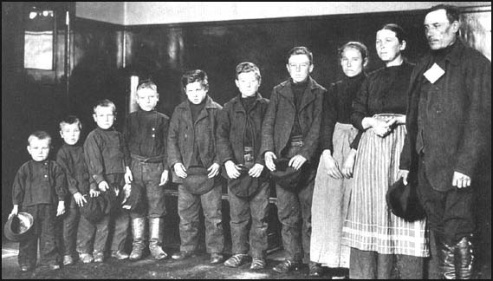
Yet, before arriving in America, what difficulties, what terrors, what manifold anguish! The obsession with pogroms runs through the texts. Cahan, in his autobiography, retraces as a historian the onset of the pogroms of 1881. Mary Antin devotes several chapters to the evocation of her child’s life in the Jewish Pale of Settlement. David Levinsky, Cahan’s fictional character, leaves Russia after seeing his mother beaten to death by a Gentile on the market square. Lamed Shapiro, the Yiddish author “of the pogroms,” evokes in The Cross and in Pour Out Thy Wrath American emigration as the direct consequence of this traumatic experience.23 In this latter story, whose principal character, Meyrl, is a child, the evocation of the departure follows the description of the home ravaged by violence: “Three weeks later, they left for America. On the water, it pitched a great deal, and his mother stayed lying down the whole time in her berth below, and she vomited terribly. Meyrl bore up well, and his father never ceased pacing back and forth, tirelessly, on the deck, even under a torrential rain, until he was brought back down.24” In Sholem-Aleykhem, Motl resists with all his might the sombre atmosphere in which the adults move: “The men, for their part, spoke of America, of business, of Columbus, of persecutions, of pogroms. They cannot do without persecutions and pogroms. And I have already told you that I don’t like that. Let someone start speaking of persecutions or of pogroms, and at once I leave.25” The impossibility, for the parents, of giving their children a suitable education because of the numerus clausus, joined to the total lack of opportunity in the impoverished small town, strangled by Tsarist legislation, or else again the will to escape the hated military service, are among other reasons invoked for departure.
The stages of the perilous journey are the object of enunciations more or less detailed but shared. Jewish emigration is massively familial, and the emigrants carry with them the last vestiges of Jewish life in Eastern Europe. In Motl, the Cantor’s Son, it is the bedding that symbolizes, like Karl Rossmann’s suitcase and umbrella, the fragile link with the past and the agonizing risk of loss. At the border crossing, dishonest smugglers confiscate it from them, thus definitively severing the umbilical cord with the small town. At the moment of leaving Europe, one of the characters delivers a speech without appeal, bidding a definitive farewell to a stepmother-homeland incapable of recognizing the merits of its persecuted sons. In Shapiro, on the contrary, the hero of The Cross, a survivor of the pogroms, prophesies a vengeful return: “There will arise a generation of iron. And it will build what we have let be destroyed.26”
The massive character of the emigration is expressed by the organization of channels taken in hand by “committees” allowing the reception of the emigrants all along the journey, the sanitary controls and the boarding of a boat, for a crossing that lasts about two weeks at the start of the century. Sholem-Aleykhem’s text is particularly detailed about the journey that leads the emigrants from the imaginary town of Kasrilevke to New York by way of Brody, Lemberg, Vienna, Antwerp, London… Everywhere, the child narrator underscores, in a typifying manner, the impression of novelty, in particular through the play on languages, clothing and cultural stereotypes, but also that of continuity, through the geographic transfer of the Eastern Jewish way of life, with its shops, its smells, its language (Yiddish), its traditions… In a recurrent and humorous fashion, the child hero observes that the foreign cities, of which he sees only the Jewish quarter, are in fact only one and the same great familiar entity: a single Berditchev, a single Kasrilevke! One of the chapters is in fact entitled “Kasrilevke in New York.”
The boat journey is particularly dreaded for the deplorable conditions of hygiene and promiscuity that reign in the steerage, augmented by the poor quality of the food, the forced fast on bread and water for observant families, and above all the anguish of storms and seasickness. The strict separation of social classes appears starkly in the enclosed space of the transatlantic liner, and even the inveterate dreamers in Sholem-Aleykhem are obliged to observe that the emigrants bound for the land of liberty are indeed treated like cattle, penned up before being subjected to the dreaded sanitary control of Ellis Island. Fixed by the images of Charlie Chaplin, the counting, the distribution of the emigrants, the brutal separation of families, the medical examinations — in particular the most dreaded of them, to diagnose trachoma — and finally the authorization or refusal to disembark make of the passage through Castle Garden or Ellis Island a moment of shock, of brutal contact with the antiseptic bureaucracy of America, the vision of a gigantism of space and of social organization from which Kafka was able to draw profit in his American novel.
Sholem-Aleykhem entitles a whole chapter of his book after the nickname of Ellis Island, “the island of tears”: long before Perec, his narrator unwinds the heart-rending stories that form an “ocean of tears” in all the languages and for all the peoples who passed through the brick buildings of Castle Garden or the immense main hall of Ellis Island. When the emigrants have no one to receive them and are without resources, they may remain for weeks at Castle Garden, waiting to find work, as numerous documentary narratives attest. Some are kept in quarantine, others are even turned away and sent back to Europe. Entry is refused to children whose parents are accepted. In Motl, the Cantor’s Son, Sholem-Aleykhem’s sentimental vein pours forth through the story of a child abandoned in a European port and taken in by the narrator’s family, to whom entry is barred because he has no papers and no acquaintance in the country. For all the new arrivals, the passage through Ellis Island is memorable, constituting a kind of touchstone of the metamorphosis demanded by acculturation and uprooting.
Death and birth
“A departure for America,” recalls Marcus Ravage, “was like a death […] The whole community would go in procession to the station, would weep loudly, would lament, and the following Sabbath one would pray for the unfortunate travellers.27” Numerous indications, even in the most personal texts, bring out the symbolic scope of the journey, compared in its unfolding and its meaning to a veritable death, at the issue of which each may hope to be reborn, on condition of surmounting the trials of the crossing and the risk of loss. In the story The Miracle, Anzia Yezierska uses the same image: “The moving along to the station was like a funeral.28”; “The procession resembled both a funeral and a triumph.29” declares Mary Antin in evoking her departure from the small town. Sholem-Aleykhem too arranges a humorous contrast between the women’s lamentations and the comic gestures of the farewells, which the child, delighted to be leaving, registers with detachment.
If the separation from the integrated collectivity of the small town is difficult (or at the very least ambivalent), that from one’s near ones is often poignant, insofar as it may appear definitive. Joseph Roth, in Hiob (Job), restores, under the appearance of the tale, the infinite pain of the rupture, akin to a mourning: “All at once she resolves on the separation. She gently sets the child down on the threshold, as one lays a dead person in a coffin.30” Isaac Bashevis Singer, in his autobiography, insists at length on the funereal atmosphere surrounding his departure from Warsaw, in 1935, even as he is aware of thus escaping a threatening fate. His train crosses Nazi Germany at the time of Hitler’s birthday, swastikas adorn the streets and the persecutions against German Jews have just begun. He leaves behind him his mother and his young brother, women he has loved, a whole Jewish atmosphere that already seems to him to be tipping over into the past and the sphere of memory: “My two suitcases, set in a corner, were the silent witnesses of the thirty years I had lived in Poland — the Poland that, on that day, seemed to me more distant still than today, forty years later. I was what the kabbalah calls a naked soul, a soul that has left one body and awaits another.31” The boat journey he evokes as a nightmare recalls the Célinian episode of paranoia aboard the Admiral Bragueton, but also the labyrinthine aspect of the ship in Kafka’s Amerika. Spatio-temporal disorientation, claustrophobia, and disturbances of memory and language characterize the regressive moment accompanying the crossing of the liquid element.
The episode of the crossing of the Atlantic and of the arrival in the New World is rich in initiatory resonances and gives rise, in the texts of literary make, to important lyrical developments. The discovery of the ocean, for Jews who have generally never seen the sea, is the occasion of a disconcerting contact with the immensity of the cosmos, the beauty of creation and the notion of eternity. Human smallness is apprehended through the image of the boat, epicentre of a fragile world and metaphor of the isolated and vulnerable self. Mary Antin, influenced by transcendentalism, evokes the feeling of close union between the self and nature, which she links to the experience of absolute solitude, with reference to Robinson Crusoe: “I was aware of no human presence; I was conscious only of sea and sky and something I did not understand […] I loved the ocean. It seemed as if it were within as well as without, part of myself…32” Shapiro, in his poetic and symbolist narrative On the Ocean, develops at length the motif of the traveller’s solitude before an eternal and quasi-genesiac nature. Time is suspended, infinite, and the traveller, like the Flying Dutchman, wanders between past and present, in an unassignable dimension, a spatio-temporal no man’s land mingling dream and reality, near memories and cosmic visions, sensations of plenitude and an anxiety close to madness. In Joseph Roth, the description of the beauty of the natural spectacle goes hand in hand with a mystical feeling of bond with the Creator: “Eternal, this was an eternal element. Mendel understood that God in person had created the waters.33” Likewise in Isaac Bashevis Singer: “God pronounced indefinitely the same word, dreadful and eternal.34” In The Cross, Lamed Shapiro prefers to evoke a Dionysian and pagan feeling of union with nature, in a “Nietzschean” hero whom the pogrom has definitively cut off from the God of his fathers: “And I, newborn, already feel myself strong enough. Very soon, I shall return to the homeland.35”
The metamorphosis of the individual who has passed through the in utero regression, assimilable to a symbolic death, is strongly underscored by Mary Antin in the introduction to her narrative: “I was born, I have lived, and I have been made over. Is it not time to write my life’s story? I am just as much out of the way as if I were dead, for I am absolutely other than the person whose story I have to tell.36” The arrival in New York reads as the culmination of this narrative of birth, through the omnipresent reference to the Statue of Liberty, seen as an ambivalent maternal figure. Always presented as monumental, crushing, it is set within a symbolism more ambiguous than that of the allegory of the Enlightenment it is supposed to embody. The child Motl sees it as an “immense and terrible silhouette of metal that resembles a wet-nurse”; the mother and child in Call It Sleep as a “massive silhouette” with “dark points that ploughed the air,” with a torch resembling an “ebony cross, the blackened hilt of a broken sword37”; in Shapiro’s On the Ocean, the statue is described as a “gigantic feminine figure with raised hand,” her gaze turned “anxiously” toward the city. In The Family Carnovsky by Israel Joshua Singer, the “Statue of Liberty darted rays of sunlight from her raised hand, but the land on which one disembarked had no relation to the glittering points glimpsed from afar. It was warm and soft and sent forth a breath heavy with sweat, like a wet rag.38” In Joseph Roth’s text, the statue is evoked with its “crown of rays” and the electric light that never goes out, but by way of a gaze external to that of the principal character, wholly passive before the landscape of the New World. The emigrant gaze in every case confers a formidable ambiguity on the gigantic form that seems to repel as much as to welcome. Its sight is sometimes accompanied by thanksgivings and hymns of praise, but it often gives way to the expression of the disquiet and anguish associated with the arrival.
“A bridge of understanding”
The contact with reality at the term of a journey that figured as a moment of suspense and indefinite waiting is accompanied by an acute feeling of loss and disaggregation, even before the inevitable disappointment before the first difficulties. Tempered by hope and idealism in the texts of the pioneer period, this anguishing sensation is explored with more literary insistence and psychological amplitude in the later fictions, such as those of Roth or of the Singer brothers. In Hiob (Job), the shock of the arrival is so intense that Mendel Singer faints: “America assailed him, America reduced him to crumbs, America shattered him.39” The abandonment of his disabled child symbolically renders the scission with the deep self, inseparable from the Jewish life of Eastern Europe. The arrival in America is equivalent to an irreducible loss of identity and condemns to solitude the inner being separated from itself. Like the narrator of Singer’s autobiography, the Rothian character is “lost in America.” The physical impression of fragmentation and dispossession is described very concretely in Aaron Roboy [Aïzik Raboï], in his Yiddish novel of 1929, A Jew in America: “Sometimes, he is so bewildered that he paces the streets and feels himself going off in little pieces, a piece here, a piece there, everywhere he loses himself.40” The American stories of Lamed Shapiro, New Yorkish, are likewise devoted to the theme of loss, even if they dwell little on the motif of the arrival. But it is no doubt in Isaac Bashevis Singer that spatial and identitarian wandering culminates, through the evocation of characters cut off from reality and given over to their inner demons. The disintegration of communal space then corresponds to a sociological reality, and the writer’s gaze on Yiddish culture is at once implicated and sarcastic. The last lines of the autobiography, after a trajectory marked by a half-unconscious will to resist adaptation, bear witness to an obscure will to engulfment and self-destruction: “Then I went to the window, opened it and contemplated the wet street, the dark windows, the flat roofs, the reddening sky, moonless, starless, opaque, stagnant, which seemed to cover the globe. I leaned out as far as I could, breathed in deeply the miasmas of the city and proclaimed to myself and to the powers of the night: I am lost in America, lost forever.41”
Of all the authors evoked, Singer is the only one to write his texts in the aftermath of the destruction of the Jews of Europe. This dimension is of course absent from the texts of the first period, where the hope of rebirth compensates for the memory of the sufferings endured and necessitates a refounding of identity, beyond the inevitable losses of the crossing. Mary Antin compares this process to the education of the infant and to a child’s “first steps” in the “nursery America.” Access to the American educational system is consequently the touchstone of the appropriation of identity: it is at the moment when the father leads his children to school, and not at the moment of the arrival, that he “takes possession” of America. Anzia Yezierska evokes the same finality in the act of emigrating: “to make a person of myself.” This demand, formulated by a few talented authors, is common to all emigrants, as Mary Antin underscores in order to justify the act of writing: “It is because I understand my history, in its larger outlines, to be typical of many, that I consider it worth recording.[…] We are the strands of the cable that binds the Old World to the New.42” Anzia Yezierska arrives at an analogous formulation: “I began to build a bridge of understanding between the American-born and myself.43” The utopian project turns around the question of a “place” to be defined and founded: a geographic place, but also an imaginary one, made of spatiality, of sociality but also of identity; a place at the interface between the individual and the collective, creating a space of “understanding” and the possibility of a future: “Could I be satisfied with just a place to sleep and eat in, and a door to shut people out — to take the place of sunlight? Or would I always need the sunlight to be happy?.. Where is America? cried my heart.44” To this question, the texts can give an answer.
Notes
Georges Perec, Ellis Island, Paris, POL, 1995. “…something I can call enclosure, or scission, or rupture, and which is for me very intimately and very confusedly linked to the fact of being Jewish” (Ellis Island, pp. 57–58). See the passage devoted to Ellis Island in Métropolis (Geneva, éditions Metropolis, 2000, pp. 16–17), where he evokes the figure of his father following a description of the central hall: “Nothing had prepared me for the unfathomable depth of this hall, for the accumulation of so much empty space. […] Seventeen million people passed through this centre. My father was only one of them. And yet, for the first time, I understood his pathology. He never fully recovered from Ellis Island.” One may also refer to a brief passage in The Invention of Solitude (Paris, Actes Sud, 1988, p. 267), which belongs to the “Book of Memory. Book Thirteen,” constructed on the model of Perec’s memorial “litanies”: “He remembers that his grandmother used to tell him her memories of her arrival from Russia in America when she was five. She told him she remembered waking, out of a deep sleep, in the arms of a soldier who was carrying her onto a boat. That, she claimed, was the only thing she could remember.”↩︎
Irving Howe, World of Our Fathers, Paris, Michalon, 1997, p. 45.↩︎
Ibid., p. 12 (preface by Jerome Charyn).↩︎
Ibid., p. 45.↩︎
Georges Perec, op. cit., p. 27.↩︎
Joseph Roth, Hotel Savoy, Paris, Gallimard, 1969, p. 188.↩︎
Mary Antin, The Promised Land, Princeton, University Press, 1985, p. 162. (The English-language quotations are given in the original; this note gives a gloss.) “At last I was leaving for America! This time, truly, I was leaving for good! The frontiers were cracking. The arch of heaven rose. A million suns eclipsed the brilliance of the stars. The winds from without rushed in, howling in my ear: ‘America! America!’”↩︎
Anzia Yezierska, How I Found America, Collected Stories, New York, Persea Books, 1991, p. 113. (“Age-old visions cradled me — songs of freedom of an oppressed people — America! America!”)↩︎
Abraham Cahan, The Rise of David Levinsky, New York, Penguin Books, 1993, pp. 59–60. (“It was then that the word America seized my imagination — the name was buzzing all around me — the great Jewish emigration to the United States, which had received its first impulse two or three years before, was already in full swing. It was then that the cry ‘to America’ arose. It spread like wildfire.”)↩︎
Sholem Aleykhem, Motl Peyse dem Khazns, New York, Farlag Matones, p. 119.↩︎
Cholem-Aleykhem, La peste soit de l’Amérique (et de quelques autres lieux) (A Plague on America [and a Few Other Places]), Paris, Liana Levi, 1992.↩︎
In a second part, not published in French translation.↩︎
Martin Zuckermann and Marion Herbst (eds.), The Three Great Classic Writers of Modern Yiddish Literature, vol. II, Malibu, Pangloss Press, 1994, p. 27.↩︎
Dan Miron, Bouncing Back: Destruction and Recovery in Sholem Aleykhem’s Motl Peyse dem khazns, YIVO Annual 17 (1978), pp. 119–185.↩︎
Anzia Yezierska, op. cit., p. 75.↩︎
Ibid., p. 112. (“I bathed in floods of light; one after another, visions of the new world offered themselves to me. The golden legend of the country paved with gold was on every lip.”)↩︎
Abraham Cahan, op. cit., p. 61. (“It was not only as a country where milk and honey flow that the United States drew me, but also, and perhaps chiefly, as a land of mystery, of fantastic experiments — of marvellous transformations.”)↩︎
Ibid., p. 85. (“America is a country apart, different from all the rest of the world.”)↩︎
Mary Antin, op. cit., p. 198. (“the noble dreams and high ideals that may be hidden beneath the immigrant’s greasy caftan.”)↩︎
Abraham Cahan, op. cit., p. 86. (“When those who first discovered America saw the land at last on the horizon, they fell to their knees and a hymn of praise rose to their lips. The scene, which is one of the most striking in History, repeats itself in the heart of every emigrant as he comes within sight of the American shores.”)↩︎
Lamed Shapiro, On the Ocean (Oyfn yam), in Di yiddishe Melukhe, New York, farlag Yiddishe Lebn, 1929.↩︎
Anzia Yezierska, op. cit., p. 114. (“In America, the rooms were without sun, rooms to sleep in, to eat in, to work in, but without sun.”)↩︎
Lamed Shapiro, Le Royaume juif (The Jewish Kingdom), Paris, Le Seuil, 1987.↩︎
Ibid., p. 49.↩︎
Sholem-Aleykhem, op. cit., p. 186 (translated by me).↩︎
Lamed Shapiro, op. cit., p. 78.↩︎
I. Kopeloff, First Days in America, in Voices from the Yiddish, Essays, Memoirs, Diaries, edited by Irving Howe and Eliezer Greenberg, New York, Schocken Books, 1975, pp. 193–201. Irving Howe, op. cit., p. 54.↩︎
Anzia Yezierska, op. cit., p. 55. (“The departure for the station resembled a funeral.”)↩︎
Mary Antin, op. cit., p. 168. (“The procession evoked at once a funeral and a triumph.”)↩︎
Joseph Roth, Hiob (Job), Paris, Calmann-Lévy, 1965, p. 108.↩︎
Isaac Bashevis Singer, Lost in America, Paris, Stock, 1983, p. 68.↩︎
Mary Antin, op. cit., p. 179. (“I felt no human presence. I perceived only the sea and the sky and something else I did not understand… I loved the ocean. It seemed to me to be a part of myself, within as without.”)↩︎
Joseph Roth, op. cit., p. 111.↩︎
Isaac Bashevis Singer, op. cit., p. 72.↩︎
Lamed Shapiro, op. cit., p. 76.↩︎
Mary Antin, op. cit., p. XIX. (“I was born, I have lived, and I have been made over. Is it not time to write the story of my life? I am so far removed from everything that I may be considered dead, for I am absolutely other than the person whose story I must tell.”)↩︎
Henry Roth, Call It Sleep, Paris, Grasset, 1968, p. 22.↩︎
Israel Joshua Singer, The Family Carnovsky (Mishpokhe Karnovski), New York, Farlag Matones, 1943, p. 339. (translated by me).↩︎
Joseph Roth, op. cit., p. 117.↩︎
Aaron Roboy [Aïzik Raboï], A Jew in America, in Une maisonnette au bord de la Vistule et autres nouvelles du monde yiddish (A Little House on the Banks of the Vistula and Other Stories of the Yiddish World), texts chosen and presented by Rachel Ertel, Paris, Albin Michel, p. 248.↩︎
Isaac Bashevis Singer, op. cit., p. 227.↩︎
Mary Antin, op. cit., p. XXI. (“It is because I consider that my story, in its broad outlines, resembles many others that I think it worth the trouble of writing… We are the strands from which are made the cables that unite the Old World and the New World.”)↩︎
Anzia Yezierska, op. cit., p. 153. (“I set about building a bridge of understanding between the native-born Americans and myself.”)↩︎
Anzia Yezierska, op. cit., p. 153.↩︎