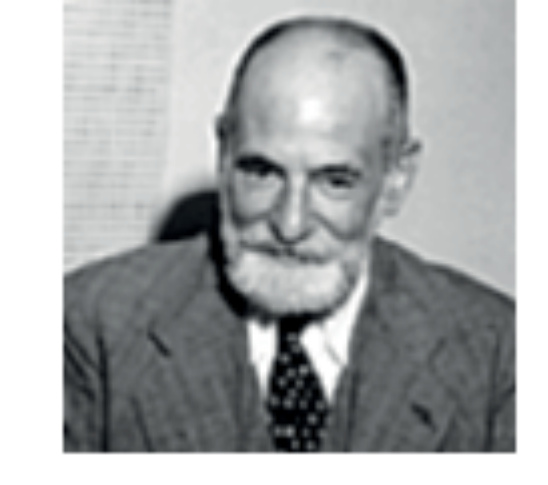
René Cassin, professor of law at the Sorbonne, was the first prominent civilian to join General de Gaulle in London, on 29 June 1940.
René Cassin, with his round hat, his frock coat and his striped trousers, thus found himself mingling with a handful of Breton fishermen, a few adventurers eager to keep fighting the Germans, a few stray officers. No elites. No ministers or former ministers, no great intellectuals (with the exception of Raymond Aron, who nonetheless did not immediately place himself at the disposal of the rebel general), no major economic operators, no academicians, no prelates of the Churches.
René Cassin’s role in the organization of Fighting France is well known and belongs to the history of France. Less well known is that, a Provençal Jew born in Bayonne to an Alsatian mother and a Niçois father, he must have felt quite alone in London among his own people.
Little by little, among the Free French, the stages of the Final Solution then being implemented on French soil came into focus. It was at this time that the guiding idea took root in René Cassin’s mind: an international justice binding on all and, if necessary, overriding the authority of states. A premise of the Nuremberg tribunal? Certainly; but perhaps more than that. The professor of law was in fact aiming at a world organization, guarantor of an international order founded on human rights — a “League of Nations” endowed with the power to intervene and able to enforce the decisions of the international community.
After the war, de Gaulle did not make René Cassin a political player in France’s renewal. He left him (out of intuition, or mistrust?) to pursue his path as a visionary of liberties.
The first stone of the project obviously consisted in giving an internationally accepted definition of human rights. This was not the easiest phase, even though it appeared to be theoretical (and therefore not very alarming to the dictatorships that were still numerous across the planet). Thus, on 10 December 1948, the Universal Declaration of Human Rights was born — conceived and largely drafted by the former Free Frenchman, a true charter written on the model of the 1789 Declaration (to which had been added social rights and rights of solidarity), and, in René Cassin’s view, in the likeness of the biblical Decalogue.
The second step consisted in getting the UN, in the midst of the Cold War, to vote for binding texts imposing an international protection of individuals, superior to the authority of states. In other words, the aim was to put an end to the sacrosanct principle of non-interference in the internal affairs of states. Success came all the more easily because many totalitarian regimes had hastened to ratify the text — not, of course, in order to abide by it, but in order to be able to accuse the Western democracies of violating it very often. Even so, even Brezhnev’s USSR was theoretically bound to respect certain principles: the worm was in the fruit.
The fulfillment of René Cassin’s political philosophy remains to be accomplished, and one cannot deny the responsibility of the Jewish communities — in particular the French one, and most especially the Alliance israélite universelle (which René Cassin presided over for thirty-three years) — in the nations’ acceptance of the idea of an International Criminal Court charged with judging not states, but the individuals guilty of the great crimes: genocides, crimes against humanity, war crimes.
The annexation of Kuwait by Iraq and the ethnic cleansing in the former Yugoslavia gave rise to interventions in line with the principle of humanitarian interference. Of course, not everything was perfect, and many criticisms can be made regarding the modalities of international action; but here again the theory of interference is on its way to being recognized as the normal response to the abuses committed by states in whose service great criminals are to be found.
Just as figures belonging to Protestant circles founded the Red Cross, just as the successive heads of the Catholic Church gradually gave human rights the place they deserved in religious thought, so it would be fitting today that, within Judaism — French Judaism in particular — there should arise clerics and religious figures borne by the idea that the ultimate meaning of beliefs consists in the protection of the individual human being and of the liberties to which he is entitled.
This is an appeal.
Gérard Israël, author of René Cassin, Desclée de Brouwer Éditeur, Paris 1990; former colleague of René Cassin at the Alliance israélite universelle.
NOTES: [^1]: Article published in Plurielles No. 8