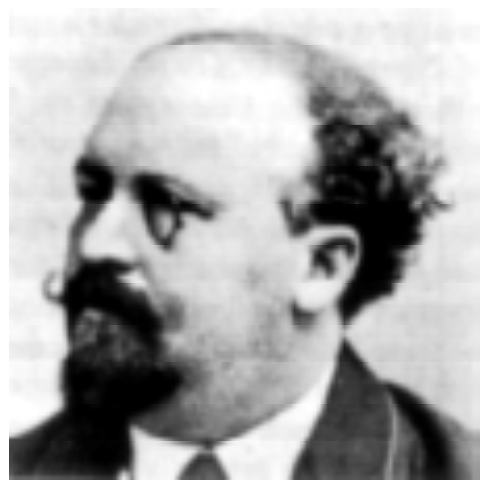
Who can say how the Dreyfus Affair might have evolved if Bernard Lazare (which in no way diminishes the eminent role of Émile Zola) had not begun the battle for the rehabilitation of the innocent captain, victim of blindness and of calumnies dusted with antisemitism.
Let us try to retrace here his itinerary (after the booklet of Dr. Benjamin Ginsbourg).
Our hero was in fact named Lazare Bernard. His father was of Alsatian origin; his maternal family, by the name of Rouget, came from the Comtat Venaissin. Raised in a milieu attached to letters, the young Lazare took up the pen. He wrote tales and poems, founded a student review. On coming of age, he went up to Paris. There he frequented the literary circles, and, with his cousin Michel (Ephraïm Mikhaël), he wrote a play entitled “La Fiancée de Corinthe” (“The Bride of Corinth”). Michel died at the age of 24. Bernard Lazare formed ties with writers who would mark his era. He wrote in various newspapers, among them “Le Figaro Littéraire.” His commitment alongside the anarchists (very active in those days) did not turn him away from his interest in the Judaism of his childhood. Having become Bernard Lazare, he was led to denounce antisemitism in Algeria. Reacting to the agitation of Édouard Drumont, he published a work on the Jewish question, certain passages of which seemed to suit Drumont. But, conscious of the danger borne within them by that man’s praises, he entered into a polemic with him. This would end on the field [of honor].
Bernard Lazare’s commitment against antisemitism grew more pronounced, which would lead him to play a major role when the Dreyfus Affair broke out. When he committed himself in favor of the innocent Captain, he would find himself there alongside figures who became illustrious, such as Léon Blum, Theodor Herzl…
Let us recall that it was Commandant Forzinetti, director of the Cherche-Midi Prison, who advised Mathieu Dreyfus to turn to Bernard Lazare. After some hesitation, the decision was made to appeal to public opinion. Bernard Lazare, to circumvent the difficulties, went to Brussels, where he had his pamphlet “Une erreur judiciaire” (“A Judicial Error”) published. Without respite, he kept prodding parliamentarians and academics. Charles Péguy, in particular, brought him his support.
Léon Blum, who notes that Bernard Lazare was the first to commit himself, calls him “the Just.” But already the Affair was about to take its full course. Colonel Picquart and others played their part in it. Émile Zola’s famous “J’accuse” was published. In the meantime, Bernard Lazare had rallied to the ideas of Theodor Herzl, a journalist who followed the trial and drew from it the conclusions we know. Bernard Lazare took part in the 2nd Zionist Congress, where he was acclaimed and named a member of the Action Committee. He resigned from it when the Action Committee decided on the creation of a Bank (the anarchist he had been could not accept it). This did not prevent him from keeping friendly relations with Theodor Herzl. Madame Isabelle Lazare, his wife, confided to me that after the rupture Herzl often came to dine at their home.
Bernard Lazare devoted himself to other works, among them “Le Fumier de Job” (“Job’s Dungheap”), but the effort he had expended had exhausted him. He died in 1903, at the age of 38. In Nîmes, a street bears his name. The statue that was raised there was destroyed by the Nazis; a plaque has replaced it in the Jardin de la Fontaine. The historians of “the Affair” are careful not to forget him.