What a tailor in America writes to a friend back home, what a tailor back home writes to a friend in America.
Written by Sholem Aleichem in 1907. Original Yiddish title Nishto kayn nayes, published in Ale verk fun Sholem Aleikhem (Collected Works of Sholem Aleichem), vol. 22, pp. 139–148, Folks Fund Oysgabe, New York, 1921. Translated by Arthur Langerman. Illustrations Marc Tarasoff, 2008.
The text presented here under the title “Nothing New” stages the correspondence and the gap between two Jewish friends, one of whom has remained in Europe while the other has emigrated to the United States. This text is a French adaptation of the first part of “Nishto kayn nayes,” a story written by Sholem Aleichem in 1907 and published in the series “Ale verk fun Sholem Aleikhem” (New York, Folksfond Oysgabe, Band 17, “Lekoved yontef,” Ershter bukh, 1921). This French adaptation does not include the translation of the English-Yiddish glossary that accompanies the Yiddish original. It appeared in 2009 in a separate illustrated booklet, enclosed with no. 689 of the review Regards (9 June 2009).
The translation is by Arthur Langerman.
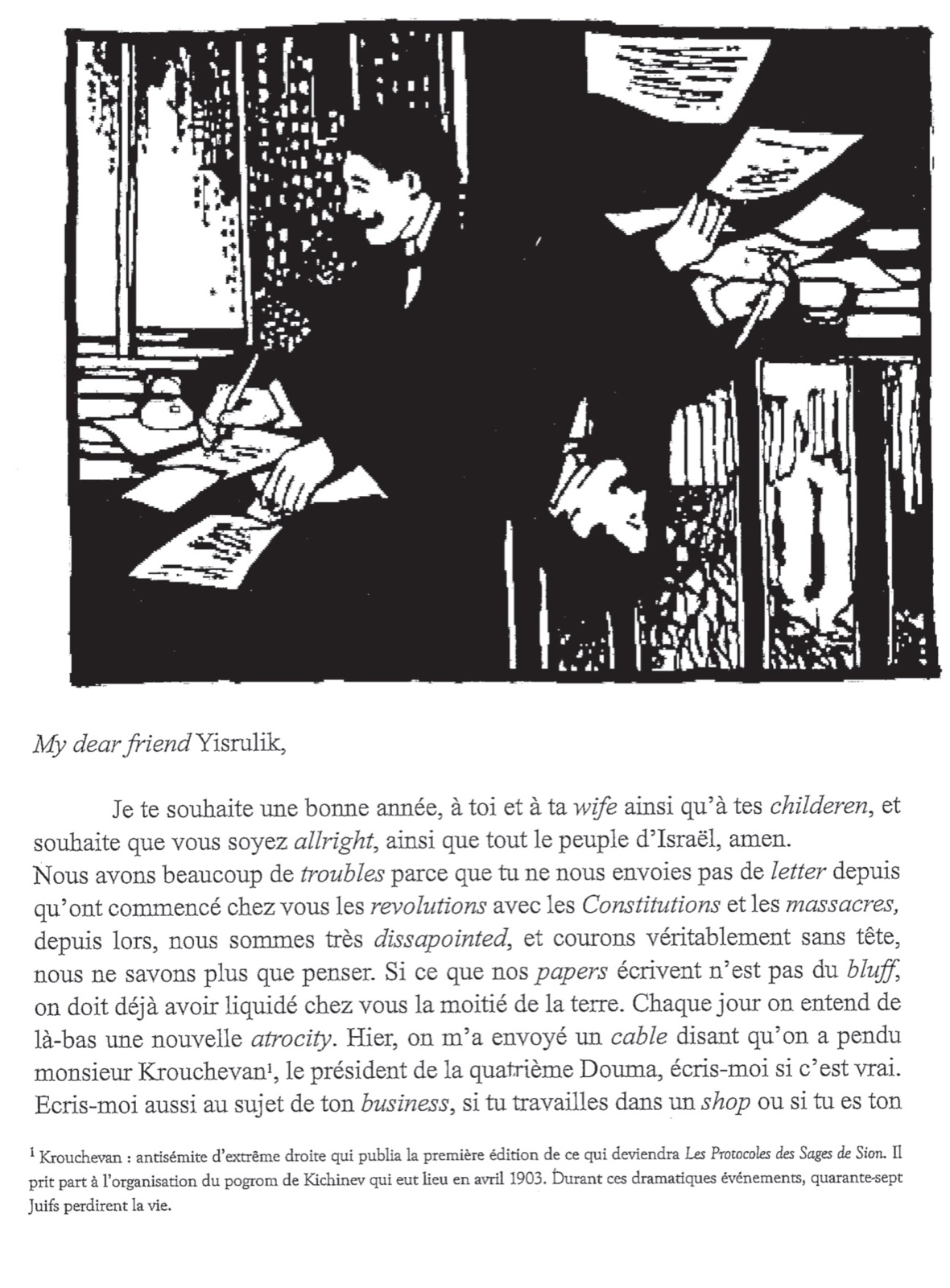
My dear friend Yisrulik,
I wish you a happy new year, you and your wife and your children, and I hope you are allright, along with all the people of Israel, amen.
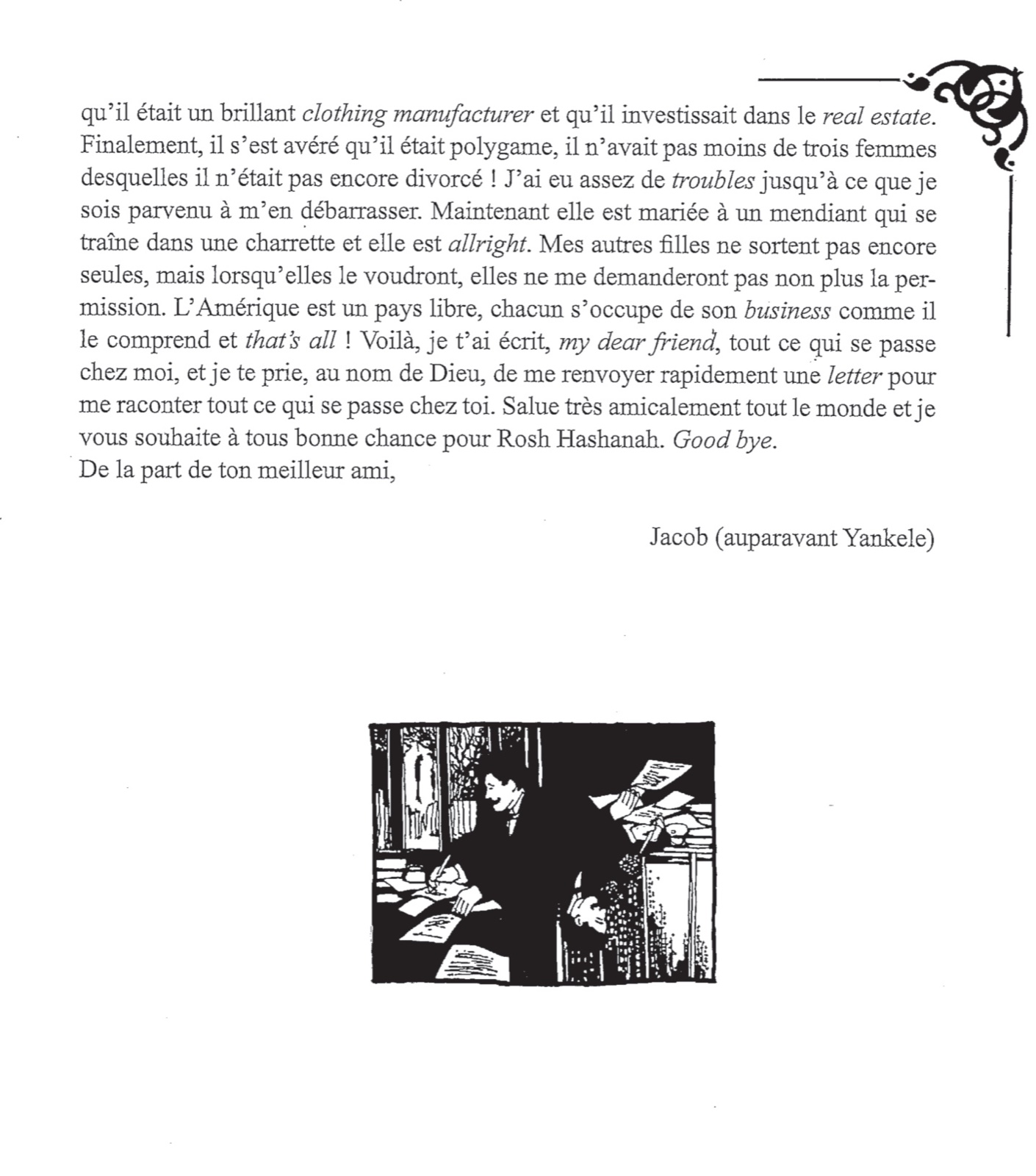
We are having a lot of troubles because you haven’t sent us a letter since the revolutions started over there with the Constitutions and the massacres; ever since, we have been very dissapointed, and we run around truly losing our heads, we no longer know what to think. If what our papers write isn’t bluff, half the country must already have been wiped out over there. Every day we hear of some new atrocity from over there. Yesterday someone sent me a cable saying that Mr. Krushevan1, the president of the Fourth Duma, had been hanged — write and tell me if it’s true. Write to me too about your business: do you work in a shop, or are you your own boss? And how is your Khane-Rokhel, and what’s Hershel your son up to, and my cousin Lipe, what is he doing? And Yossel-Henikh, and Betsy and Rokhel, and Motel and all the other workers, how are they? What do you think about coming over to join us in America? Answer all these questions in your letter. And as for me, what is there to tell you about myself, my dear friend? I am allright and my wife is allright and my children are allright. Let us thank the Almighty, we have a good life here. We work very hard, but life is good. We don’t save any money, but we rent a fine apartment with two rooms and the kitchen. We work all day and in the evening we go out to take some pleasure or go to a meeting with the socialists or with the zionists, or else we go to a Yiddish theater. Life is hard, but here we are free. If I want, I can become a member of the society of my choice, and on top of that become an American citizen and take part in the elections. One thing is missing here… home. Oy, how homesick we are! My Jenny (she’s no longer called Blume, but Jenny) gives me no peace, she keeps after me to leave for Rosh Hashanah so we can go and pray at our parents’ graves. You should see my Jenny now, you wouldn’t recognize her. A lady with a hat and gloves. I’m enclosing a picture of my Jenny and the family. What do you think of my boy, the eldest? That’s Motel, he’s 14, my dear Mike now, and he’s allright. He works in a factory and earns ten to twelve dollars a week. If only he weren’t such a gambler, he’d be allright! My other son, Jack, used to work too, but now he’s learned a little English and become a bookkeeper in a barbershop. The third one is very resourceful and works in a saloon. The fourth doesn’t draw a fixed wage, but he brings home ten dollars, and other times eight. The fifth, the little one in the hat, is very sporty, he really wants to go to school and spends day and night playing ball in the street. The girls are allright too, they work as saleswomen in a store and already have money in the bank. The drawback here is that you can’t keep an eye on them, they go when they want, where they want, and with whom they want. America is a free country, and you can’t criticize anyone, not even your own daughter. For example, Khaye she was called — now her name is Frances — well, she gave me a job! She fell in love and got married, without my permission, to a vulgar boy, one of those who run with the pickpockets. My friend, a fellow on the run from his own home. He told her he was a brilliant clothing manufacturer and that he invested in real estate. In the end it turned out he was a polygamist, with no fewer than three wives he hadn’t yet divorced! I had troubles enough before I managed to be rid of him. Now she’s married to a beggar who drags himself along in a cart, and she’s allright. My other daughters don’t go out alone yet, but when they want to, they won’t ask my permission either. America is a free country, everyone minds his own business as he sees fit, and that’s all! There, my dear friend, I’ve written you everything that’s happening with me, and I beg you, in God’s name, to send me back a letter quickly telling me everything that’s happening with you. Give my warmest regards to everyone and I wish you all good luck for Rosh Hashanah. Good bye.
From your best friend,
Jacob (formerly Yankele)
Dear friend Yankele,
Your letter of good wishes arrived just in time for the eve of Rosh Hashanah. Thank you very much for it, and I wish you too a good and happy year; may God unite our hearts and rejoice in this moment, amen. Now I have come to your letter. But first I must tell you one thing: here you go, once in two years you send me a letter of good wishes — at least write it properly, like a man worthy of the name. Who here is able to understand words like letter, paper, picture, bluff, and other such terms? You ask me to write to you, but do you want it to be the “nothing new with us” kind? Now, thank God, things have settled back into order. The rich are doing fine as usual and the poor are starving to death as always. We workers are entirely out of work, but there is one thing, thank God, with which we are very well served: the pogroms. We’ve reached the point where we’re hardly afraid of a pogrom anymore, because there’s already been one — two, in fact. A thing like that can only happen in Kishinev! Believe me, it even came to us a little late, which is why we got to live through it with all the possible refinements. To cut it short, thank God, compared with other towns, we don’t have much to complain about. I can tell you one thing all the same, Yankele: I am alive! I escaped Death three times, and a fourth time it was a near thing. Do you remember him? “If it is written that he must suffer, let us thank God who gave us life!” I had — and above all saw — my good goy who took in my wife and children and sent them to hide at another goy’s, who concealed them in his attic for two days and two nights. They neither drank nor ate nor slept, God forbid. It was only on the third day, when it was all over — when there was nothing left to plunder and no one left to abuse — that, thank God, everything returned to its normal order. We came slowly down from the attics, all of us in good health, and praise the Eternal, no one in our neighborhood was hurt, except Lipe, who was killed for nothing, Noyekh and Moylekh, two magnificent young men worth their weight in gold, and also Moyshe-Hertz, whom — pardon the expression — they cut down from the tree where he’d been hanged, and Perl-Dvoyne, who was found dead a little later in her cellar with her little child, Rayzele, tied to her breast. Counting the children, all told they killed seven people in our neighborhood — which is what Getsi was saying: “It could still have been worse; as for better, there’s no limit…” You ask how Herchele is doing? Don’t worry, he’s been in prison for more than half a year now. Why? Probably because he looked at a Cohen during his blessing2; now we wait: either he’ll be hanged, or he’ll be shot, it’ll all depend on his lucky star. Meanwhile, as Getsi says, you have to have luck. For instance, the one who has no luck is Yossel-Henikh, who died in his bed — locked up in prison. Apart from that, there’s nothing new to write you. Don’t you want to ask anything about the son of Nekemleh the carpenter, Leyb? Do you remember him? There’s nothing left, and Leyb the fowl, as they called him. Today he’s like a reaper of Peterpavlovsk. Do you know who really deserves to be pitied? Zlatke — they say she’s gone mad with grief… and not for nothing: in one week she lost both her children! And the son of Avrom-Moyshe, he’s gone off and is probably in America now. If you run into him, give him my regards and tell him his father was a hero: he died even before the Constitution. And our Motel, he’s vanished entirely, nobody even knows where he went. Many of their bodies were never found. Many fled, many were exterminated, and many lie in the prisons or in the Siberian snows, pushing wheelbarrows — but who knows where they are? The comrades have dug in once and for all: the Constitution or death! There’s no joking among us workers, as Getsi says about the bee: “Don’t sting me and don’t give me honey.” He’s a strange fellow, that Getsi: one of his sons was killed in the war, the other is in prison, and he himself is also in want, but whenever he gets the chance to crack a good line or a pun, he goes wild over it. Apart from that, I’ve nothing new to write you. Everything has, thank God, returned to order and we are in good health, except my Khane-Rokhel, who, poor thing, complains of her heart — and, oddly enough, of the fear of the expropriations… You surely don’t know what that’s eaten with, so I’ll explain it to you. Someone comes to your house with a rifle that isn’t loaded with flour, no, but with powder and nails, and tells you: “Hands up,” they unbutton your coat and take everything you own. After that, go ahead and complain! Another such case is us: two fellows came into my place, gave me their spiel, and confiscated my machine. I also had a cow — well, it dropped dead on its own. My blessing is that I’m now much poorer than before; they’ll have nothing left to take from me! And Alter, he’s still got a long way to go before becoming rich — there’s nothing left. And Leyzer, who was expelled over his passport, it’s his own fault entirely: who told him to be so careless? And Mendel, he’s got his book of woes too, they died at his place. Some say of pity, some say of hunger, dead on the road, others of their own will when fleeing. In short, I’ve nothing more to tell you. I must say, about what Blume — or whatever she’s called now, Jenny — wants, to come and pray at her parents’ graves: now is not the time, Yankele! Leave it for five years, God willing, when things here are calmer, when people have finished slaughtering one another; you can come and we’ll go together, God willing, to the cemetery… We’ve added to it, praise God, a fair number of friends, and I’ve no other news to write you. Be in good health and give my warmest regards to everyone. I don’t like your America at all. A country where there’s no “payday,” where Blume becomes Jenny, and where a bridegroom has three wives. From such a country, don’t be cross, one must flee! From your letter I see that where you are, you’ll get your Constitution; with more hope, we won’t need any America. By then we’ll have a far better America here than you have. Yankele! You mustn’t worry: I wish us all, God willing, plenty of fresh air and a plague upon the Constitution that Krushevan wants to give us! I hope we’ll all have a good year, we here and you over there.
From your friend Yisroel

Krushevan: a far-right figure who published, in its first edition, what would become The Protocols of the Elders of Zion. He took part in organizing the Kishinev pogrom of April 1903. During those tragic events forty-seven Jews lost their lives.↩︎
The blessing of the Cohanim: during services, when the Cohen (priest) blesses the congregation, it is customary for the faithful not to look at him.↩︎