Father-son relations (or, more broadly, parent-child relations) are neither simple nor easy. They are even less so when those involved are caught, or have been caught, in a situation of extreme danger. The situations that exist after the event can be very diverse, and one must take this diversity into account to avoid undue generalizations. Some survived, together or alone, and others died—parents, spouse, child—; some formed a new couple, gave birth to another child, and so on. The relation between the parents themselves is complex, difficult, sometimes violent, which can be shocking (“after what you went through!”). We will draw on two books by two major writers, Wiesel and Kertész, in an attempt to understand some of the mechanisms at play in these situations.
The child may hold the parent responsible for his (or their) misfortune, for having made the wrong choices or for not having transmitted the markers of identity, the values—those that would have allowed them to hold firm morally, to be alive while so many others died—out of the sense of injustice: “Why should I be the only one to have suffered, to suffer!” The ordeal is an ordeal of truth, of individuals and of relations, whether of the parent-child relation—and each person, whatever his age, is inevitably the child of his parents, living or dead, and the parent of his children, born or to be born—or of the couple’s relation.
My reading of Elie Wiesel bears on the son-father relation, that of Kertész on the father-son relation.
ELIE WIESEL
LA NUIT (NIGHT), MINUIT 2007
The limit-experience
In La Nuit (Night), published in 1958, Elie Wiesel gives the account of his deportation to Auschwitz and then to Birkenau. He will never again see his mother and his little sister, but he will share with his father the experience of the camp. He recounts their shared sufferings but also the way they passed through his adolescence in this terrible context: the upheaval of the relation to his father was the major ordeal. The analysis of the process of dehumanization at work in the camp helps in understanding the traumatic aftereffects he retains and the way in which, in his work as a writer, he seeks to free himself of them.
To survive. How did he manage to survive? A nagging question for him as for all those who were deported, and one put to them by those who were not. He says he has no answer, that he had nothing to do with it1. And yet he resisted the extreme distress that makes death the solution, and he made risky decisions. But he also, at one moment, rejected God and abandoned his father. To answer the question would imply taking stock of all these actions, including those of which he remains ashamed. He nevertheless has the courage to recount them to the reader. But is it bearable to tell oneself that one’s survival has no explanation, no rational cause, that the death that carried off his parents and his sister was the work of chance? Against whom, then, is one to turn one’s desire for vengeance; how is one to overcome the trauma if thought keeps stumbling against the senseless? To decide to decide, despite the undecidable, is to preserve one’s active position and one’s right of oversight over one’s life, is to resist the process of dehumanization. Other deportees survived as long as they preserved their faith or their principles of simple, elementary dignity2, but his father, so respectful of religion and of men, died. The questioning about his present responsibility toward the dead as much as toward the living3, together with the pride of having escaped death, attenuates his shame and his guilt. This demand to give meaning as much to the death that could have been his as to his life since his liberation is indeed the same one that confronts every human subject: “Why was I born, why my death, near or distant? My life, long or short, was it worth living?” To this crucial question he cannot answer alone; he must hear it from those for whom he counts, and first of all from those who were at the origin of his life. But his mother could not know his thoughts and his acts in the camp, and his father died before having seen the end of his deportation. There remain the readers.
The father occupies a central and complex place in his account. His relation to him is, as for any adolescent, ambivalent, but exacerbated and overturned in the context of the camp, and the consequences of this are dramatic. He feels anger and reproach against his father—why did he not make the decision to leave when there was still time?—even though he knows his father was not the only one. But if he wishes to assume his responsibilities as an adult—he shared his father’s mistakes—his reproaches are necessary to him in order to preserve his reassuring childish belief in his father’s omnipotence. Not to criticize his parents, so unhappy and fragile, makes him their protector and bars his passage through adolescence toward adulthood, for that passage requires revolt against them. The same is true if he keeps silent out of fear of their anger or their abandonment. If he revolts and they die, his guilt will be crushing and paralyzing, even though he knows the Nazis are the murderers. A narrow and risky path, for the adolescent and for his parents.
Elie brutally discovers his father’s fragility4, his physical, psychological, and moral degradation, his despair, which he cannot bear. Further along in adolescence, he would no longer have needed an ideal father, would not have passed from extreme admiration to the greatest disappointment5. He observes upon the rabbi’s son the ravaging effects of this collapse: the son ended up betraying and sacrificing his father, and he knows that he too could do it6. This unqualified rejection of the father, who has lost his parental legitimacy, marks an important step in the process of dehumanization. Elie, facing his father, has the feeling of being able to penetrate into his very depths, nothing any longer obstructing the intrusion of his gaze, and he sees there only dread and emptiness7. And death8, which he wished for him. A child in danger, facing the distress of his parents, certainly wonders whether he can still count on them but also what place he occupies in their life and whether they would be ready to sacrifice themselves to save him or whether, on the contrary, they might rather be tempted to sacrifice him to save themselves or to protect another. Elie discovers in himself these temptations, so contrary to the strict upbringing he received, to his moral bearings, to his love for his father9. He hides nothing from the reader of his cowardice10, of his temptation to attribute to his father the responsibility for his father’s misfortune and for his own11, as if he wished to be judged by him, without extenuating circumstances, even though he well knows that those primarily responsible are the Nazis.
The flames of the crematory ovens burn souls as much as bodies but also penetrate into the very depths of beings, leaving nothing to subsist of what made their worth and their unique identity12. He wonders who he now is, where his thoughts and his acts come from, those that fill him with horror. After having felt guilty for losing faith, he accuses God of being responsible for it13, following the same movement used against his father. This reaction, so banal in adolescence in ordinary times, here entails a terrible solitude14 and the feeling that to live is no better than to be dead.
Aftereffects
What is lived in the camp—the sensations, the perceptions, the images, the emotions, the thoughts—is inscribed deeply in memory. Elie Wiesel encountered there the whole palette of the human, in the other deportees as much as in himself15. Guilt will never leave him, and it will appear under diverse forms in his works of fiction, as well as in the preface to this book, written in 200616.
The feeling of elation that overwhelms him at the liberation shows as much the violence he underwent as the radical solitude that is now his17. Having become incomprehensible to others, in the experience he has passed through and in what it has made of him, he is so to himself as well, no longer recognizing himself, neither physically nor morally18. He passed through the Shoah without an image of himself, but with his eyes wide open. He observed the degradation of bodies and souls—such as the madness of a son who renounces his father and kills him for a piece of bread, which will at once be stolen from him along with his life, the corpses and, more than anything, his father: his bloodied face and his shattered skull, his beseeching gaze, his inner emptiness, his dead body. More than anything, he observes that the Nazis made of him a field of ruins and a monster, a living corpse. Dead was his faith in God, in man, in the future, in culture, in his father, in himself. It is thus that he must go on living.
To write
The work of writing perpetuates the trauma—it imposes its demand to go ever further—as much as it frees him from it, and he does not know what he expects of these two extremes19. What he lived and learned in the deportation cost him such effort that he cannot easily leave this period of his life. He assumes these contradictions: his madness and his suffering must show the world the madness of Nazi barbarity20 in order to ward off the risk of its rebirth. Describing his own experience, he draws near to that of the other deportees, far more perhaps than in the camp itself. But it is his father whom he wishes to draw near to.
He writes “to bequeath to men words, memories” (p. 9) but also to bear witness to his betrayal and to what the Nazis made of him, so that this destruction of his adolescence should not have taken place in vain21. Writing transforms him as much as the very experience of the camp: both are ordeals of truth.
To whom is his book addressed, for whom does he bear witness? To expiate his unpardonable fault, to recover an identity, to defend the memory of those who died, and first of all that of his father—to obtain his father’s forgiveness, to find him again, to give him back his rightful place—and to emerge at last from the trauma, or, on the contrary, to remain in it forever, with him. The courage the book requires of him is all the greater in that he describes, to be sure, the cold, the hunger, the illness, the sadistic and criminal brutality of the SS, but above all emotions, thoughts (even those of which he remains ashamed), and the relation to his father.
We can find, in a number of the books—some closer to autobiography, others to fiction—that he wrote thereafter, figures of fathers, toward whom he feels an admiration and a demand to relieve his distress such that they provoke dependence. Did this relation to father figures preexist the experience of deportation with his father, or is it a consequence of it? We leave the question open.
IMRE KERTÉSZ
KADDISH POUR L’ENFANT QUI NE NAÎTRA PAS (KADDISH FOR AN UNBORN CHILD)
ACTES SUD, 1995
Kertész interrogates, with great subtlety, not devoid of suffering, the complexity and the difficulty of being a survivor of the Shoah. The refusal, or the impossibility, of being a father, of having a descendant to make live in the world after the Shoah, to whom to transmit his history, his values, his markers of identity, can be understood only in his relation to the other elements of his life. What he describes of it belongs, to be sure, to the fiction that characterizes all writerly work, but it rings true.
Social place, the relation to others
Kertész writes, driven by the irresistible demand22 to become nothing, anonymous, invisible, like all and like no one, as he was in the camp, as he has been since his return. But this obstinate labor makes of him a writer, visible. If this excessive speech helps him as much to empty himself of the experience of the camp as to fill the unbearable void it hollowed out in him23, it risks driving others away and reinforcing his solitude.
The affective
He feels emptied of all love, incapable of feeling it24, and this incapacity provokes the affective ruptures that justify it and reinforce it. Insensibility protects him from the risk of suffering when he comes to observe, sooner or later, the sclerosis of feelings that age and habit bring about in the close other. He remains a spectator of others and of himself25, condemned to a lucid and despairing powerlessness, and only hatred, through the violence it provokes in him, helps him stay alive. His life as a couple is thereby rendered impossible. This relation was constituted on the same misunderstanding—of which he is not innocent—as with others: pity and admiration toward him26, and incomprehension of the experience he has passed through27. He has remained impenetrable, protecting from all intrusion into him his memories and his terrible suffering, his unshareable possessions. The rupture resulted from it.
His identity and his identifications
In the camp he lost all sense of identity. But in this void there unfolds the terrifying and fascinating image of Judaism embodied by his pious aunt, who observed the obligation to shave her head and wear a wig28. The sight of the Jews, corpses or living-dead, reactualized this image and validated his archaic fantasies. To free himself from their traumatic effects, he must recover and assume the confrontation between these two experiences. Likewise, he must understand and assume his ambivalent feelings toward his parents, those of the child before the Shoah and those of the man after. The memory of the gesture of gratuitous generosity, at the risk of his life, of another deportee, a schoolteacher—who, simply, brings him back his piece of bread—shatters the monolithic image of the barbarity undergone and preserves forever the place of the happiness he felt at it and of the irreducible, absolute freedom to do Good from which he benefited.
The feeling of otherness, of existence, of identity
Kertész feels the irreducible difference that separates him from others29. He feels no need to know its cause, out of indifference or out of fear of destabilizing the fragile equilibrium he has built for himself. He keeps his mysteries and his secrets, his wretched private treasures. To attenuate this malaise he gives it a definition and a place, that of an illness30, which escapes medical knowledge as much as common knowledge, and which others qualify as imaginary. He defends himself against this accusation, affirming that such a malaise belongs to the human condition31. He feels his fragility as a living being through the feeling of his slight reality. He knew in the camp the effacement of the border between life and death, between the living and the dead, but he now confronts rather the one that separates reality and the imaginary, lucidity and madness, living and existing. The concentration-camp experience rendered derisory all those he would live thereafter, exhausted the beauty and the goodness of the world, and the disinvestment he then had to make in order to count on his sole survival instinct persisted outside the camp. The world will recover its consistency—and its banal mediocrity—only if he recovers his own, psychic as much as physical.
Social exile and psychic exile are permanently intertwined32 in the reference to death. No place to be that is his own—his city, his couple, his body33, his profession, his life—in which to recognize himself. The non-place has become his place, exile his identity, absence to himself his presence to the world. No imaginary but the void, which incessant writing and food seek to fill, or to hollow out still more. No more than over his body does he recognize for himself a right of property over his thought, which is foreign too, living its own life. Fascinated by the process of his disappearance34, he has nonetheless not renounced the hope of recovering the feeling of his identity and of his consistency. But to attain it, he must first reduce the gap that separates him from his body35, return to the experience lived in the camp where it was not his will that decided but this body and its instincts36. He must also recover his capacity for the imaginary so that his thoughts not be mere abstractions37, all emotion excluded or unfelt. He must also recover the consciousness of his existence, of the presence of the world, going beyond the nagging interrogation: “would it not have been better had I not been born?”38 Kertész coexists with himself, that inaccessible other who accentuates the painful feeling of his powerlessness.
To be a survivor
He must recover the feeling of the continuity of his life so that the Shoah not inscribe in it a radical rupture, neither efface nor annul his past. To overcome the shame of living, when his parents and so many others died, he makes of it the justification of his survival and of his work as a writer. He recognizes for himself no responsibility as a survivor, neither that of bearing witness nor that of being without flaw, as some demand of the survivors. Does this modesty bear witness to the desire to recover the banality of life, to become anonymous again39? And yet he never stops writing, in order to exhaust himself and not think—all thought would bring him back to the camp—as much as in order to free himself from his suffering, which his pessimism exacerbates: the world has drawn no lesson from barbarity. His survival is entirely occupied by the mourning of his parents and of the world he knew, of his past, of his childhood, of himself40. Time is dead, no longer passes, and there remains only the present of the crime and of the catastrophe, and the guilt of one who, not trusting the criminals to assume it, takes upon himself their fault41. What difference between living and surviving? His life has no value nor objective of its own except that of enduring, in order to remain an object of shame. No need to bear witness, to recount, to explain the camp, to claim reparation or judgment: it is enough for him to show himself in his mediocrity, his malaise, in the hope that a few will see and take back upon themselves the shame of what other men will have done42.
To have a descendant, to be a father
His freedom and his right to act upon his life cannot be embodied in acts, and in particular not in that of giving birth to a son. This impossibility, this refusal, have several causes43. Deportation indissolubly bound death to birth, the two major arbitrary chances of his life. Deportation became his origin, traumatic, and Auschwitz, in its unsurpassable double aspect—that of the worst barbarity as well as of the extreme freedom, that of the schoolteacher—took the place of the father44. How then could he in turn occupy this place?45 He can, to be sure, free himself from the hold of the SS46 and say to himself: “this murderer was not a god but a man like me, only perverse, cowardly, despicable, etc.” But how is he to free himself from that of the schoolteacher?
The camp made of him a living-dead, reduced to ashes the values that had been instilled in him, his beliefs and his hopes, his markers of identity. What could he transmit to his son47 except his death, and perpetuate in him the destruction he has undergone? Or else the inestimable value Auschwitz had for him? To transmit thus the double figure of Judaism and of his Jewishness: on one side the pious woman with the shaved head and the Shoah, on the other the experience of the camp, which includes the luminous memory of the schoolteacher48. But to transmit life would be contradictory with what gives the minimum of meaning and consistency to his survival: to assume his state as a living-dead. He could not survive the birth of his son. It would be senseless and cruel to give birth to an orphan who, in his turn, would wonder whether it would not have been better had he not been born. But the absence of a son signifies, in the more or less long term, the definitive end of his history, which will have been only his and which will stop with him. Yet, through his books, it is every reader whom he places in the position of being that son who could have received the testimony, in words and in acts, of the experience of his life, which is not reducible to Auschwitz but which includes it.
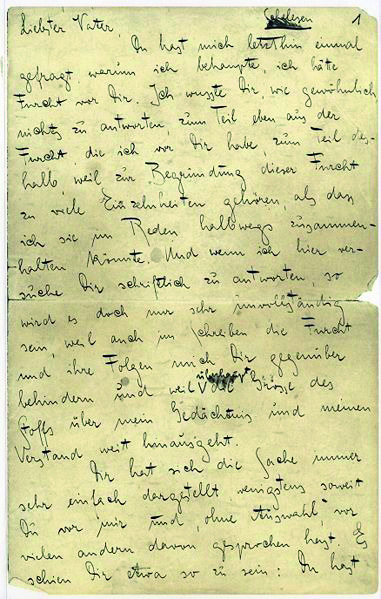
Dearest Father,
You asked me recently why I claim that I am afraid of You. As usual, I knew not how to answer You, partly precisely because of this fear I have of You, partly because there are so many particulars justifying this fear that I could hardly gather them together in any coherent discourse. And if I try here to answer You by writing to You, it will nonetheless be only in a very incomplete way, because, even in writing, the fear and its consequences hamper my relation with You, and because, in any case, the subject is so vast that it far exceeds my memory and my understanding. To You the matter always seemed very simple, at least in what You have said of it before me and, without the slightest discrimination, before many other people. To You, things appeared roughly thus: You have […]
(translation by Philippe Zard)
Notes
p. 10. “I can thank only chance.”↩︎
p. 153. “The block leader… ordered four prisoners to scrub the floor… one hour before leaving the camp. — For the liberating army… Let them know that here lived men and not pigs.”↩︎
p. 10. “It falls to me to confer a meaning upon my survival.”↩︎
p. 56. “My father was weeping. It was the first time I saw him weep. I had never imagined that he could.”↩︎
p. 130. “I raised my eyes to see my father’s face… to try to catch a smile… But nothing… Defeated.”↩︎
p. 165. “My God…, give me the strength never to do what the son of Rab Eliahou did.”↩︎
p. 141. “His eyes emptied all at once, were no more than two open wounds, two wells of terror.”↩︎
p. 185. “I felt that it was not with him that I was arguing but… with the death he had already chosen.”↩︎
p. 186. “I went off in search of him [his father]. But at the same moment there awoke in me this thought: ‘If only I do not find him! If I could be rid of this dead weight.’ At once I was ashamed.”↩︎
p. 109. “My father first bent under the blows, then broke in two… I had witnessed this whole scene without moving.”↩︎
p. 109. “If I was angry… it was not against the kapo but against my father… This is what camp life had made of me.”↩︎
p. 83. “The Talmudic student, the child I had been, had been consumed in the flames. There remained only a form that resembled me.”↩︎
p. 129. “Today, I no longer implored… I felt, on the contrary, very strong. I was the accuser. And the accused: God.”↩︎
p. 129. “I was alone, terribly alone in the world, without God or men. Without love or pity. I was no longer anything but ashes.”↩︎
p. 194. “The officer then dealt him a violent blow of the truncheon on the head. I did not move. I feared, my body feared, receiving in its turn a blow. My father gave one more death-rattle, and it was my name: ‘Eliezer.’… I did not move… I had no more tears… Had I searched the depths of my feeble conscience, I might perhaps have found something like: free at last!”↩︎
p. 16. “I will never forgive myself for it. Never will I forgive the world for having driven me to it, for having made of me another man, for having awakened in me the devil.”↩︎
p. 158. “We were the masters of nature, the masters of the world. We had forgotten everything—death, fatigue, natural needs… and the desire to die…, we were the only men on earth.”↩︎
p. 200. “I had not seen myself since the ghetto. From the depths of the mirror, a corpse contemplated me. Its gaze in my eyes never leaves me.”↩︎
p. 9. “Why did I write it? In order not to go mad or, on the contrary, in order to go mad.”↩︎
p. 9. “And thus better understand the madness, the great, the terrifying madness?”↩︎
p. 9. “To leave a trace of the ordeal I had undergone at the age when the adolescent knows of death and of evil only what he discovers in books?”↩︎
p. 112. “How could I accomplish my self-liquidation, my only task on this earth, while harboring within myself illusory ulterior thoughts such as a literary success?”↩︎
p. 21. “My emptiness concealed beneath a need to speak.”↩︎
p. 14. “I fear there is no love IN ME… Whom could I love, and why?”↩︎
p. 26. “I look… with the cold gaze of the professional that, at bottom, I like to cast upon all things.”↩︎
p. 150–151. “At first what she admired in me was that they had broken me, to be sure, but that I had not, all the same, been broken.”↩︎
p. 150–151. “She said I had been broken, that she had not seen it right away…, on the contrary.”↩︎
p. 31. “A bald woman… seated before her mirror… her gleaming head recalling that of a mannequin…, of a corpse, or that of the great prostitute.”↩︎
p. 8. “I do not know why, with me, things always and everywhere go differently than with others.”↩︎
p. 82. “I suffered greatly on account of a sensation that I might call an illness and that… I had named ‘feeling of otherness.’”↩︎
“It is an illness… in no way imaginary,… it rests on reality, on the reality of our human condition.”↩︎
p. 82. “A ‘feeling of otherness,’ a state of total exile,… a pure absence of any home of mine,… I often wonder what sort of home death would be.”↩︎
p. 85. “My body too is foreign to me, it keeps me alive and will end by killing me.”↩︎
p. 112. “My self-liquidation, my only task on this earth.”↩︎
p. 85. “If it should happen to me… to live for an instant to the rhythm… of my kidneys and my liver…, of the figuration of the abstract thoughts of my mind and also of the pure consciousness of my consciousness,… then I would know at last what it means to be.”↩︎
p. 7. “Our instincts act against our instincts,… our counter-instincts act in the place of our instincts.”↩︎
p. 84. “I can enter into contact with life only in the form of a logical game.”↩︎
p. 85. “We do not know the purpose of our presence, and we do not know why we must disappear.”↩︎
p. 36. “I was quite simply like a survivor… who feels no necessity to justify his survival, to assign a purpose to his survival.”↩︎
p. 121. “I had to think of it [survival] because of my dead…, of my dead childhood and of my unimaginable survival.”↩︎
p. 121. “This is what a murderer must feel who… suddenly falls back upon the scene of his crime and finds it unchanged, with the corpse.”↩︎
p. 156. “To subsist… for the one who will feel shame because of us and (possibly) for us.”↩︎
p. 43. “The question… : my existence considered as the possibility of your being… was transformed… to become: your nonexistence considered as the radical and necessary liquidation of my existence. For it is only thus that everything that happened has a meaning,… that my senseless life takes on a meaning.”↩︎
p. 147. “Auschwitz… represents for me the image of the father… And if it is true that God is a sublimated father, then God revealed himself to me in the form of Auschwitz.”↩︎
p. 119. “No!—I will never be able to be the father, the destiny, the god of another being.”↩︎
p. 11. “I am a murderer… since… you are not here, whereas I feel in perfect security since, by saying no, I have destroyed everything.”↩︎
p. 116. “I will be able to give him—you—nothing, neither explanation, nor faith, nor firearm, since my Jewishness means nothing to me: nothing as Jewishness but everything as experience.”↩︎
p. 155. “I consider it a piece of luck… and even a grace… to have been able to be at Auschwitz as a stigmatized Jew and to have, through my Jewishness, lived something… from which I will never budge.”↩︎